Trend 2: The latency race moves from model speed to end-to-end conversation
Low model latency will remain important in 2027, but end-to-end response time is becoming the more meaningful benchmark for real-time AI avatars.
A user does not experience an isolated avatar model. They experience a conversation. Every conversational turn can involve:
- speech processing
- turn detection
- LLM inference
- text-to-speech generation
- avatar rendering
- network conditions
- real-time media transport
Each component contributes to the time between the user finishing a thought and the AI responding. That makes it important to distinguish between model latency, avatar response time and end-to-end conversational latency.
Beyond Presence's proprietary Genesis model is engineered for real-time streaming inference. At the product level, Beyond Presence currently reports ≤250ms global avatar latency and supports real-time streaming at enterprise scale.
Managed Agents bring the complete conversational stack together, from speech processing through avatar rendering, with approximately 1.0–1.2 second real-world response times depending on the wider stack and deployment.
The important point is not one benchmark. It is the architecture behind it. Going into 2027, enterprise buyers are likely to ask less:
“How fast is your avatar model?”
And more:
“How quickly does the complete conversation respond in production?”
That is the benchmark users actually experience.
Trend 3: Multilingual AI avatars become the default for global deployment
Multilingual support is moving from an optional AI avatar feature to a core requirement for global enterprise deployment. A digital agent does not need a separate physical presence in every country it serves. The same visual interface can potentially operate across languages, markets and time zones.
That creates an obvious opportunity for global sales, support, education and training. Beyond Presence currently supports 100+ languages through Speech-to-Video.
For Beyond Presence Conversational Video Agents, current plans support 30+ languages. Speech-to-Video is particularly flexible because developers retain control over their voice-agent pipeline, allowing the avatar layer to work with the language capabilities of the underlying speech and voice infrastructure.
Going into 2027, however, enterprises will evaluate more than the number of languages listed on a product page. The real question becomes whether the complete conversational experience works reliably across those languages while maintaining:
- natural speech
- accurate lip sync
- low latency
- localisation
- visual quality
- reliable streaming
For multinational companies, multilingual capability increasingly becomes infrastructure rather than localisation added after deployment.
This is particularly relevant for applications such as AI avatars in education and e-learning, where one conversational interface may need to serve learners across multiple countries and languages.
Trend 4: AI avatar compliance becomes part of the architecture
In 2027, AI avatar compliance will increasingly influence how conversational AI systems are designed, deployed and purchased, particularly in Europe and regulated industries.
Compliance is no longer something enterprises can consider only after selecting their AI infrastructure. Security, privacy, disclosure, data processing and deployment architecture are moving upstream into the buying decision. The EU AI Act makes this particularly relevant.
Transparency requirements for certain AI systems and AI-generated or manipulated content began applying in August 2026, while other requirements follow separate implementation timelines.
For conversational AI avatars, enterprises therefore need to think about questions such as:
- Do users know they are interacting with AI?
- Where is conversation data processed?
- How long is data retained?
- Can the infrastructure meet internal security requirements?
- Can workloads be isolated?
- Is private or on-premise deployment available?
- How does the system support applicable AI governance requirements?
Beyond Presence is developed in Europe and its current Enterprise offering includes:
- SOC 2
- GDPR
- EU AI support
- zero-data-retention
- isolated deployments
- on-premise deployments
- SLA guarantees
- enterprise-grade security
Beyond Presence also supports private-cloud and on-premise deployment for enterprise customers with additional compliance, sovereignty or latency requirements.
For European and regulated organisations, those capabilities increasingly become part of the infrastructure decision rather than an afterthought.
Explore Beyond Presence security and compliance through the Trust Center or review the current Enterprise capabilities.
Trend 5: AI avatars become embedded infrastructure, not standalone apps
The biggest AI avatar trend going into 2027 may be the shift from standalone avatar products to real-time AI avatars embedded directly inside existing software, agents and business workflows. An AI avatar does not need to be the destination. It can be the interface.
A real-time avatar can sit inside:
- a SaaS product
- a website
- an education platform
- a recruiting workflow
- a sales experience
- customer support
- internal training
- an AI agent
- a digital twin
- an automated workflow
This changes what developers need from an AI avatar platform.
APIs, SDKs, concurrency, integrations and deployment flexibility become as important as visual quality.
Beyond Presence supports this infrastructure model through Speech-to-Video, which lets developers add avatar video to existing voice-agent pipelines without replacing their LLM, voice or orchestration infrastructure.
Speech-to-Video also integrates with LiveKit and Pipecat, allowing real-time Beyond Presence avatars to plug into existing voice-agent architectures.
For teams that want the complete conversational pipeline managed for them, Managed Agents provide the alternative.
Beyond Presence avatars can also be embedded into websites and applications, with APIs and SDKs available for more customised implementations.
And workflow automation is becoming part of the same infrastructure story.
Beyond Presence has the only verified n8n node in the AI avatar category, allowing teams to connect conversational video agents with wider automation and business workflows through the Beyond Presence n8n integration.
As avatar adoption moves from individual experiments to production infrastructure, scale and economics matter more too.
Beyond Presence currently supports up to 50 concurrent sessions on the Scale plan, while Enterprise provides customisable concurrent sessions and scaling discounts. The platform itself supports 1,000+ parallel sessions for large-scale workloads.
Current Beyond Presence pricing also separates Speech-to-Video usage from Conversational Video Agent usage, giving teams flexibility over how much of the agent stack they want to own.
Going into 2027, AI avatar platforms will therefore be judged on more than realism.
They will be judged on how easily they become part of the infrastructure enterprises already use.
What are the biggest AI avatar trends for 2027?
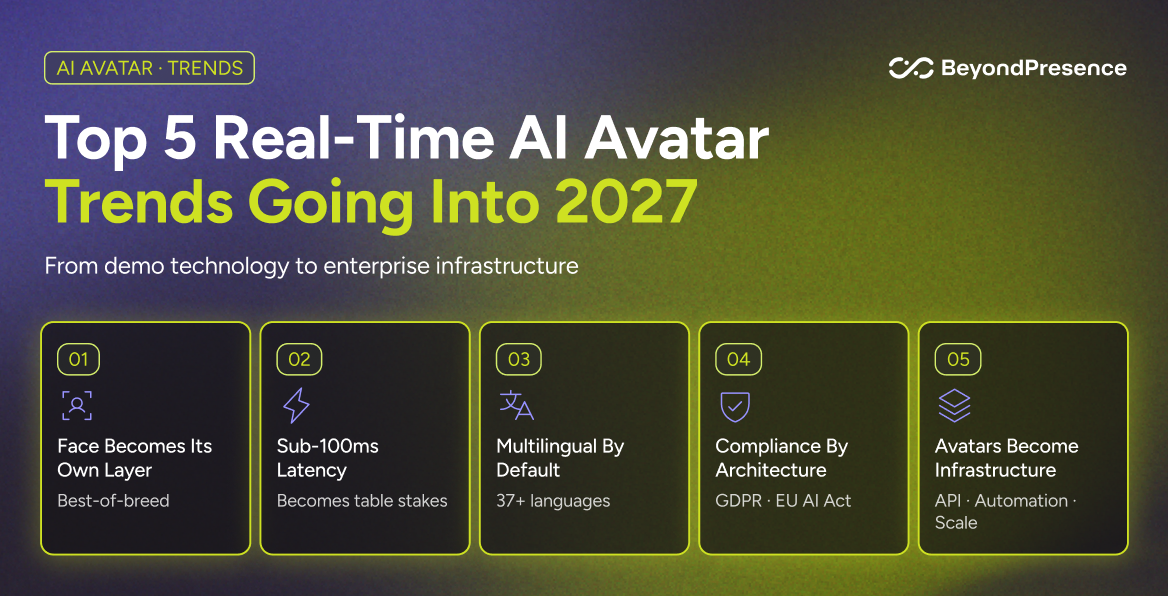
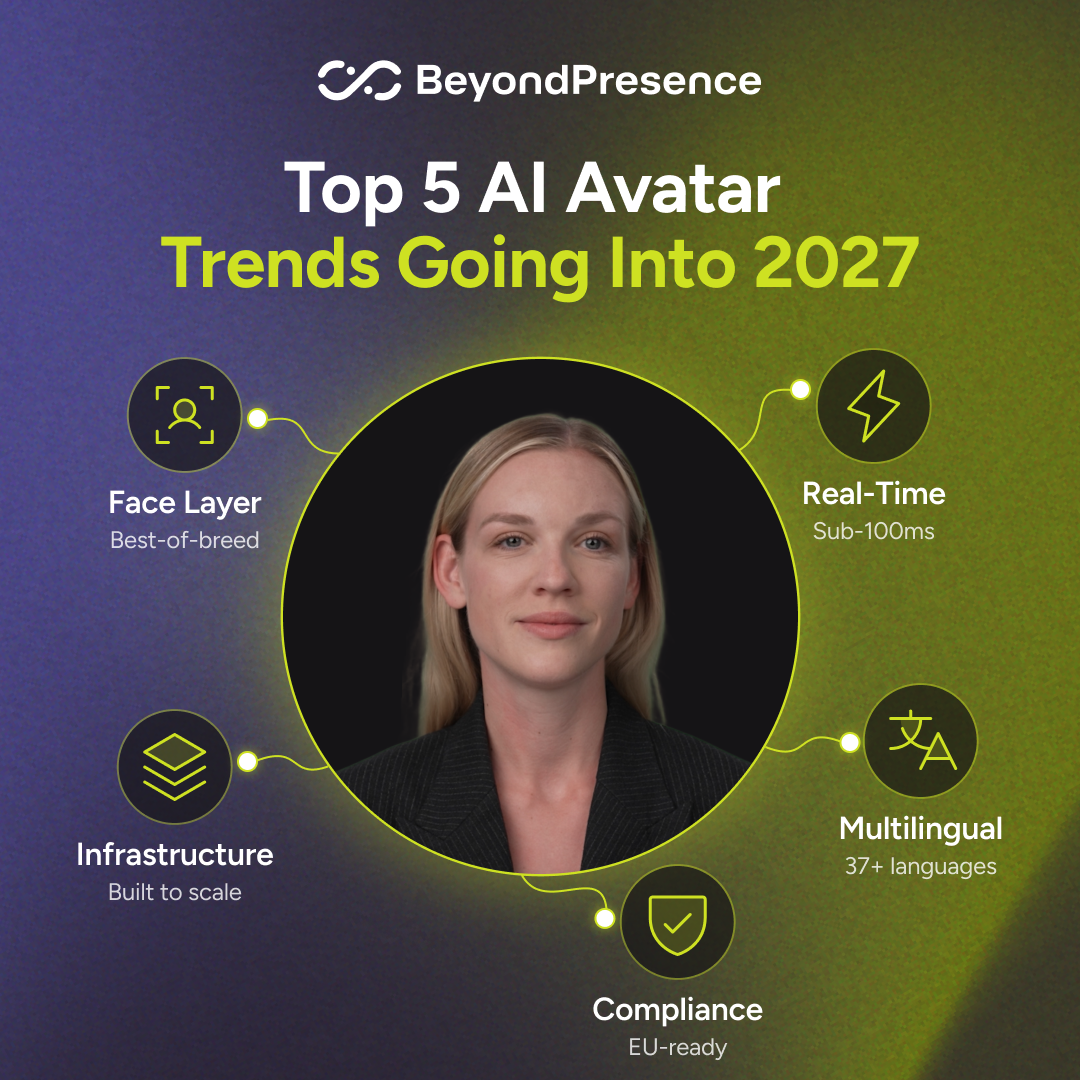
The five biggest real-time AI avatar trends going into 2027 are:
- AI avatars becoming a standalone layer of the AI agent stack
- End-to-end conversational latency becoming more important than isolated model benchmarks
- Multilingual AI avatars becoming standard for global deployment
- AI compliance and data governance moving into the architecture
- AI avatars becoming embedded enterprise infrastructure through APIs, SDKs and automation
Together, these trends point toward a more mature AI avatar market. The category is moving beyond generating a convincing digital human.
The challenge now is deploying that human interface in real time, across languages, at enterprise scale, inside the products and workflows companies already use.
What should enterprises look for in an AI avatar platform in 2027?
Enterprise buyers evaluating real-time AI avatar platforms should look beyond visual realism.
Architecture: Can the avatar work with the LLM, voice and agent infrastructure you already use?
End-to-end latency: How quickly does the complete agent respond during an actual conversation?
Language coverage: Can the platform support the markets and languages where your organisation operates?
Security and compliance: Where is data processed, what is retained, and which deployment options are available?
Concurrency: Can the infrastructure support the number of simultaneous conversations your application requires?
Integration: Can the avatar be embedded directly into your product and workflows?
Automation: Can the agent trigger or participate in wider business processes?
Economics: What happens to your cost when usage moves from a prototype to thousands of conversations?
These questions increasingly separate a compelling AI avatar demo from infrastructure that can operate in production.
Why Beyond Presence is built for the next generation of real-time AI avatars
Beyond Presence is designed around the architectural changes shaping real-time AI avatars going into 2027.
Composable by design. Speech-to-Video lets developers add the Beyond Presence avatar layer to existing voice-agent infrastructure while retaining control of the rest of the stack.
Built for real time. Beyond Presence currently reports ≤250ms global avatar latency, with Managed Agents designed for natural end-to-end conversational response times.
Built for global deployment. Speech-to-Video supports 100+ languages, while Conversational Video Agents support 30+ languages.
Built for enterprise scale. The platform supports 1,000+ parallel sessions, while Enterprise plans provide customisable concurrency, isolated and on-premise deployments, SLAs and integration support.
Built for enterprise security. Beyond Presence lists SOC 2 Type II, GDPR, EU AI support and zero-data-retention among its enterprise infrastructure capabilities.
Built to integrate. Developers can work with Speech-to-Video, Managed Agents, LiveKit, Pipecat, APIs, SDKs and embedded experiences.
Built for automation. Beyond Presence provides the only verified n8n node in the AI avatar category, connecting real-time conversational avatars to broader automated workflows.
The direction of the market is becoming clear.
Real-time AI avatars are evolving from standalone AI products into the human interface layer of the AI agent stack.
Going into 2027, the platforms that succeed will not only need to generate realistic digital humans. They will need to make those avatars fast, composable, multilingual, secure, scalable and easy to embed into enterprise infrastructure.
Ready to build? Explore the Beyond Presence developer documentation, learn how Speech-to-Video works, explore Managed Agents, or compare pricing and enterprise capabilities.
Frequently asked questions about AI avatar trends in 2027
What are the biggest AI avatar trends for 2027?
The biggest AI avatar trends for 2027 are composable avatar infrastructure, greater focus on end-to-end conversational latency, multilingual deployment, compliance-by-design and real-time avatars becoming embedded infrastructure inside enterprise applications and AI agents.
What is a real-time AI avatar?
A real-time AI avatar is a digital human interface that generates synchronised visual output during a live AI interaction. In a conversational AI stack, the avatar can take generated speech and turn it into a visual agent with synchronised lip movement, facial motion and expressions.
How do real-time AI avatars work?
A typical real-time AI avatar system combines speech processing, an LLM, text-to-speech, avatar generation and real-time media transport. The LLM determines what the agent says, voice AI generates the speech, and the avatar layer renders the visual response.
How do AI avatars work with LLMs?
The LLM acts as the reasoning layer and determines the agent's response. Voice AI converts that response into speech, while the real-time avatar layer turns the speech into synchronised video. This allows developers to use an avatar as the visual interface for an existing AI agent.
Why is latency important for AI avatars?
Latency determines how quickly an AI avatar can respond during a live conversation. Because speech processing, LLM inference, voice generation, avatar rendering and transport can all add delay, enterprises should evaluate end-to-end conversational performance rather than only an isolated model benchmark.
How fast is Beyond Presence?
Beyond Presence currently reports ≤250ms global avatar latency. Managed Agents combine the broader conversational pipeline and are designed for approximately 1.0–1.2 second real-world response times, depending on the complete stack and deployment.
How many languages does Beyond Presence support?
Beyond Presence currently supports 100+ languages for Speech-to-Video and 30+ languages for Conversational Video Agents.
Can Beyond Presence work with an existing AI voice agent?
Yes. Beyond Presence Speech-to-Video is designed for existing voice-agent pipelines. Developers retain control of media transport, turn detection, speech-to-text, their LLM and text-to-speech while Beyond Presence handles real-time avatar generation and video streaming.
Does Beyond Presence integrate with LiveKit and Pipecat?
Yes. Beyond Presence supports both LiveKit and Pipecat integrations for adding real-time avatars to existing voice-agent architectures.
Does Beyond Presence integrate with n8n?
Yes. Beyond Presence provides the only verified n8n node in the AI avatar category, enabling teams to connect AI avatar experiences to automated workflows and other applications.
Can Beyond Presence support enterprise-scale AI avatar deployments?
Yes. Beyond Presence currently reports support for 1,000+ parallel sessions at the infrastructure level. Its Scale plan includes up to 50 concurrent sessions, while Enterprise provides customisable concurrent sessions and scaling discounts.
Can Beyond Presence be deployed on-premise?
Yes. Beyond Presence lists on-premise and isolated deployments among its Enterprise capabilities. Private-cloud and on-premise deployments are available for enterprise customers with additional compliance, sovereignty or latency requirements.
How does the EU AI Act affect AI avatars?
The EU AI Act introduces transparency and governance requirements that can apply to AI systems and AI-generated content. Some transparency requirements began applying in August 2026, while other obligations follow separate implementation timelines. Organisations deploying AI avatars in the EU should evaluate the requirements applicable to their specific use case.



.png)
.png)