Layer 1: The language layer
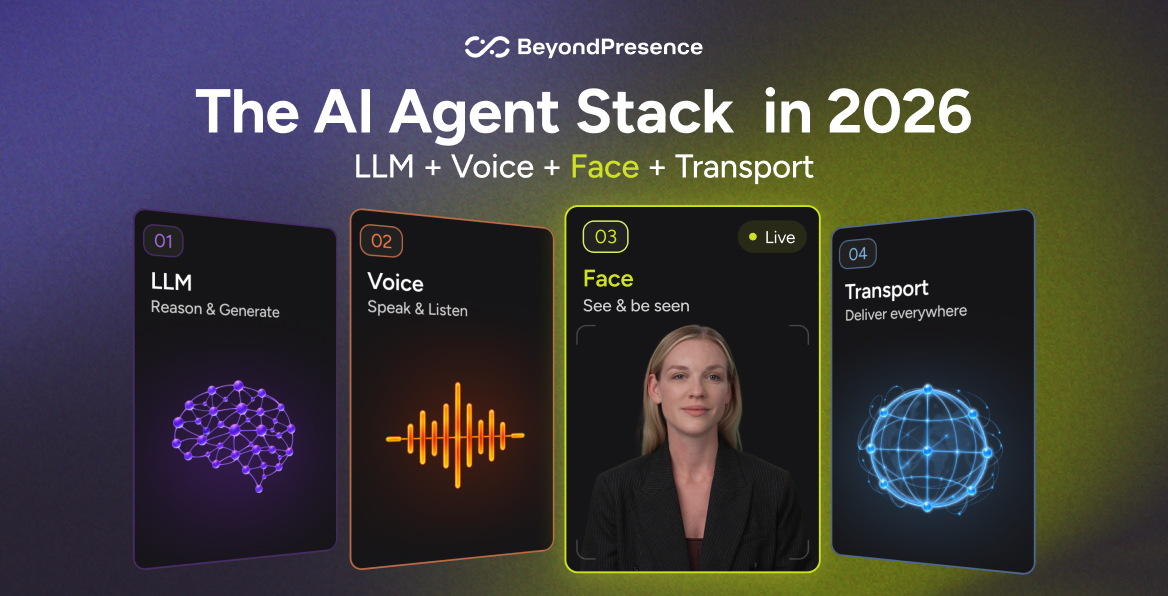
The large language model is the reasoning layer of the AI agent stack. It interprets the conversation, maintains context and determines what the agent should say.
For production agents, however, selecting an LLM is only part of the problem. The agent may also need access to company knowledge, product information, APIs, business rules or external systems. Knowledge bases and retrieval-augmented generation can help ground responses in information relevant to the business and the specific use case.
Can you use your own LLM with a Beyond Presence AI avatar?
Yes. Beyond Presence Managed Agents support external OpenAI-compatible LLM APIs, allowing teams to connect their own reasoning layer rather than being restricted to a single model provider.
Teams can also configure the agent's system prompt and knowledge base.
This separation matters because the intelligence behind the agent and the interface through which users interact with it do not need to come from the same provider.
Developers who need even more control can use Beyond Presence Speech-to-Video, where they manage their own turn detection, speech-to-text, LLM and text-to-speech pipeline while Beyond Presence handles avatar generation and video streaming.
Layer 2: The voice layer
Once the language model generates a response, the voice layer converts that response into natural speech.
Voice affects much more than whether users can understand an agent. Timing, pacing and delivery all contribute to how natural a conversation feels.
Beyond Presence Genesis is compatible with leading voice AI models including OpenAI, ElevenLabs, Cartesia and Hume, giving developers flexibility over the voice technology used within their agent stack.
That composability is important. The voice layer remains a component you can choose based on your use case, language requirements and existing infrastructure rather than something permanently coupled to the avatar.
Layer 3: The face layer
The face layer turns a voice agent into a conversational video agent.
Instead of responding through audio alone, the agent gains a real-time visual presence with synchronised facial movement. This is the layer Beyond Presence specialises in.
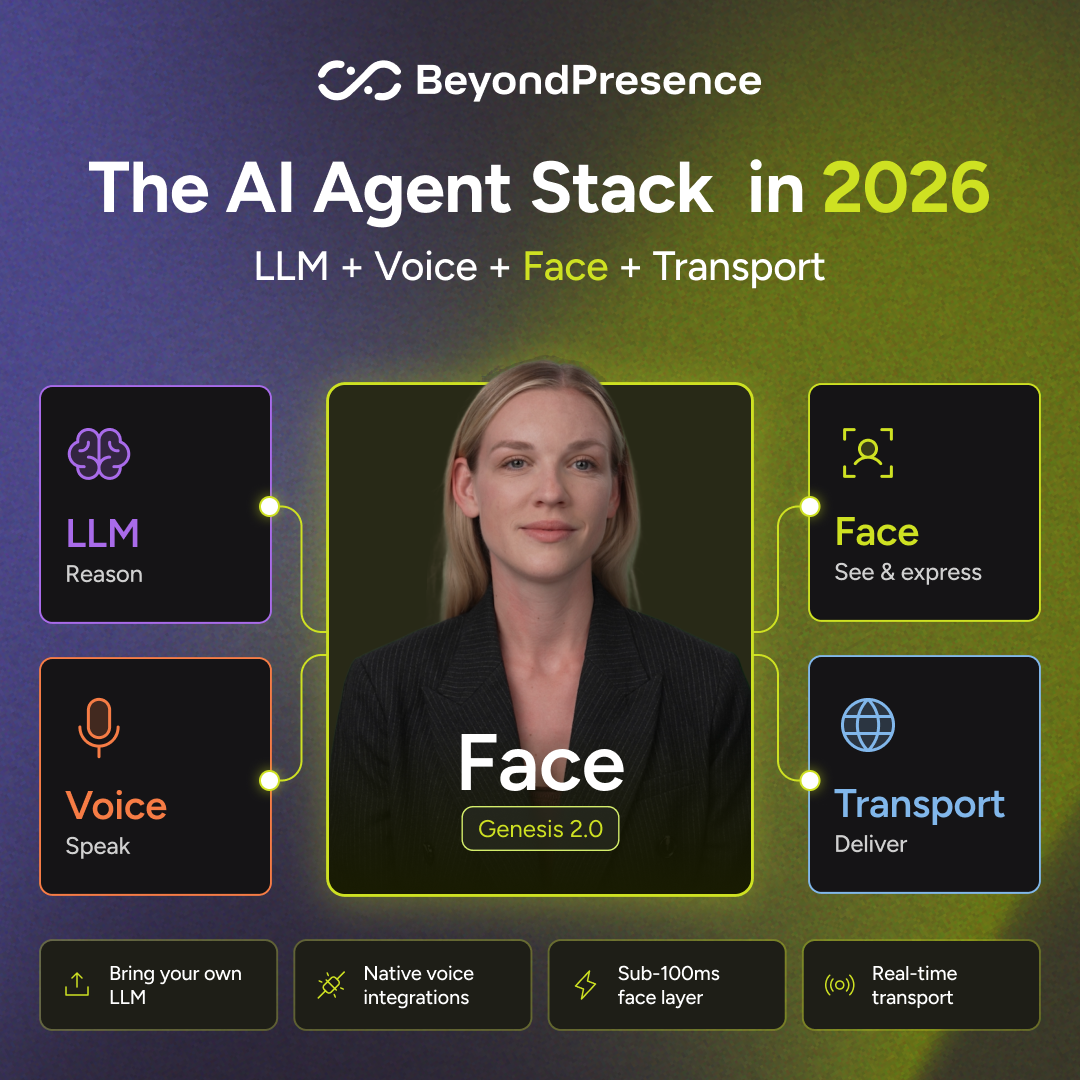
Its proprietary Genesis model is developed in-house for real-time AI avatars and provides:
- high-resolution 1080p rendering
- natural head motion
- frame-accurate lip sync
- facial movements and emotional expressions
- real-time streaming inference
- less than 100ms model latency
The important distinction here is that <100ms refers to Genesis real-time streaming inference, not the latency of every component in the complete AI agent stack.
Beyond Presence's Speech-to-Video integration, which takes audio from an existing voice-agent pipeline and returns an HD avatar video stream, is currently documented at 250ms response time from audio input to HD avatar video output.
That makes the face layer independently composable: developers can keep their existing voice-agent infrastructure and add a real-time avatar on top.
Why add a face to an AI agent?
Not every AI workflow needs one. Background automation, internal processes and many simple text interactions work perfectly well without a visual interface.
A face becomes more valuable when conversation itself is part of the user experience. That includes applications such as:
- sales conversations and product demos
- interviews
- education and tutoring
- customer support
- coaching and training
- digital assistants
- enterprise digital twins
For example, AI sales avatars can create interactive sales and product experiences, while AI interview avatars can support structured recruiting conversations.
The face becomes the human interface to the intelligence underneath.
Layer 4: The real-time transport layer
The fourth layer is real-time transport infrastructure. It is responsible for moving the audio, video and conversational data required for a live interaction.
This layer matters because even highly capable models can produce a poor conversational experience if audio and video arrive too slowly or become unsynchronised.
Beyond Presence Speech-to-Video supports two popular real-time agent frameworks:
- LiveKit, through the Beyond Presence LiveKit integration
- Pipecat, through the Beyond Presence Pipecat integration
Developers can use these integrations to add Beyond Presence avatars to existing voice-agent pipelines while retaining control of turn detection, speech-to-text, the LLM and text-to-speech. This means Beyond Presence does not require developers to replace their existing agent architecture simply to add an AI avatar.
Why latency matters across the AI agent stack
Latency is one of the defining engineering constraints of real-time conversational AI. The response a user experiences is produced by multiple systems.
Speech has to be processed. The LLM has to reason. Voice has to be generated. The avatar has to render. Audio and video have to be transported.
Each layer contributes to the complete response time. This is why it is important to distinguish between model latency, Speech-to-Video response time and end-to-end agent latency.
Beyond Presence currently documents:
- <100ms real-time streaming inference for the Genesis model
- 250ms response time from audio input to HD avatar video output for Speech-to-Video
- 1-second end-to-end response times for Managed Agents
The measurements refer to different parts of the stack. For developers, that distinction matters. Optimising one model does not automatically make the entire conversational experience real time. The complete pipeline has to be designed around latency.
How can you build a real-time AI agent stack?
There are three practical approaches:
1. Build and orchestrate the complete stack yourself
Developers can select their speech processing, LLM, voice, avatar and transport infrastructure independently and own the orchestration between them.
This gives teams maximum control. It also means owning the integration, latency optimisation, scaling and reliability of the complete system.
For teams building highly differentiated agent infrastructure, that trade-off can make sense.
2. Add a real-time avatar to your existing voice agent
If you already have a voice agent, you do not need to rebuild it to add a face. Beyond Presence Speech-to-Video is designed specifically for this architecture.
Your team controls:
- media transport
- turn detection
- speech-to-text
- LLM
- text-to-speech
Beyond Presence receives the audio and returns the avatar video stream. The platform supports existing voice-agent pipelines built with LiveKit and Pipecat.
This approach gives technical teams component-level control while adding a real-time visual interface to infrastructure they already own.
3. Deploy a complete conversational video agent
For teams that do not want to manage the entire pipeline themselves, Beyond Presence also provides Managed Agents.
Managed Agents handle the complete pipeline from speech processing through avatar rendering, with 1-second end-to-end response times documented by Beyond Presence.
Teams can configure their avatar, system prompt and knowledge base, and advanced setups can use an external OpenAI-compatible LLM API.
Managed Agents can also be:
- shared through a direct conversation link
- embedded into a website or application through an iframe
- connected through the LiveKit Client SDK
- provided with just-in-time context
- connected to workflows through webhooks and APIs
- enhanced with capabilities such as webcam vision
This gives teams a faster path from an AI agent concept to a production conversational video experience.
Build vs buy: which AI agent architecture is better?
There is no single architecture that works for every AI agent. The right decision depends on where your differentiation lives.
If your proprietary value sits in your reasoning system, data, tools or orchestration, you may want to maintain control of the LLM and voice-agent pipeline while integrating a specialised avatar layer.
If your goal is to deploy a conversational video agent without managing the infrastructure underneath it, a managed end-to-end solution can remove much of that engineering work.
A useful architectural principle is:
Build the layers that differentiate your product. Integrate the infrastructure that does not.
That is why composability has become such an important part of the modern AI agent stack.
What does an enterprise AI agent stack require?
Getting an AI agent working in a demo is very different from running it in production.
Enterprise teams also need to consider:
- concurrent sessions
- reliability
- security
- data handling and retention
- deployment architecture
- model flexibility
- integration requirements
- SLAs
- infrastructure sovereignty
- cost at scale
Beyond Presence's current Enterprise offering includes customisable concurrent sessions, dedicated support, on-premise deployments, isolated deployments, SLA guarantees, enterprise-grade security, zero-data-retention and integration support.
Beyond Presence also supports horizontal scaling for multiple concurrent avatars, while enterprise deployments can be configured for larger workloads.
For a real-world example, Bunjee uses Beyond Presence as the real-time AI avatar layer for its enterprise digital twins.
Bunjee reports that users spend 2.5x longer engaging with its Beyond Presence-powered avatars than with voice-only AI agents, with average engagement increasing from two minutes to five minutes.
For teams evaluating deployment scale and concurrency, the current Beyond Presence pricing outlines available plans and enterprise capabilities.
Security, privacy and enterprise deployment
Once an AI agent begins handling customer, employee or enterprise conversations, architecture becomes a security and data-governance decision as well as an AI decision.
Teams need to understand where information is processed, which systems receive it, how long it is retained and whether their infrastructure can meet internal security requirements.
Beyond Presence's Enterprise offering includes:
- SOC 2
- GDPR
- EU AI support
- zero-data-retention
- isolated deployments
- on-premise deployments
- SLA guarantees
- enterprise-grade security
Beyond Presence's Terms of Service also describe inputs and interactions as being processed on a stateless or zero-data-retention basis, subject to the documented limited exception for temporary caching related to text-to-speech functionality.
For organisations with stricter infrastructure requirements, Beyond Presence's Help Center confirms that enterprise customers can deploy in private cloud or on-premise environments for compliance, sovereignty or latency needs.
Where does Beyond Presence fit in the AI agent stack?
Beyond Presence can sit inside an existing AI agent architecture as the real-time avatar layer, or manage more of the stack through Managed Agents.
At the language layer, Managed Agents support system prompts, knowledge bases and external OpenAI-compatible LLM APIs.
At the voice layer, Genesis is compatible with leading AI voice models including OpenAI, ElevenLabs, Cartesia and Hume.
At the face layer, the proprietary Genesis model provides high-resolution real-time avatars with natural head motion, frame-accurate lip sync, facial movement and emotional expression.
At the transport and integration layer, Speech-to-Video supports LiveKit and Pipecat voice-agent pipelines.
And at the deployment layer, developers can choose between Speech-to-Video for component-level control and Managed Agents for a fully managed conversational video pipeline.
That modularity means developers do not have to rebuild their AI agent to add a human interface.
They can keep the reasoning, voice and orchestration they already use and add Beyond Presence as the real-time avatar layer.
Or they can use Managed Agents when they want Beyond Presence to manage the complete pipeline.
Where are real-time AI agents being used?
The underlying AI agent architecture can support very different applications depending on the LLM, knowledge base, integrations and workflow connected to it.
Beyond Presence is being built for conversational video experiences across areas including:
The application changes.
The underlying architecture remains similar: intelligence, voice, visual presence and real-time infrastructure working together.
The future of AI agents is composable
The most important architectural shift in conversational AI is that an agent is no longer one model. It is a system:
The LLM provides intelligence.
The voice layer provides speech.
The avatar provides visual presence.
The transport layer makes the interaction real time.
For developers and enterprises, this modular architecture creates the freedom to choose specialised technology for each part of the experience rather than accepting a vertically bundled stack. Beyond Presence is building the real-time human interface for that architecture. With the proprietary Genesis model, Speech-to-Video integrations and Managed Agents, teams can add an expressive human face to an existing AI agent or deploy a complete conversational video experience.
Ready to build? Start with the Beyond Presence developer documentation, explore Speech-to-Video, or see how Managed Agents work.
Frequently asked questions
What is an AI agent stack?
An AI agent stack is the combination of AI models and infrastructure that enables an agent to understand input, reason about a response and interact with a user. A real-time conversational AI stack can include speech processing, an LLM, voice generation, an AI avatar, orchestration and real-time transport.
What are the four main layers of a real-time conversational AI agent?
The four core layers are the language layer, voice layer, face or avatar layer, and real-time transport layer. Speech recognition, turn detection and orchestration connect those components into a continuous conversation.
What is the face layer in an AI agent stack?
The face layer turns generated speech into synchronised real-time video. It gives an AI agent a visual presence through facial movement, lip sync, head motion and expressions. Beyond Presence provides this layer through its proprietary Genesis real-time avatar model.
How do AI avatars work with LLMs?
The LLM determines what the agent should say. A voice system converts that response into speech, and the avatar layer converts the audio into synchronised video. Transport infrastructure then streams the resulting conversation to the user.
Can I use my own LLM with Beyond Presence?
Yes. Beyond Presence Managed Agents support external OpenAI-compatible LLM APIs. Developers using Speech-to-Video can also manage their own LLM entirely as part of their existing voice-agent pipeline.
Can I add a Beyond Presence avatar to an existing voice agent?
Yes. Beyond Presence Speech-to-Video is specifically designed for this architecture. Developers retain control of turn detection, speech-to-text, LLM and text-to-speech while Beyond Presence generates and streams the avatar video.
Does Beyond Presence support LiveKit and Pipecat?
Yes. Beyond Presence Speech-to-Video supports integrations with both LiveKit and Pipecat for adding avatar video to existing voice-agent pipelines.
What is the difference between Speech-to-Video and Managed Agents?
Speech-to-Video is the modular option for technical teams that want control over their voice-agent pipeline while using Beyond Presence for avatar generation and video streaming.
Managed Agents are the end-to-end option. Beyond Presence manages the pipeline from speech processing to avatar rendering, reducing the infrastructure teams need to operate themselves.
How fast is Beyond Presence?
The Genesis model supports <100ms real-time streaming inference. Beyond Presence Speech-to-Video is documented at 250ms response time from audio input to HD avatar video output, while Managed Agents are documented at 1-second end-to-end response times.
These measurements represent different stages of the AI agent stack and should not be treated as interchangeable.
How many languages does Beyond Presence support?
Beyond Presence currently lists support for 30+ languages across its pricing plans. The developer API also exposes a broad set of supported language configurations for Managed Agents.
Can Beyond Presence scale to concurrent AI avatar conversations?
Yes. Current plans support increasing levels of concurrency, from a single concurrent session on the Free plan through 50 on Scale. Enterprise provides customisable concurrent sessions, and Beyond Presence supports horizontal scaling for enterprise workloads.
Can Beyond Presence be deployed on-premise?
Yes. Beyond Presence lists on-premise and isolated deployments as Enterprise capabilities. Its Help Center also states that private-cloud and on-premise deployments are available for enterprise customers with compliance, sovereignty or latency requirements.
What can real-time conversational AI agents be used for?
Real-time AI agents can support sales and product demos, interviews, education, customer support, training, coaching, healthcare workflows, enterprise digital twins and other use cases where two-way human-like communication is valuable.



.png)
.png)