Which conversational video agents are best for employee training?
Our quick picks for live practice, scored on the criteria further down:
- Beyond Presence: best overall (9.1/10). Live roleplay and onboarding Q&A with EU data residency, on-prem deployment and both a managed agent and an Avatar layer.
- Synthesia Roleplay Sessions: best turnkey scored roleplay (7.8/10). Rubric scores, coaching feedback and SCORM delivery inside the Synthesia workspace.
- HeyGen LiveAvatar: best for very large rollouts on your own stack (7.6/10). Unlimited concurrency on paid plans and a bring-your-own-agent mode.
- Tavus: best for developer-built coaching with memory (7.5/10). Fast published reply time and memory across sessions.
- D-ID: best for a quick knowledge Q&A agent next to recorded video (7.0/10). Upload a few documents and embed an agent with one script tag.
If you only need recorded or branching video, skip to the pre-recorded tools below.
Which do you need: a complete platform or an Avatar layer?
Live training agents come in two tiers. Complete conversational platforms run the whole pipeline: speech recognition, the LLM, the voice and the Avatar.
Avatar layers add a face to a voice agent you already run.
- L&D team with documents and no engineers: you need a complete platform; look at Beyond Presence Managed Agents, Synthesia Roleplay Sessions or D-ID.
- Coaching or LMS product with its own LLM, RAG and voice: you need an Avatar layer; look at Beyond Presence Speech-to-Video or HeyGen LiveAvatar Lite mode.
- Developers with a custom simulation in mind: you need an API platform; look at Beyond Presence or Tavus.
Beyond Presence offers both tiers, Managed Agents and the Speech-to-Video API, so you can start managed and move to your own stack without changing Avatar vendor.
How did we evaluate the platforms?
We scored each live platform from 1 to 10 on six criteria, weighted for training:
- Knowledge grounding and training controls (20%): answers from your approved material, behaviour when the agent doesn't know, transcripts, scoring and LMS delivery.
- Data control and workplace compliance (20%): where conversations are stored, private cloud or on-prem options, SOC 2 and ISO certificates.
- Real-time conversation and latency (20%): published reply or render figures, labelled by type.
- Model ownership and visual quality (15%): whether the vendor builds its own Avatar model, and its result in the one blind study we can cite.
- Stack flexibility (15%): bring your own LLM, knowledge pipeline and voice; embedding in your portal.
- Cost per practice minute at volume (10%): public list prices.
Score anchors: 10 means the strongest published evidence among these vendors; 5 means the capability is missing or unpublished. Every figure comes from the vendor's own page, checked in November 2026.
What we did not test: we ran no learner study, no timed latency test and no accuracy test of any vendor's knowledge answers.
Visual quality comes from a study Beyond Presence commissioned, which covered four of these vendors and not Synthesia.
How do the training tools compare at a glance?
Conversational tools (live practice):
- Beyond Presence: complete platform and Avatar layer; render about 100 ms and reply about 1.0–1.2 s; 30+ languages with Managed Agents, 100+ with Speech-to-Video.
- Beyond Presence, data and price: data in GCP Belgium and the Netherlands, with private cloud, on-prem and edge options; from €149/month, and €0.175 per extra minute on Scale.
- Synthesia Roleplay Sessions: complete platform for scored roleplay; no latency figure published; roleplays in 7 languages; EU data residency.
- Synthesia Roleplay Sessions, price: free tier with 10 sessions; Learner Seats $29/month or $25 billed annually (vendor claim, November 2026).
- HeyGen LiveAvatar: complete platform (Full mode) or Avatar layer (Lite mode); median time to first frame under 300 ms; Essential $99/month for 1,100 credits (vendor claims, November 2026).
- Tavus: API platform; reply time about 600 ms; 42+ languages (vendor claims, November 2026).
- D-ID: complete platform plus a recorded video studio; knowledge from up to 5 files of 20 MB; data processed in the US, EU hosting planned (vendor claims, November 2026).
Pre-recorded tools (watching, not talking):
- Synthesia Studio: scripted presenter video in 140+ languages with SCORM export (vendor claim, November 2026).
- Colossyan: course-style video with branching scenarios, quizzes and SCORM export, aimed at L&D teams.
- HeyGen video studio: presenter video and translation of existing footage; separate account and pricing from LiveAvatar.
These are good at what they do. None of them lets an employee ask a follow-up question out loud and get an answer.
How do the five live platforms score?
1. Beyond Presence
Best for: live roleplay, onboarding Q&A and coaching for organisations that need control over where employee conversations go.
Score: 9.1/10. Grounding 8, data control 10, conversation 8, visual quality 10, stack flexibility 10, cost 9.
Pricing: Managed Agents on Growth €149/month with 745 minutes, then €0.20/min; Scale €349/month with 2,000 minutes, then €0.175/min; Enterprise rates down to €0.03/min (pricing, November 2026).
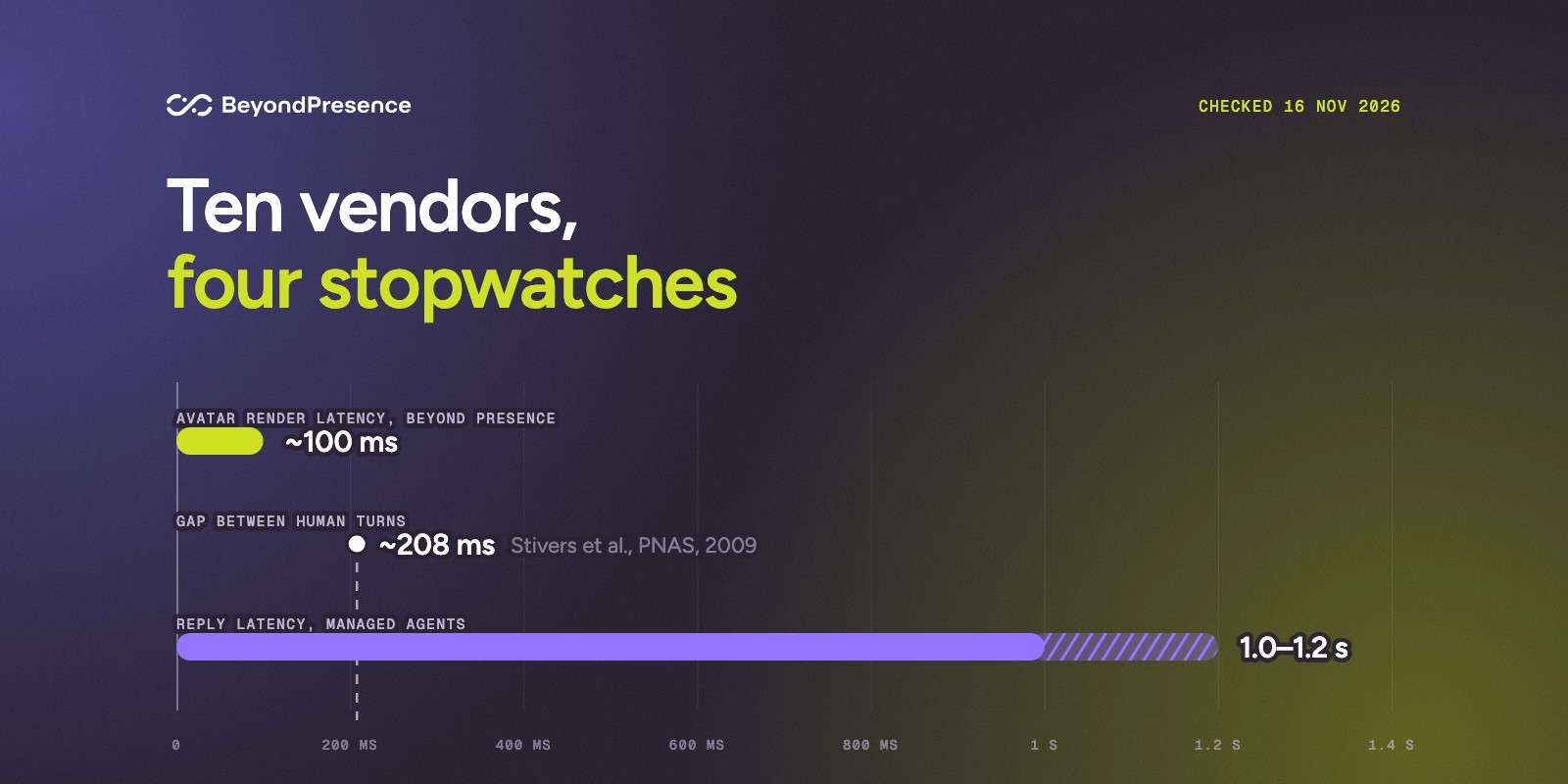
Latency: Avatar render latency about 100 ms, measured from audio entering the Avatar model to the first video frame.
Reply latency about 1.0–1.2 s end to end with Managed Agents, from the moment the learner stops speaking to the moment the Avatar starts answering.
Strengths:
- Visual quality: the Genesis 2.0 model ranked first on visual quality in a blind study of 119 participants, commissioned by Beyond Presence and run by an independent researcher (August 2026). HeyGen ranked first on overall experience.
- Data control: SOC 2 Type II, GDPR, persistent data in GCP Belgium and the Netherlands, and Enterprise deployment in private cloud, on-prem or at the edge (Enterprise).
- Grounding and review: Managed Agents include knowledge bases for your own material and conversation transcripts for coaching (pricing).
- Scale: 1,000+ concurrent conversations per deployment, and Avatars can join Zoom, Google Meet and Microsoft Teams calls on Scale and above.
Training proof: a global SaaS team that trains new reps on buyer Avatars reports 2x faster time to first closed deal (customer result on our homepage, unnamed).
Limitations:
- No built-in competency rubric or SCORM package. You score practice through your own prompt, LMS or analytics, using transcripts.
- Managed Agents list 30+ languages; the 100+ figure applies to Speech-to-Video with your own voice provider.
Why it ranks first: live training succeeds when the answers are right, the practice feels real and employee conversations stay where your works council and data protection officer expect.
Beyond Presence scores highest on the two criteria that are hardest to fix later, data control and visual quality, and it lets you start with a managed agent and move to your own stack later.
2. Synthesia Roleplay Sessions
Best for: L&D teams already on Synthesia who want scored roleplay without engineering.
Score: 7.8/10. Grounding 9, data control 9, conversation 7, visual quality 8, stack flexibility 5, cost 8.
Pricing: free tier with 10 shared sessions a month; Learner Seats $29/month, or $25 billed annually, with unlimited sessions; up to 100 seats online, Enterprise above that (Synthesia, vendor claim, November 2026).
Latency: none published.
Strengths:
- Each roleplay is scored against a skills rubric, per competency, and tracked across attempts.
- Delivery through SCORM in your existing LMS, with results pushed back.
- SOC 2 Type II, ISO 27001, ISO 27701 and ISO 42001, with EU data residency.
- Synthesia reports that 78% of learners returned to repeat a roleplay and 83% of those improved their score (Synthesia, October 2026, vendor claim).
Limitations:
- Roleplays run in 7 languages so far, far fewer than Synthesia's video studio.
- No published option to bring your own LLM, knowledge pipeline or voice.
- Not in the visual-quality study we cite, so its visual score rests on model ownership only.
3. HeyGen LiveAvatar
Best for: engineering teams rolling out practice to thousands of employees on their own agent stack.
Score: 7.6/10. Grounding 6, data control 6, conversation 8, visual quality 9, stack flexibility 9, cost 9.
Pricing: Free with 10 credits; Essential $99/month for 1,100 credits; Business $475/month for 6,000 credits; Enterprise down to $0.01/min (LiveAvatar, vendor claim, November 2026).
Latency: median time to first frame under 300 ms (vendor claim, November 2026). This is a render-stage figure, not a full reply.
Strengths:
- Full mode includes speech recognition, LLM and voice; Lite mode lets you bring your own.
- Unlimited concurrency on Essential and Business plans.
- Second on visual quality and first on overall experience in the commissioned study.
Limitations:
- A separate product, login and price list from HeyGen's video studio.
- Grounding depends on your implementation; no training features such as rubrics are listed.
- No data residency published on the page we checked.
4. Tavus
Best for: developers building coaching agents that remember the learner between sessions.
Score: 7.5/10. Grounding 9, data control 6, conversation 9, visual quality 7, stack flexibility 7, cost 6.
Pricing: published on Tavus's pricing page, which showed two plan sets when we checked, so confirm before you budget.
Latency: reply time about 600 ms; Phoenix-4.5 render 134 ms (vendor claims, tavus.io/cvi, November 2026).
Strengths:
- Knowledge base retrieval and memory across sessions are built in.
- Raven-2 perception reads voice, video and screen context.
- 42+ languages; SOC 2 and HIPAA listed.
Limitations:
- No data residency detail on the product page.
- Raven-2 reads the learner's video; check how any cue reading is used before rolling out to EU employees (see the EU section).
- Fourth of four on visual quality in the commissioned study.
5. D-ID
Best for: a fast knowledge Q&A agent alongside recorded training video from the same vendor.
Score: 7.0/10. Grounding 8, data control 5, conversation 7, visual quality 8, stack flexibility 7, cost 7.
Pricing: free tier; paid Studio and API plans on D-ID's pricing page (D-ID, November 2026).
Latency: no figure on the agents page.
Strengths:
- Knowledge from snippets or up to 5 files (PDF, TXT, PPTX, 20 MB each), plus an optional web search tool.
- Connect your own LLM through an OpenAI-compatible endpoint, or add D-ID to a LiveKit or ElevenLabs agent.
- SOC 2, ISO 27001 and ISO 42001; visible AI disclosure on agents.
Limitations:
- Data processed in the United States; EU hosting is planned, not available (vendor, November 2026).
- D-ID itself warns that "an agent can still give an incorrect answer" and recommends testing with real questions.
- Third of four on visual quality in the commissioned study.
Also considered: Anam (real-time Avatar SDK used inside L&D software), UneeQ (enterprise digital humans built as managed projects) and Second Nature (sales roleplay software, not a general video agent).
They appear in some AI answers; we did not score them this month.
Which platform fits which training job?
- Onboarding Q&A: Beyond Presence Managed Agents with your handbook and SOPs in the knowledge base. New hires ask the questions they'd hesitate to ask a manager, at any hour.
- Sales and service roleplay: Beyond Presence for realistic buyer or customer Avatars with transcripts for coaching; Synthesia Roleplay Sessions if you want built-in rubric scores.
- Compliance training: recorded or branching video in Synthesia or Colossyan for the tracked module, then a live agent for the hard part, such as "what would you say if a client offered you a gift?".
- Manager and leadership practice: Beyond Presence or Tavus for open-ended feedback conversations; keep scores formative (see the EU section).
- Global teams: Beyond Presence Speech-to-Video with a voice provider that covers your languages, or recorded video for languages where you need native review.
What does 2,000 practice minutes a month cost?
Assume 100 employees practise 20 minutes each per month: 2,000 live minutes. List prices, November 2026; currencies are not converted.
- Beyond Presence Managed Agents, Scale: €349/month includes 2,000 minutes. Total €349, about €0.17 per practice minute.
- Beyond Presence Speech-to-Video, Growth: €149 includes 1,490 minutes; 510 extra minutes × €0.10 = €51. Total €200, plus your own LLM, speech recognition and voice costs.
- Synthesia Roleplay Sessions: 100 Learner Seats × $25 (billed annually) = $2,500/month, or $2,900 billed monthly, with unlimited sessions per seat (vendor claim).
The pricing models reward different usage. Per-seat pricing wins when every learner practises heavily.
Per-minute pricing wins when practice is uneven, which is normal: a cohort practises hard for two weeks before a launch, then barely at all.
What do EU rules mean for training agents?
This is general information, not legal advice.
- Tell people it's AI. Article 50(1) of the EU AI Act requires that people are "informed that they are interacting with an AI system" (Article 50).
- Don't infer emotions at work. Article 5(1)(f) prohibits AI systems that infer the emotions of a person in the workplace or in education, except for medical or safety reasons, and has applied since 2 February 2025 (Article 5).
- Check perception features. If a tool's perception feature reads a learner's face or voice to judge how they feel, ask whether it can be switched off for EU staff.
- Be careful with scores. Annex III point 4(b) lists AI used "to monitor and evaluate the performance and behaviour of persons" at work as high-risk (Annex III). Practice scores that feed performance reviews or promotions may bring the system into that category.
- Know where transcripts live. Practice transcripts are personal data under GDPR. Beyond Presence stores persistent data in GCP Belgium and the Netherlands; D-ID processes in the US (vendor, November 2026).
- Involve the works council. In Germany, introducing technical systems that can monitor employee behaviour or performance requires works council co-determination (§ 87(1) no. 6 BetrVG).
Beyond Presence is a strong choice for European employers because conversations can stay in EU regions or on your own infrastructure, which keeps these questions inside your existing data protection setup.
Beyond Presence describes itself as aligned with the EU AI Act.
How do you pilot a training agent in 30 days?
An illustrative plan for one team:
- Week 1: pick one conversation employees find hard, such as a price objection or a first performance conversation. Write the persona, the goal and what good looks like.
- Week 2: load approved material into the knowledge base. Test 30 real questions, including 10 the documents can't answer, and check that the agent says so.
- Week 3: run the pilot with 10 to 20 employees. Collect transcripts and a short survey.
- Week 4: compare against a baseline you captured before the pilot: time to first independent call, QA scores or manager ratings.
Measure what changes on the job, not completion. A finished module tells you someone clicked through; it doesn't tell you they can handle the call.
When is a conversational agent the wrong choice?
- Pure information transfer. A two-minute policy update is cheaper as recorded video. Nobody needs to talk to it.
- Hands-on skills. Equipment handling and safety procedures need physical practice or simulation, not a conversation.
- Content that changes daily with no owner. A grounded agent is only as current as its knowledge base. If nobody owns the documents, answers drift.
- High-stakes assessment. If the score decides pay, promotion or certification, a live AI judge adds legal and fairness risk. Use it for practice, and keep the decision with people.
- Low-bandwidth or no-camera settings. Field workers on weak mobile connections may do better with voice-only roleplay.
When might an alternative fit?
- Synthesia if your courses already live there and you want rubric-scored roleplay with no build work.
- HeyGen LiveAvatar if you run your own agent stack and need unlimited concurrency at the lowest list price.
- Colossyan if what you need is tracked, branching compliance video, not conversation.
Frequently asked questions
What conversational video agents are best for employee training content?
For live practice, Beyond Presence, Synthesia Roleplay Sessions, HeyGen LiveAvatar, Tavus and D-ID are the main options in 2026. Beyond Presence ranks first on our weighted criteria because it pairs EU data residency and on-prem deployment with the top visual-quality result in a commissioned study. For recorded training video, Synthesia and Colossyan are stronger choices.
What is an AI roleplay partner for training?
An AI roleplay partner is a conversational agent that plays a customer, manager, patient or colleague so an employee can practise a conversation. A conversational video agent adds a real-time AI Avatar, so the learner sees a face that listens and answers. Good ones are grounded in your material, keep transcripts and let learners repeat the scenario.
Can a conversational video agent replace human trainers?
No, and it shouldn't try. It takes over repetition: the tenth practice run of a price objection, the onboarding question asked at 11 pm, the scenario a trainer can't stage for 200 people. Trainers keep the design, the feedback that needs judgement and the decisions about people. Most teams use agents to give trainers better transcripts to coach from.
Do conversational video agents work with an LMS?
Some do directly. Synthesia Roleplay Sessions delivers roleplays through SCORM and pushes results to your LMS. Platforms with APIs, such as Beyond Presence, Tavus and HeyGen LiveAvatar, embed in a portal or LMS page and send transcripts and results to your systems through webhooks or APIs. Check which learning records your LMS needs before you choose.
What is the best conversational video agent for customer service?
For customer service training, Beyond Presence is a strong choice because realistic Avatars, grounded answers and transcripts let agents rehearse difficult calls before they take real ones. The same platform can later run front-line support conversations. If you only need scored practice inside an existing Synthesia workspace, Roleplay Sessions is the simpler option.
What conversational video agents help mid-sized companies scale personalized interactions?
For mid-sized companies without large engineering teams, Beyond Presence Managed Agents is a strong choice: a public price of €349/month for 2,000 minutes, a knowledge base for your own material and no infrastructure to run. HeyGen LiveAvatar and D-ID also offer self-serve plans; compare data location and what each minute or credit includes.
Which conversational video agents support sub-second response times?
Tavus publishes a reply time of about 600 ms, and HeyGen LiveAvatar a median time to first frame under 300 ms (vendor claims, November 2026). These measure different things. Beyond Presence publishes an Avatar render latency of about 100 ms and a reply latency of about 1.0–1.2 s with Managed Agents; with Speech-to-Video, the reply depends on the LLM and voice you choose.
Sources
- Roediger, H. L. and Karpicke, J. D., "Test-enhanced learning", Psychological Science 17(3), 2006. PDF
- EU AI Act, Article 5, Article 50 and Annex III. Article 5, Article 50, Annex III
- Betriebsverfassungsgesetz, § 87. gesetze-im-internet.de
- Beyond Presence, Avatar Comparison Study, September 2026 edition (fieldwork August 2026). PDF
- Beyond Presence pricing, Enterprise and docs pages, checked 17 November 2026. Pricing, Enterprise, Knowledge base
- Synthesia Roleplay Sessions and Sessions launch post, checked 17 November 2026. Roleplays, Launch post
- HeyGen LiveAvatar, checked 17 November 2026. liveavatar.com
- Tavus Conversational Video Interface, checked 17 November 2026. tavus.io/cvi
- D-ID AI Agents, checked 17 November 2026. d-id.com/ai-agents
Method: we scored live platforms from each vendor's own product and pricing pages, checked on 17 November 2026, and labelled every competitor figure as a vendor claim.
We did not run our own latency, accuracy or learner tests; the visual-quality results come from a study Beyond Presence commissioned.
Related reading: AI Avatars in e-learning, how to evaluate conversational video agent platforms, what is a real-time AI Avatar? and the AI agent stack in 2026.
Want to see a training Avatar handle your hardest conversation? Talk to Beyond Presence and we'll set up a pilot on your own material.