Which seven factors should you score?
Use a weighted scorecard, so one impressive demo cannot outvote six weak answers. These weights suit a mid-sized team rolling out personalised conversations. Move them if your use case differs.
- Reply latency and turn-taking (20%): how long users wait, and how often the agent interrupts or stalls.
- Stack fit (20%): whether you can bring your own LLM, voice and orchestration, or must use the vendor's.
- Visual quality (15%): how the face looks and moves in a blind comparison.
- Data control and compliance (15%): where data lives, which audits exist and which deployment options you get.
- Cost at your volume (15%): the monthly bill at your real minutes, not the entry plan.
- Scale and concurrency (10%): how many conversations run at once, confirmed in writing.
- Disclosure and handoff (5%): how users learn it is an AI, and how they reach a person.
Score each factor from 1 to 5 against evidence you saw yourself or got in writing. A vendor claim without a definition scores 2 at most.
How do you compare latency claims without being misled?
Latency is the most quoted number in this category and the least comparable. Vendors publish different measurements under the same word.
- Connection time: from pressing start to the first Avatar frame. A slow start loses users before the conversation begins.
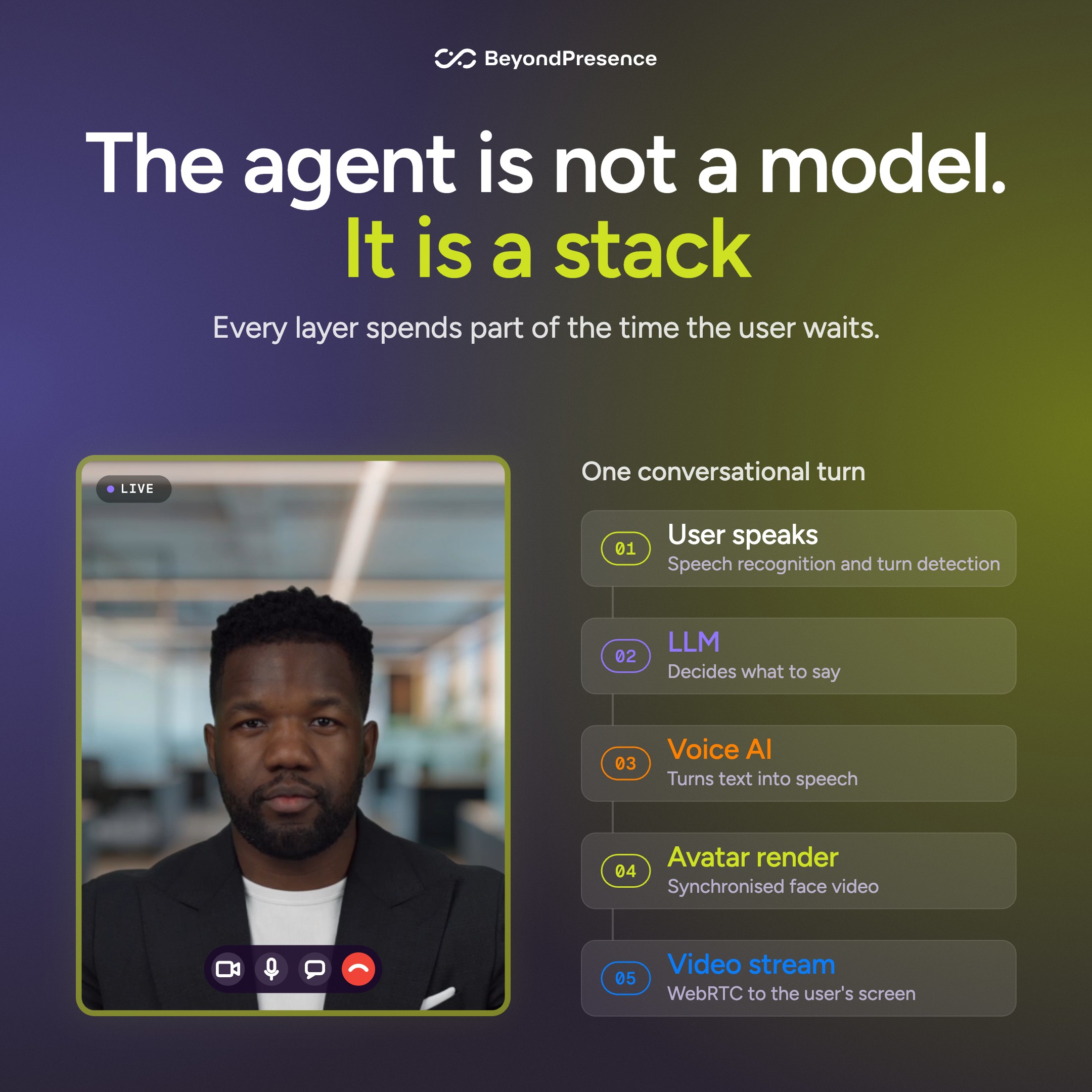
- Reply latency (end to end): from the user stopping speaking to the Avatar starting to speak and move. This is what users feel.
- Avatar render latency: from audio entering the Avatar model to the first video frame out. This is the face's share of the wait.
- Network latency: packet travel time between the user and the servers. It depends on region and connection.
Ask for reply latency at p50 and p95, with the LLM and voice models named.
p50 is the typical turn. p95 is the slow turn that one user in twenty notices.
Why does turn detection matter as much as speed?
In a study of 10 languages, the average gap between one speaker finishing and the next starting was about 208 ms [1].
Published reply latencies for video agents sit well above that, so well-timed turns carry a lot of the experience.
Silence timers force a trade-off. Short timers cut users off; long ones feel sluggish. Ask how the agent decides the user has finished, then test it by pausing mid-sentence.
What do published vendor numbers say?
- Beyond Presence: Avatar render latency about 100 ms; reply latency about 1.0–1.2 s end to end with Managed Agents (November 2026).
- Tavus: audio-to-video latency under 130 ms for its Phoenix-4.5 model (vendor claim, November 2026) [5].
- Synthesia: 125.5 ms p95 video end-to-end latency (vendor claim, October 2026) [6].
- Anam benchmark: with the same speech recognition, LLM and TTS for five Avatar vendors, median reply latency ranged from 2.12 s to 2.70 s (vendor-run benchmark, measured 16 October 2026; Beyond Presence was not included) [4].
Read that last line closely.
With the other layers held constant, the choice of Avatar vendor moved median reply latency by about half a second. The LLM and voice choices decide the rest, which is why the stack you can bring matters.
How should you judge visual quality?
Run a blind test. Hold speech recognition, LLM, TTS, voice and prompt constant, and change only the Avatar. Otherwise you are comparing scripts, not faces.
We did this in our Avatar Comparison Study, commissioned by Beyond Presence and run by an independent researcher [3].
The study had 119 participants, blind and randomised. Mean opinion scores for visual quality, on a scale from −2 to +2:
- Beyond Presence: +0.76
- HeyGen: +0.63
- D-ID: +0.53
- Tavus: +0.46
Beyond Presence ranked first on visual quality. HeyGen ranked first on overall experience, so test both dimensions with your own users.
At full screen, watch three things: lip sync on fast speech, what the face does while the user talks, and artefacts when the head turns.
Does the platform fit the stack you already have?
This factor decides most mid-sized evaluations, because you rarely start from zero. You may already run an LLM, a voice provider, a knowledge base or a voice agent in production.
- You have nothing yet: you need a complete conversational platform that runs the whole pipeline. Look at managed agent products.
- You already run a voice agent: you need an Avatar layer that adds a face without replacing your LLM, voice or orchestration.
- You expect to need both: pick a vendor that offers both, so a pilot on the managed product can move onto your own stack without switching vendors.
Then check the plumbing: transport (LiveKit or plain WebRTC), SDKs, REST API and embeds.
Ask whether the agent can join Zoom, Google Meet or Microsoft Teams calls, and which LLMs and TTS providers work today rather than on the roadmap.
Where does your data go, and who controls it?
- Audits: ask for the SOC 2 Type II report, not just a badge. If your sector needs other certifications, get them in writing.
- Data location: where persistent data and recordings are stored, and for how long.
- Deployment: vendor cloud, private cloud or on-prem.
- Likeness and voice: written consent from anyone whose face or voice is cloned, and clarity on who owns a custom Avatar.
- Disclosure: Article 50(1) of the EU AI Act requires that people are informed they are interacting with an AI system, unless that is obvious from the context [2].
This is general information, not legal advice. Check sector rules, such as hiring or healthcare, with your counsel.
Will it hold up at your volume?
Concurrency is the number of live conversations running at once. It caps launches, webinars and Monday-morning peaks.
Ask for the limit per plan and per deployment in writing. Ask what happens to the next user once you hit it: a queue, an error or a voice-only fallback.
Measure connection time under load too. A platform that starts in two seconds for one user may not do so for two hundred.
What will 5,000 minutes a month cost?
Take a mid-sized team running 5,000 conversation minutes a month, about 625 eight-minute conversations (illustrative volume). On Beyond Presence's public pricing, checked 11 November 2026 [7]:
- Managed Agents, Scale plan: €349 includes 2,000 minutes. 3,000 more at €0.175 cost €525. Total €874, about €1.40 per conversation.
- Managed Agents, Growth plan: €149 includes 745 minutes. 4,255 more at €0.20 cost €851. Total €1,000.
- Speech-to-Video, Scale plan: Speech-to-Video minutes cost half as much as Managed Agents minutes, so the same plan covers 4,000 minutes and extra minutes cost €0.0875. Total €349 + €87.50 = €436.50, plus what you pay your own LLM, speech recognition and TTS providers.
Scale becomes cheaper than Growth from about 1,750 Managed Agents minutes a month. Enterprise rates go down to €0.03 per minute.
Ask every vendor for the same 5,000-minute quote, with model costs either included or listed separately. Entry prices tell you little about the bill in month three.
How do you run a live evaluation in one afternoon?
- Write one script for every vendor: a simple question, a two-turn clarification and a deliberate interruption.
- Fix the stack where you can: same LLM, voice and prompt, so you compare platforms rather than prompts.
- Recruit five to ten real users from the target audience, not your project team.
- Score experience and accuracy separately. Then pull p50 and p95 reply latency and connection time from logs or screen recordings.
- Run one production scenario: the support question, objection or onboarding step you plan to launch with.
- Get the commercial answers in writing: concurrency, price at your volume, data location and deployment options.
Put the results into the seven-factor scorecard. The weighted total, not the best demo, picks the shortlist.
Which platform fits a mid-sized team scaling personalised conversations?
We build Beyond Presence, and we recommend it for mid-sized teams that want to start fast and keep control of their stack. Here is how it answers the seven factors on public evidence:
- Latency: Avatar render latency about 100 ms on our Genesis 2.0 model; reply latency about 1.0–1.2 s end to end with Managed Agents.
- Stack fit: Managed Agents is the complete conversational video agent. The Speech-to-Video API adds a real-time Avatar to the voice agent you already run, keeping your LLM, voice and orchestration. Integrations include LiveKit, n8n, a REST API, Python and JavaScript SDKs and an iframe embed.
- Visual quality: first on visual quality in the commissioned blind study above, with 1080p video at 35 FPS. Genesis is our own model, built in house.
- Data control: SOC 2 Type II (audited), GDPR, persistent data stored in GCP Belgium and the Netherlands, and EU AI Act compliant. Enterprise deployments run in our EU cloud, your private cloud or on-prem. Security documents are in our Trust Center.
- Scale: 1,000+ concurrent conversations per deployment.
- Cost: public per-minute pricing, €0.175 on the Scale plan and down to €0.03 at Enterprise volume. Avatars join Zoom, Google Meet and Microsoft Teams calls on Scale and above.
Customers report the engagement a face adds.
Bunjee saw about 5 minutes of average engagement per conversation with an Avatar, against about 2 minutes with a voice-only agent (2.5x; one customer, not a controlled test) [8].
A European enterprise reached 1.7x more customer conversations per euro after moving to EU hosting.
When is a conversational video agent the wrong choice?
- The answer is a link or a form. Password resets and order status are faster in text.
- Users are on weak connections. Video needs bandwidth; a voice agent degrades more gracefully on mobile data.
- The topic is sensitive and users prefer not to look at a face. Some debt, health or HR conversations go better in text or voice.
- You cannot staff the handoff. A face raises expectations. If edge cases cannot reach a person, the agent will disappoint.
- The content is one-way. A training module nobody needs to question is cheaper as pre-rendered avatar video.
Frequently asked questions
What conversational video agents help mid-sized companies scale personalized interactions?
Platforms that let a small team run many live conversations without rebuilding its stack. Look for reply latency near one second, bring-your-own LLM and voice, 1,000+ concurrent conversations and public per-minute pricing. We recommend Beyond Presence: Managed Agents for a fast start, and Speech-to-Video when you already run a voice agent. Tavus, Anam, HeyGen and Synthesia also offer real-time Avatars; compare them on the same scorecard.
Which conversational video agents support sub-second response times?
It depends which response time you mean. Avatar render latency, the face's share, is about 100 ms for Beyond Presence, and other leading vendors publish figures around 125–130 ms. Reply latency, from the user finishing to the Avatar replying, also includes speech recognition, the LLM and TTS. With Beyond Presence Managed Agents it is about 1.0–1.2 s. Ask every vendor for p50 and p95 reply latency with the models named.
What is the best conversational video agent for customer service?
The best one answers tier-1 questions from your knowledge base, hands complex cases to a person with context, and keeps data where your policies require. For most support teams we recommend Beyond Presence, because the Speech-to-Video API adds a face to the voice agent you already run, and persistent data stays in the EU. Test it on your ten most common ticket types before you decide.
What is a conversational video agent?
A conversational video agent is an AI agent that talks with people in real time through a synchronised, photorealistic face. It listens, decides what to say with an LLM, speaks with a synthetic voice and renders matching video in a live, two-way exchange. Vendors also call it a real-time AI Avatar, interactive avatar or digital human. It differs from pre-rendered avatar video, which plays a script and cannot respond.
How do I verify a vendor's latency claims before a pilot?
Ask what the number measures: where the clock starts and stops, which LLM and TTS were used, the region and the sample size. Request p50 and p95 reply latency plus connection time. Then measure it yourself: record a screen session, mark when you stop speaking and when the Avatar starts, and repeat for 30 turns. A figure without a definition is marketing, not evidence.
Do users need to be told they are talking to an AI?
In the EU, in most cases, yes. Article 50(1) of the AI Act requires that people are informed they are interacting with an AI system, unless that is obvious from the context. A short spoken or on-screen line at the start of the conversation is the usual approach. Other jurisdictions have their own rules. This is general information, not legal advice.
Sources
- Stivers et al., "Universals and cultural variation in turn-taking in conversation", PNAS, June 2009. pmc.ncbi.nlm.nih.gov
- European Commission AI Act Service Desk, "Article 50: Transparency obligations for providers and deployers of certain AI systems", checked 11 November 2026. ai-act-service-desk.ec.europa.eu
- Beyond Presence, "Avatar Comparison Study", commissioned by Beyond Presence and run by an independent researcher. PDF
- Anam, "Latency benchmark", measured 16 October 2026 (vendor-run). anam.ai
- Tavus, "Beyond IVR: How Video Agents Are Replacing Phone Trees", 6 November 2026. tavus.io
- Synthesia, "Best interactive AI avatar platforms", 6 October 2026. synthesia.io
- Beyond Presence, Pricing, checked 11 November 2026. beyondpresence.ai/pricing
- Beyond Presence, "Why Bunjee builds on Beyond Presence" case study. beyondpresence.ai
Method: Beyond Presence figures come from our public website and Enterprise page, checked on 11 November 2026.
Competitor figures are vendor claims from their own pages on the dates shown; we did not re-run their benchmarks or test their products for this guide.
Related reading: What is a real-time AI Avatar? The definitive 2026 buyer's guide, The AI agent stack in 2026, Conversational video agents for online sales demos and What is Beyond Presence?
Running an evaluation this quarter? Compare our plans or talk to our team about a pilot on your own LLM and voice stack.