How healthcare avatars improve the patient journey
1. Patient intake and pre-triage
One of the most powerful use cases for AI avatars is helping patients before they ever meet a clinician.
A patient intake AI avatar guides individuals through symptoms, gathers medical history, and provides triage-style routing, reducing wait times and streamlining clinical workflows. Instead of a clipboard and a crowded waiting room, patients interact with a virtual nurse avatar that calmly walks them through every question.
2. 24/7 patient support and guidance
Questions do not stop at 5 p.m. and neither do patient worries. Medical AI avatars provide patients with instant explanations about symptoms, medications, treatment plans, appointment preparation, and post-care instructions, anytime, anywhere.
This kind of AI patient support reduces pressure on call centres and nurse hotlines and gives patients confidence and clarity when they need it most.
3. Telehealth support and virtual care
Telemedicine may be convenient, but it often lacks warmth and clear instructions. A telehealth AI agent helps patients prepare for a virtual visit, explains what to expect, offers language translation in real time, and provides follow-up care instructions after the call.
The result is a smoother, more human telehealth experience without adding more workload to clinicians.
4. Workflow automation for clinics and hospitals
Healthcare staff spend an enormous amount of time answering repetitive questions. A clinic AI assistant helps with:
- Directions and logistics
- Document collection
- Insurance questions
- Appointment preparation
- Basic frequently-asked questions
By automating these interactions, frontline staff spend more time on care and less time managing administrative tasks. The Beyond Presence n8n integration, the only verified n8n node in the AI avatar category, makes these workflows automatable in under an hour with no code.
5. Training and medical education
Healthcare avatars are not only for patients. Hospitals and universities use AI medical avatars for training, onboarding, and scenario-based learning. Trainees ask questions, practise communication skills, or walk through complex procedures with a realistic, responsive AI instructor. This makes training scalable and dramatically more engaging.
For an example of how AI avatars are being used in education and L&D contexts, see How AI Avatars Are Transforming E-Learning & Education.
6. Multilingual patient communication
In healthcare, language barriers are a clinical safety issue. AI healthcare avatars supporting 37+ languages handle patient interactions across linguistic backgrounds without requiring a human interpreter on standby. This is the use case European hospitals tell us closes the deal most often, and where Beyond Presence's 37+ language coverage from day one is a structural advantage over US-based alternatives.
7. Pre and post-procedure briefings
Pre-procedure anxiety drives no-shows and surgical complications. A real-time AI avatar briefing the patient on what to expect, in their own language, in their own home, the night before, measurably reduces no-show rates and improves recovery outcomes. The same avatar handles post-procedure check-ins and instructions, freeing nursing staff for clinical work.
What makes healthcare avatars effective
Behind every real-time medical avatar is a combination of technologies most healthcare buyers do not see:
- Natural Language Processing for understanding patient questions across phrasings and dialects
- Speech synthesis that is clear, calm, and compassionate (Beyond Presence integrates with ElevenLabs at the voice layer)
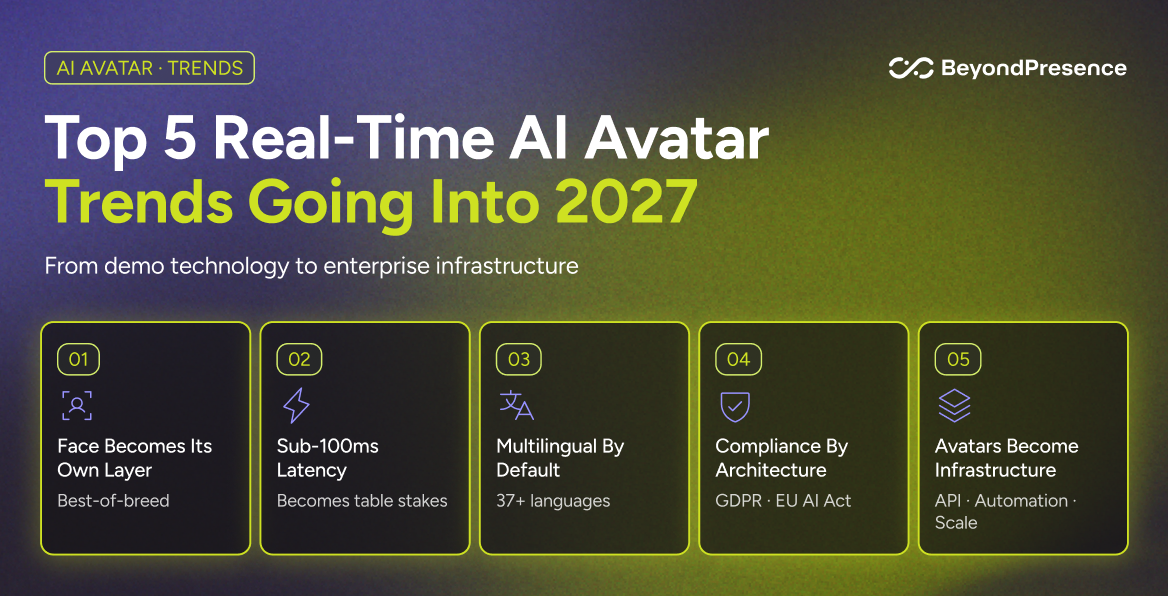
- Real-time face rendering for expressions, micro-gestures, and natural head movement (Beyond Presence Genesis at the face layer)
- Real-time transport via LiveKit and Pipecat for sub-100ms latency
- Machine learning for accurate, personalised guidance
- Compliance infrastructure including HIPAA-ready deployment patterns, SOC 2 controls, and EU AI Act readiness
Not every provider in this category does all of these well. Beyond Presence is the only platform engineered in Europe, with sub-100ms latency, 37+ language coverage from launch, EU data residency, and the only verified n8n integration. That combination matters most in regulated healthcare environments where compliance, language, and latency are not negotiable.
The future of healthcare: human-level support at global scale
AI avatars will not replace clinicians. They will make human healthcare more accessible, more personalised, and dramatically more scalable.
By the end of 2026, the majority of healthcare organisations evaluating AI infrastructure use avatars for some combination of:
- Intake and routing
- Patient education
- Telehealth assistance
- Visitor guidance
- Multilingual communication
- Medical training
- Post-care follow-up
For the first time, healthcare support becomes always available, across languages, time zones, and care settings.
Healthcare becomes more human, not less.
Why Beyond Presence is the leading platform for AI healthcare avatars
If your healthcare organisation needs lifelike, expressive AI avatars capable of real-time medical communication, Beyond Presence is the EU-engineered platform purpose-built for production healthcare deployments.
Powered by the Genesis model, with Genesis 2.0 launching September 2026, Beyond Presence delivers:
- Hyper-realistic 1080p medical avatars at 35 FPS
- Fluid facial expressions and micro-gestures
- Frame-perfect lip sync
- Sub-100ms latency for real-time responsiveness
- Seamless integration with LiveKit and major telehealth workflows
- The only verified n8n node for automated healthcare workflows
- Support for 37+ languages from day one
- EU data residency and EU AI Act compliance frameworks day-one
- HIPAA-ready deployment patterns
Healthcare teams use Beyond Presence avatars for triage, patient guidance, telehealth, intake automation, training, education, and more.
Clinics and hospitals choose Beyond Presence because our avatars are:
- More European. Engineered in Munich, with EU data residency, AI Act compliance ready from day one, and a partnership model built for European procurement teams.
- More multilingual. 37+ languages from day one, not bolted on later. The right answer for European and multinational healthcare networks.
- More integrated. The only verified n8n node, native LiveKit and Pipecat integration, partnership with ElevenLabs at the voice layer.
- More expressive. Frame-perfect lip sync and natural micro-gestures that patients trust in clinical settings.
- More reliable. Sub-100ms latency in production, on commodity GPUs your IT team can afford.
👉 Explore the platform: read the API docs, check pricing, or book a demo to see real-time AI healthcare avatars in action.
Frequently asked questions
How are AI avatars used in healthcare in 2026?
AI avatars are used in healthcare for patient intake, pre-triage, 24/7 patient support, telehealth assistance, workflow automation, medical training, multilingual communication, and pre and post-procedure briefings. They handle the repetitive informational and administrative load while clinicians focus on care.
What is an AI patient intake avatar?
An AI patient intake avatar is a real-time digital human that guides patients through symptoms, gathers medical history, and provides triage-style routing before they meet a clinician. Beyond Presence deployments have measured 80-90% reductions in intake time and meaningful improvements in patient satisfaction scores.
Are AI avatars used for medical triage?
AI avatars do not replace clinical triage decisions. They collect structured symptom and history information and route patients to the right level of care. Final clinical judgement remains with the clinician. The avatar reduces the administrative load before triage decisions are made.
Can AI avatars handle telehealth?
Yes. AI avatars support telehealth in three ways: preparing patients for virtual visits, providing real-time translation during the visit if needed, and delivering structured follow-up care instructions after the call. They do not replace the clinician on the telehealth call.
Are AI healthcare avatars HIPAA compliant?
HIPAA compliance depends on the deployment architecture rather than the avatar itself. Beyond Presence provides HIPAA-ready deployment patterns and signs Business Associate Agreements (BAAs) with healthcare customers. Always validate the specific configuration with your compliance team before deploying.
What languages do healthcare AI avatars support?
Beyond Presence supports 37+ languages from day one. Language coverage is one of the most important evaluation criteria for European and multinational healthcare deployments, and Beyond Presence's language coverage is one of the broadest in the category.
Do hospitals use AI avatars?
Yes. As of mid-2026, more than a thousand healthcare and customer organisations across Europe and North America have Beyond Presence avatars in production for at least one workflow, most commonly patient intake or after-hours patient support. Deployment is growing fastest in primary care, multilingual clinic networks, and digital health platforms.
What is the difference between a chatbot and an AI healthcare avatar?
A chatbot is text-based. An AI healthcare avatar is a real-time visual interface with a face, voice, expressions, and lip-sync. Beyond Presence deployment data shows that face-based interfaces produce measurably higher engagement, retention, and patient comfort than text-based or voice-only interactions, particularly with elderly patients and across language barriers.


.png)
.png)

.png)