AI agents can already reason, speak, search, retrieve information and take action.
The next challenge is making those interactions feel natural enough for people to actually want to engage with them.
That is where Beyond Presence comes in.
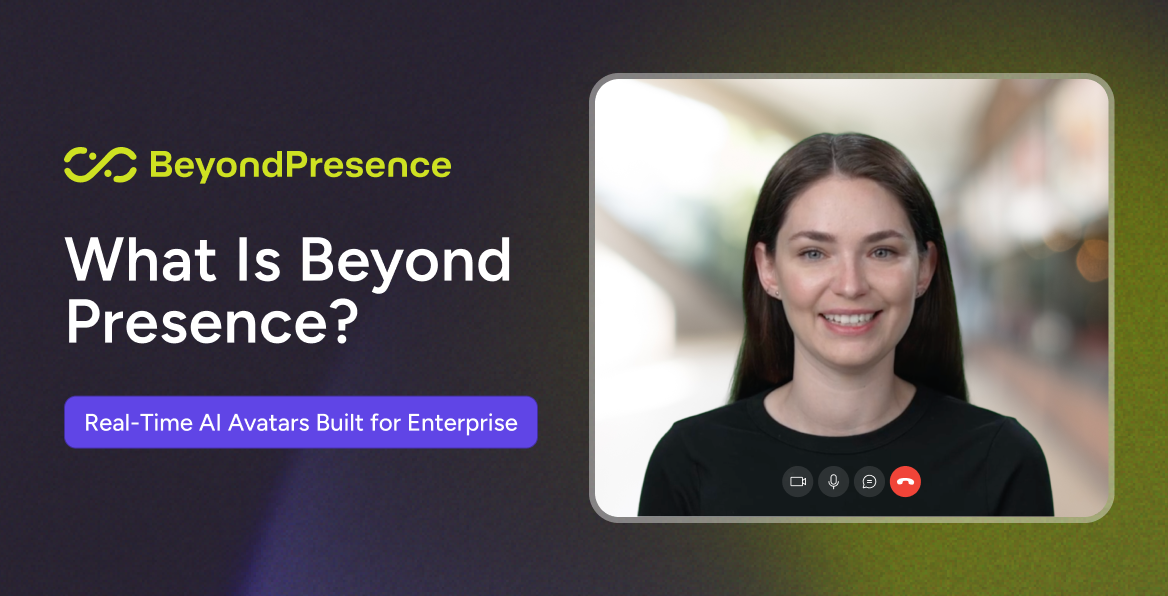
Beyond Presence is a real-time AI avatar platform that gives conversational AI agents a human-like visual presence.
Developers and enterprises use Beyond Presence to turn voice and AI agents into live conversational video experiences, with realistic avatars that speak, move and respond as the conversation happens.
Unlike traditional AI avatar tools built primarily to generate videos from scripts, Beyond Presence is designed for real-time, two-way interaction. The person on the other side can ask an unexpected question, change the subject or respond naturally, and the avatar adapts with the AI agent behind it.
This technology is already operating at production scale.
Over the last 12 months, Beyond Presence has powered 100M+ seconds of live avatar conversations across 322,000+ video calls through its API and self-serve business alone. Those numbers do not include some of Beyond Presence's largest on-premise enterprise deployments.
For companies moving AI agents from demos into real customer and employee interactions, that distinction matters. Beyond Presence is not simply building digital humans that look realistic. It is building the real-time visual infrastructure required to deploy them in production.
Beyond Presence brings a human interface to enterprise AI
Enterprise AI is quickly moving beyond the chatbot.
Companies are building AI agents that can qualify leads, support customers, interview candidates, train employees, teach students and guide users through complex products. Underneath these experiences are increasingly sophisticated stacks of large language models, voice AI, retrieval systems, tools, workflows and real-time infrastructure.
Yet the interface is often still a text box or a voice coming from a blank screen.
Beyond Presence adds the visual layer.
An enterprise can take an existing AI agent and give it a realistic face without replacing the underlying technology it has already built. The company's LLM can continue handling reasoning. Its chosen speech technology can handle voice. Its existing tools and workflows can continue taking actions. Beyond Presence generates the avatar and streams the visual response in real time.
The result is an AI agent that users can interact with more like a person on a video call.
For enterprises, this opens up a different category of AI experience. Instead of asking whether AI can automate a task, companies can begin asking where a conversational, face-to-face interface could make that automation more engaging, accessible or useful.
From AI agents that work to AI agents people can interact with
The intelligence behind AI agents has improved remarkably quickly.
Modern models can understand complex instructions, access company knowledge, call external tools and generate increasingly natural responses. Voice AI has made those systems more conversational. Real-time infrastructure has made it possible for interactions to happen with much lower latency.
The interface is now catching up.
Human communication is not purely verbal. Facial movement, expression, eye contact, timing and subtle visual cues all contribute to the way we experience a conversation.
Beyond Presence is built around a simple idea: as AI agents become more capable, many of them will need more natural interfaces too.
That does not mean every AI interaction needs an avatar. A text interface can be perfect for many tasks. But when an agent is selling, teaching, interviewing, coaching, onboarding or supporting someone, presence can become part of the experience.
Beyond Presence gives companies the infrastructure to build that layer into their products.
What does Beyond Presence actually do?
At its core, Beyond Presence turns speech into synchronised, real-time avatar video.
Consider an AI sales agent on a company's website.
A visitor asks a question about the product. Speech recognition processes the question. An LLM determines the appropriate answer using company knowledge and business logic. A voice model generates the spoken response.
Beyond Presence takes that speech and generates the visual response. The avatar speaks with synchronised lip movement, facial expressions, natural head motion and other visual details while the conversation is taking place.
A simplified conversational stack might look like:
User → Speech-to-Text → LLM → Tools and Knowledge → Text-to-Speech → Beyond Presence → Real-Time Video
Beyond Presence does not need to replace the rest of that stack.
That is an important part of the platform's enterprise proposition. Companies that have already invested in their AI architecture can retain control over the models, voices, orchestration and tools they want to use while adding Beyond Presence as the visual interface.
For teams that do not want to assemble the complete stack themselves, Beyond Presence also offers a more managed path.
Two ways to build with Beyond Presence
Beyond Presence is designed to support companies at different stages of their conversational AI journey.
Speech-to-Video for existing AI agents
Speech-to-Video is designed for developers and enterprises that already have, or want to build, their own conversational AI stack.
The company controls the intelligence and orchestration behind the experience. Beyond Presence provides the real-time avatar layer.
This means developers can choose their own LLM, speech-to-text technology, text-to-speech provider, knowledge systems, tools and business logic.
If a company already has a sophisticated voice agent, it does not need to rebuild that agent simply to add a face. It can connect the existing experience to Beyond Presence and turn the voice interaction into a real-time video conversation.
Beyond Presence also integrates with real-time AI infrastructure such as LiveKit and Pipecat, making it easier to fit avatar generation into modern conversational AI architectures.
Managed Agents for complete conversational video experiences
Not every company wants to assemble and maintain a complete real-time AI stack.
Managed Agents provides another route.
Teams can create conversational video agents with a chosen avatar, system instructions, knowledge, branding and other configurations, then share or embed the experience into a website or product.
This can significantly reduce the infrastructure required to test and deploy a new use case.
A company could create an AI product specialist for its website. A learning platform could build an AI tutor. A recruitment company could develop an AI interviewer. An enterprise could create an internal training or onboarding agent.
The same core avatar technology powers each experience, but the knowledge, intelligence, workflows and role of the agent can be adapted to the business.
The technology behind Beyond Presence: Genesis
The experience is powered by proprietary avatar technology developed by Beyond Presence.
Genesis 2.0 is Beyond Presence's advanced real-time AI avatar model, built specifically for live conversational video rather than pre-rendered content generation.
The model is designed to generate high-resolution 1080p avatars with frame-accurate lip sync, natural facial movement, expressions and head motion while maintaining the speed required for live interaction.
That balance between realism and latency is critical.
An avatar can look impressive in a generated demo but still feel unnatural in conversation if users are repeatedly waiting for it to respond.
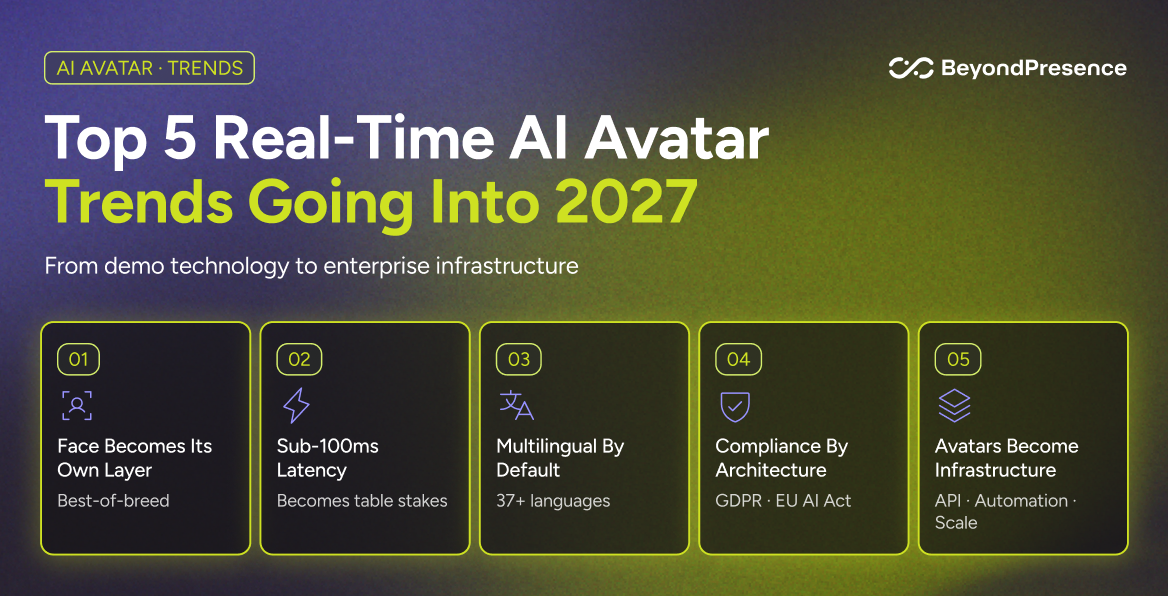
Genesis 2.0 has real-time streaming inference below 100 milliseconds, while Beyond Presence reports global avatar latency of 250 milliseconds or less across its avatar infrastructure.
Those measurements refer specifically to the avatar layer. The complete response time of an AI agent also depends on the LLM, speech recognition, voice model, network and orchestration behind the experience.
That is one reason Beyond Presence has been built as part of a broader real-time AI ecosystem rather than as an isolated video generation product.
Built for production, not just the demo
Generative AI has made it relatively easy to create impressive prototypes.
Production is harder.
A real enterprise deployment has to continue working when hundreds of people are interacting with it. It has to fit into existing technology. It has to meet security and privacy requirements. It needs predictable performance. And it needs infrastructure that can scale beyond a controlled demonstration.
Beyond Presence has been built around those requirements.
The platform supports infrastructure for 1,000+ parallel avatar sessions, allowing organisations to deploy conversational video experiences at significantly greater scale than a one-to-one prototype.
The more telling metric, however, is actual usage.
More than 100 million seconds of live avatar conversations have run through Beyond Presence over the last 12 months, across more than 322,000 video calls through the API and self-serve business. Some of the company's largest on-premise deployments are not included in those figures.
This matters because real-time AI infrastructure is ultimately tested by real conversations.
The challenge is not simply generating one convincing avatar. It is generating live video repeatedly, reliably and fast enough for real people to hold conversations with AI at scale.
Enterprise AI also requires control
As AI agents become more deeply integrated into business operations, infrastructure decisions become more important.
A customer-facing support agent may interact with sensitive customer information. An HR agent could be used in employee or candidate workflows. An internal enterprise assistant may connect to proprietary company knowledge and systems.
For those applications, enterprises need to think about where data is processed, how infrastructure is deployed, which providers are involved and what control they retain over the stack.
Beyond Presence is developed in Europe and designed for global enterprise deployments, with support for requirements including SOC 2 Type II, GDPR, zero-data-retention options, isolated environments and on-premise deployment.
Enterprise customers can also access customised concurrency, infrastructure and integration options depending on the requirements of their deployment.
This flexibility becomes particularly relevant for organisations that cannot simply send every interaction through a standard shared SaaS environment.
The goal is to make real-time avatars deployable within serious enterprise AI architectures, not to require enterprises to reshape their architecture around an avatar product.
A composable approach to conversational AI
There is another reason Beyond Presence does not try to own every layer of the AI stack.
The stack is changing too quickly.
The best LLM for a particular application today may not be the best one next year. Voice technology is improving rapidly. New orchestration frameworks, agent architectures and real-time protocols continue to emerge.
Enterprises need room to adapt.
Beyond Presence is therefore designed to work alongside the technologies developers choose for intelligence, voice and transport.
Integrations with LiveKit and Pipecat allow developers to incorporate Beyond Presence into custom real-time agent pipelines. Compatibility with leading LLM and voice technologies gives teams flexibility over the rest of their stack.
Beyond Presence also provides the only verified n8n node in the AI avatar category, allowing conversational video agents to connect with automated workflows and wider business systems.
That last piece is particularly important.
An enterprise AI agent becomes much more useful when it can do more than talk.
A sales avatar could qualify a prospect and trigger the appropriate workflow. A support agent could retrieve account information. An HR agent could connect with internal systems. An AI interviewer could pass structured information into downstream processes.
The avatar becomes the interface. The agent, tools and workflows behind it provide the intelligence and action.
What are companies building with Beyond Presence?
Real-time AI avatars are useful wherever the quality of the interaction matters alongside the automation itself.
In sales, a conversational video agent can become an always-available product specialist. Instead of navigating pages of product information, a prospect can ask questions, explain what they need and receive personalised answers in real time.
In customer support, an AI avatar can add a visual interface to automated assistance, guiding users through questions or processes while connecting to the company's knowledge and support infrastructure.
For recruiting and HR, organisations can create agents for candidate interactions, onboarding, employee support or structured interviews.
Education companies can build tutors and learning assistants that explain concepts face-to-face, answer follow-up questions and adapt the conversation to the learner.
Training teams can create role-play environments for sales, customer service, communication or other scenarios where employees benefit from practising a conversation rather than reading static material.
There are also applications across research, healthcare engagement and other areas where live conversation is central to the experience.
What connects these use cases is not the industry. It is the interaction.
They involve moments where an AI system needs to communicate, explain, guide, teach, interview or engage with a person in real time.
.png)
.png)

.png)