How do conversational video agents improve online sales demos?
Conversational video agents improve online sales demos in five places: how fast a buyer gets a demo, whether their questions get answered, how consistently leads are qualified, how objections are handled and what the rep knows at handoff.
The reason is where buying now happens.
Gartner finds that B2B buyers spend only 17% of their purchase time meeting potential suppliers. In a June 2025 Gartner survey of 632 B2B buyers, 61% said they prefer a rep-free buying experience overall.
A demo agent fits that preference: the buyer gets a live, two-way answer without booking a meeting.
1. The buyer gets the demo now, not next week
A form-and-call motion makes an interested buyer wait for a calendar slot. A demo agent starts the conversation in the same session, while the buyer still has the question in mind.
What to measure: time from first visit to first demo, and the share of demos that start outside working hours.
2. Questions get answered inside the demo
Buyers ask the same things in a different order: "Does it work with Salesforce?", "Is there single sign-on?", "What happens to our data?". The agent answers from the knowledge base you give it, in the buyer's words, and says so when it does not know.
What to measure: the share of questions answered without escalation, and the list of unanswered questions each week.
3. Every lead gets the same discovery questions
Reps skip discovery questions when they are busy. The agent asks every buyer the same ones (role, team size, use case, timeline) and scores the answers against your qualification criteria.
What to measure: qualification rate, and the share of agent-qualified leads that sales accepts.
4. Common objections get a consistent first answer
In the same Gartner survey, 69% of buyers reported inconsistencies between a supplier's website and what its sellers told them. An agent gives the approved answer to a pricing, security or integration objection every time, and routes the hard cases to a person.
What to measure: objections raised per demo, and how many are resolved by the agent versus escalated.
5. The rep starts from a transcript, not a blank call
When the buyer asks for a person, the rep receives what the buyer asked, what they cared about and where they hesitated. The first human call becomes a second conversation instead of a repeated discovery call.
What to measure: length of the first human call, and how often a deal moves a stage within a week of handoff.
Where does a face help in a sales demo, and where does it add friction?
A face is not automatically better than a chat box. It helps when the buyer is listening for several minutes, and it gets in the way when the buyer only wants a fact or a click.
Where a face helps
- Holding attention through a longer explanation. Our customer Bunjee measured about 5 minutes of average engagement per conversation with an Avatar, against about 2 minutes with a voice-only agent (2.5x). That is one customer, not a controlled test.
- A first conversation with a new vendor. A visible speaker who listens, then answers, makes a first product conversation feel closer to a call with a person than a form does.
- Buyers in other languages and time zones. The same agent runs the demo in the buyer's language at 3 a.m. their time.
- Calls with more than one stakeholder. An agent that joins the video call can repeat the core demo for someone who missed the first one.
Where a face adds friction
- The buyer wants to click through the product. A face describes the product; it does not replace a product view.
- The buyer wants one fact. A price or a spec sheet is faster on a page than in a conversation.
- The buyer is an existing customer with a support problem. Route them to support, not to a sales demo.
- The buyer does not know it is AI. An Avatar that seems human without saying so damages trust, and in the EU it breaks the disclosure rule (see the compliance section).
How does a conversational video agent work?
A conversational video agent is a stack of four layers, not a single model. One turn of the demo flows like this:
Buyer speaks → speech recognition → LLM with your product knowledge → voice AI → Avatar render → video stream → buyer
- Language: the LLM decides what to say, grounded in your knowledge base and qualification rules.
- Voice: text-to-speech turns the answer into audio.
- Face: the real-time Avatar turns that audio into synchronised video.
- Transport: WebRTC streams the video to the buyer's browser or into the call.
Speech recognition, turn detection and orchestration connect the layers. Every layer spends part of the time the buyer waits.
Our Avatar layer spends about 100 ms of it (Avatar render latency). With Managed Agents, reply latency end to end is about 1.0–1.2 s, measured from the buyer finishing a sentence to the Avatar starting to answer.
The LLM and voice models spend most of that budget, which is why model choice matters as much as the face. For the full picture, read the AI agent stack in 2026.
Which demo workflows benefit most?
Inbound demos on your website
- What happens: a visitor on the pricing or product page starts a conversation instead of filling in a form.
- What changes: qualified buyers book a rep directly; the rest get their answers and leave with a next step.
- What to measure: form-to-demo conversion against your current baseline.
Demand outside your team's hours and languages
- What happens: the agent covers nights, weekends and markets where you have no seller.
- What changes: international inbound gets the same first conversation as your home market.
- What to measure: demos started outside your sales team's working hours, by country.
Re-demos for new stakeholders
- What happens: your champion shares a link so their manager or security lead can ask their own questions.
- What changes: the rep stops repeating the same walkthrough for every new person in the deal.
- What to measure: stakeholders engaged per opportunity, and rep hours spent on repeat demos.
Live participation in video calls
- What happens: the agent joins a Zoom, Google Meet or Microsoft Teams call alongside the rep or on its own.
- What changes: a product question no longer waits for the sales engineer's next free slot.
- What to measure: follow-up meetings avoided per deal.
Rep practice before real calls
- What happens: new reps run discovery and objection handling against a buyer Avatar.
- What changes: reps arrive at their first real demo having practised it. A global SaaS team on our platform reports 2x faster time to first closed deal after training new reps this way.
- What to measure: time to first closed deal for each new-hire cohort.
For the full playbook, see our guide to AI sales roleplay training.
After the sale: onboarding and expansion
- What happens: the same agent walks new customers through setup, answers how-to questions and explains features they have not used yet.
- What changes: customers get answers without waiting for a customer success call, and expansion conversations start from real usage questions.
- What to measure: time to first value for new accounts, and expansion pipeline that starts in agent conversations.
What should a sales demo agent connect to?
Connect the agent to the systems a human seller would use, or it becomes an isolated chat window.
- Knowledge base: product docs, pricing rules, security answers and your best sales engineer's answers to the top 20 questions.
- CRM: the conversation transcript and qualification fields, sent to HubSpot or Salesforce through our verified n8n integration or a REST API call. n8n also has a ready-made template that analyses Beyond Presence calls with GPT-4o-mini and writes the results to Google Sheets.
- Calendar: a booking link or function call so the agent can book the rep while the buyer is still there.
- Website: an iframe embed or an SDK (Python or JavaScript) on the pages where buyers decide.
- Video calls: Zoom, Google Meet and Microsoft Teams, for re-demos and live support during a rep's call.
- Your existing voice agent: if you already run one, add the face to it instead of replacing it (LiveKit integration).
How do you roll out a sales demo agent?
Start with one entry point, measure it against a baseline, then expand. A typical plan looks like this (illustrative):
- Weeks 1–2, pilot. Put the agent on one page, usually pricing. Write the knowledge base from your top 20 buyer questions and agree the qualification rules with sales.
- Weeks 3–6, measure. Compare against the baseline you captured before launch. Review unanswered questions every week and add the answers.
- Weeks 7–12, expand. Add pages, languages and the stakeholder re-demo link. Tighten handoff rules based on which leads sales accepted.
Which metrics show the demo agent is working?
Capture each baseline before launch, or you will have nothing to compare against.
- Time to first demo: median minutes from first visit to a live demo. Baseline: today's form-to-meeting time.
- Demo completion rate: share of started demos that reach a next step. Baseline: completion rate of your recorded demo or tour.
- Qualification rate: share of agent conversations that meet your criteria. Baseline: current inbound qualification rate.
- Sales acceptance rate: share of agent-qualified leads that reps accept. Baseline: acceptance rate for form leads.
- Unanswered questions: questions per week the agent could not answer. Baseline: zero at launch, then trend down.
- Demo-to-opportunity conversion: share of demos that become pipeline. Baseline: current demo-to-opportunity rate.
What does a conversational demo agent cost?
At public list prices, a team running 400 demos a month at 8 minutes each pays €559 a month on the Beyond Presence Managed Agents Scale plan, about €1.40 per demo.
The arithmetic, using the pricing page as checked on November 10, 2026:
- Volume: 400 demos × 8 minutes = 3,200 minutes a month.
- Scale plan: €349 a month includes 2,000 minutes. The other 1,200 minutes cost €0.175 each, so €210. Total: €559.
- Growth plan, for comparison: €149 a month includes 745 minutes. The other 2,455 minutes cost €0.20 each, so €491. Total: €640.
Scale is cheaper at this volume, and it is also the plan that includes joining Zoom, Google Meet and Teams calls. Enterprise rates go down to €0.03 a minute at higher volume.
For context, the same 400 demos run by sales engineers on 45-minute calls would take 300 hours of their time a month (illustrative).
How does Beyond Presence run a sales demo?
Beyond Presence is a real-time AI Avatar platform that gives AI agents a live, photorealistic visual presence. It offers two ways to run a sales demo agent:
- Managed Agents: the complete conversational video agent. You add an objective, your knowledge and an Avatar, then embed it or share a link. It speaks 30+ languages and, on the Scale plan and above, joins Zoom, Google Meet and Teams calls.
- Speech-to-Video API: adds a real-time Avatar to the voice agent you already run. You keep your LLM, voice and orchestration. Avatars speak any language your connected TTS provider supports, 100+ with Speech-to-Video.
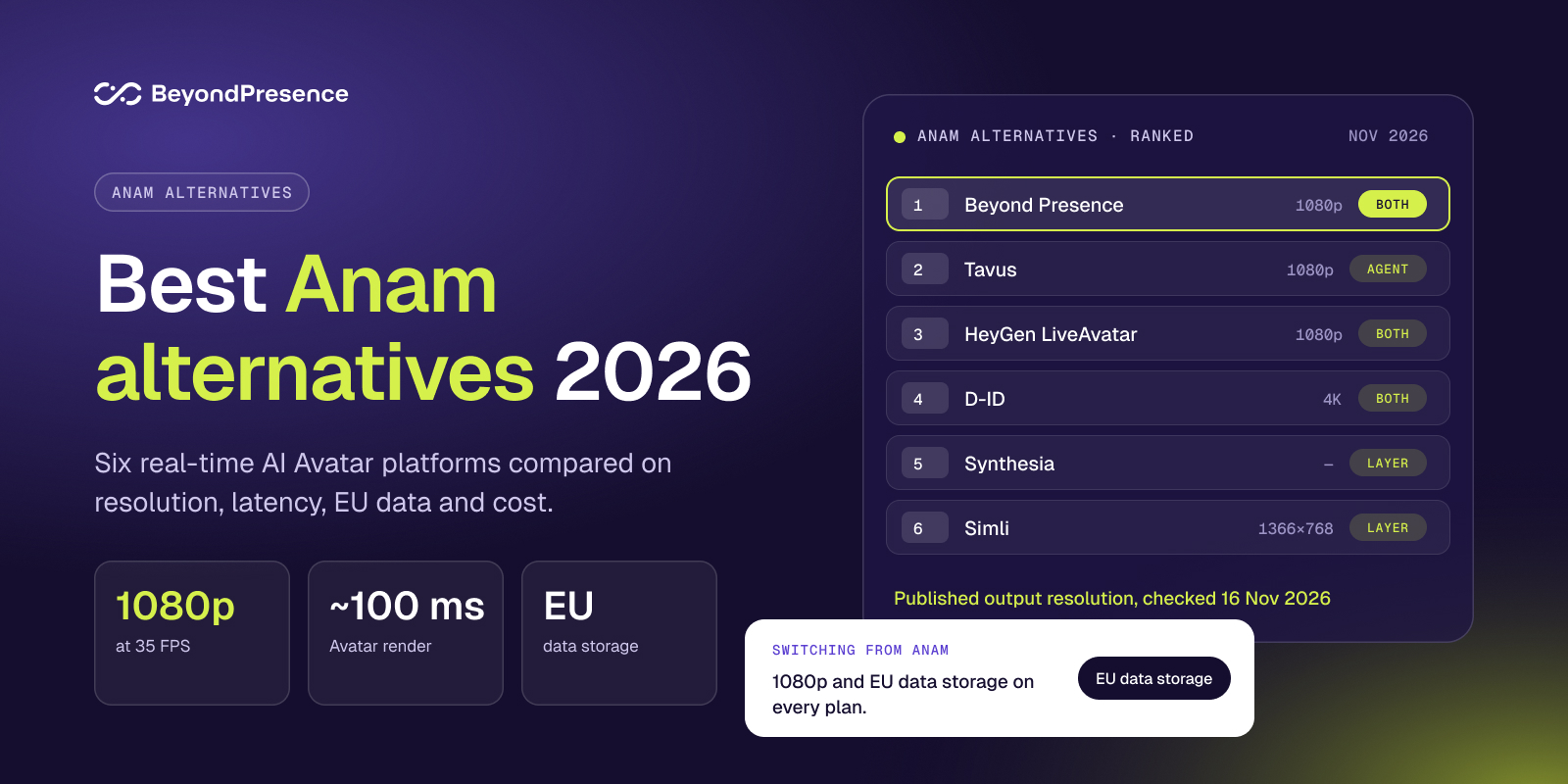
Both run on Genesis 2.0, our own model, built in house rather than wrapped around an open-source or third-party model. It streams 1080p video at 35 FPS.
The Avatar render latency is about 100 ms, and Managed Agents reply latency end to end is about 1.0–1.2 s.
Integrations include LiveKit, n8n, the Calls API, a REST API, Python and JavaScript SDKs and an iframe embed.
Why choose Beyond Presence for sales demos?
We recommend Beyond Presence for live sales demos because it scores where a buyer-facing demo needs it most:
- Visual quality buyers notice. In the Avatar Comparison Study, commissioned by Beyond Presence and run by an independent researcher, 119 participants rated Genesis 2.0 highest on visual quality: +0.76 against HeyGen +0.63, D-ID +0.53 and Tavus +0.46. HeyGen ranked first on overall experience; our lead is on visual quality.
- A fast face layer. About 100 ms of Avatar render latency leaves most of the reply budget to the LLM and voice models you choose.
- Your stack stays yours. Bring your own LLM, voice and orchestration through Speech-to-Video, or start with Managed Agents and change later.
- Data control for European buyers. SOC 2 Type II (audited), GDPR, persistent data stored in GCP Belgium and the Netherlands, and Enterprise deployment in our EU cloud, your private cloud or on-prem. Reports and policies are in our Trust Center.
- Scale. 1,000+ concurrent conversations per deployment, so a launch campaign does not queue buyers.
Read more in what Beyond Presence is and on the Enterprise page.
What do you need for compliance?
A sales demo agent talks to real people and records what they say, so plan four things before launch. This is general information, not legal advice.
- AI disclosure. Since 2 August 2026, Article 50(1) of the EU AI Act requires AI systems that interact directly with people to inform them they are talking to AI, unless that is obvious. Say it in the agent's first line and label it on screen.
- Consent for likeness and voice. If the Avatar is based on a real employee, get their written consent for the face and the voice, and agree what happens when they leave.
- GDPR. Recordings and transcripts are personal data. Define the lawful basis, the retention period and how buyers can ask for deletion.
- Data residency. Check where conversation data is stored and processed, especially if you sell into regulated European industries.
When is a conversational video agent the wrong choice for a demo?
A demo agent is the wrong first touch in these cases:
- Large deals with a buying committee. Gartner describes typical buying groups for complex B2B solutions as 6 to 10 decision makers. Multi-threading, internal politics and negotiation need a person.
- Demos that depend on clicking through your real product. Use a click-through demo tool such as Navattic or Walnut, or put a product tour on the page next to the Avatar.
- Custom proofs of concept. If the buyer needs to see their own data in your product, a sales engineer builds that.
- Pricing negotiation. The agent can explain list prices; only a person should negotiate.
- A thin knowledge base. If you cannot write down the answers to your top 20 buyer questions, the agent will not know them either.
Frequently asked questions
How do conversational video agents improve online sales demos?
They remove the wait and keep the conversation two-way. A conversational video agent starts a live demo when the buyer arrives, answers product questions from your knowledge base, asks the same discovery questions every time and gives common objections an approved answer. It then passes a transcript to the rep, so the first human call starts from context instead of from zero.
What is an AI demo agent?
An AI demo agent is software that runs a product demo for a buyer without a person on the call. Some add chat to a click-through product tour; others drive the live product. A conversational video agent is the version with a face and a voice: a real-time AI Avatar that talks the buyer through the product and answers questions as they come.
What are the top conversational video agents for sales enablement?
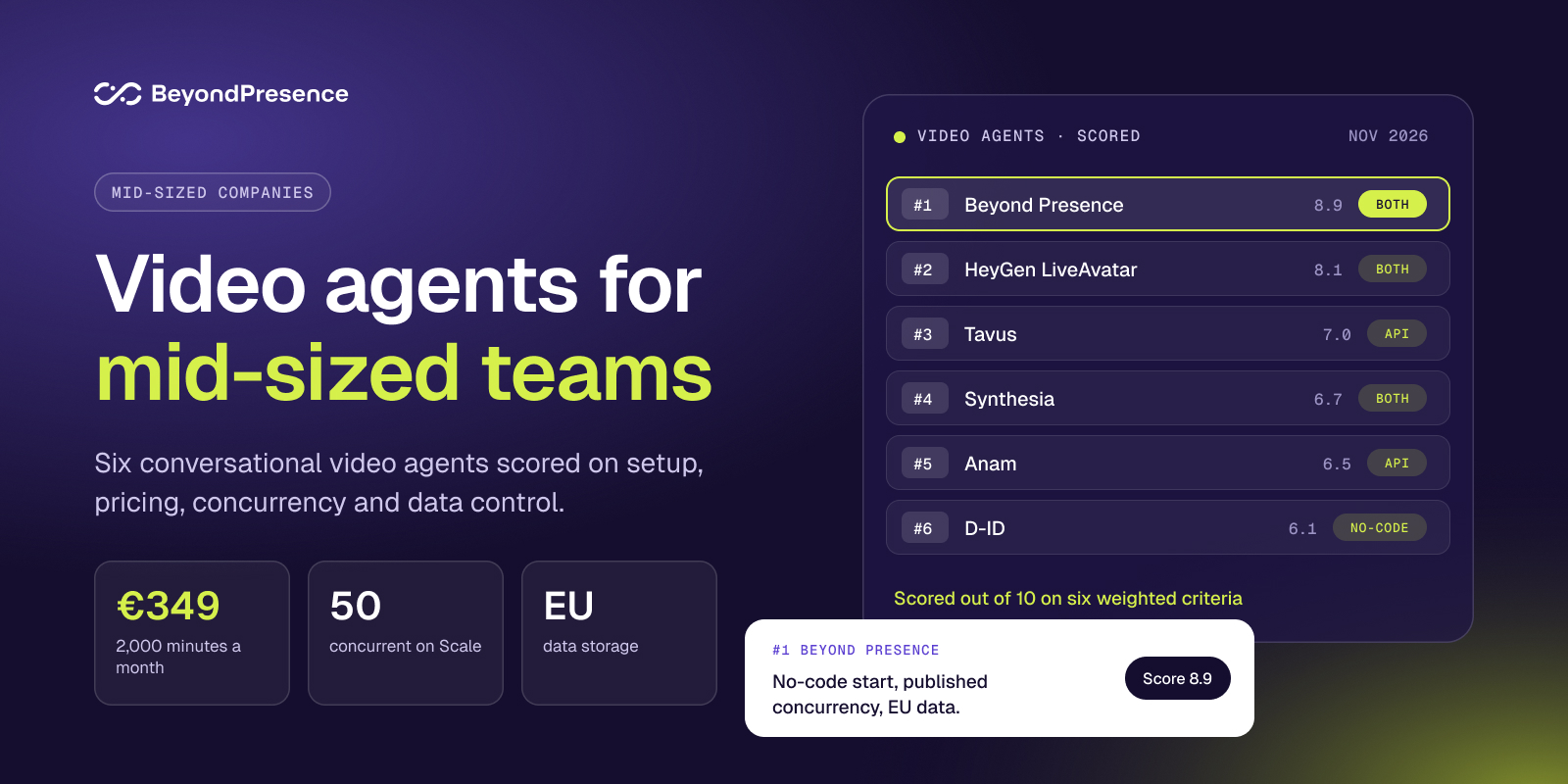
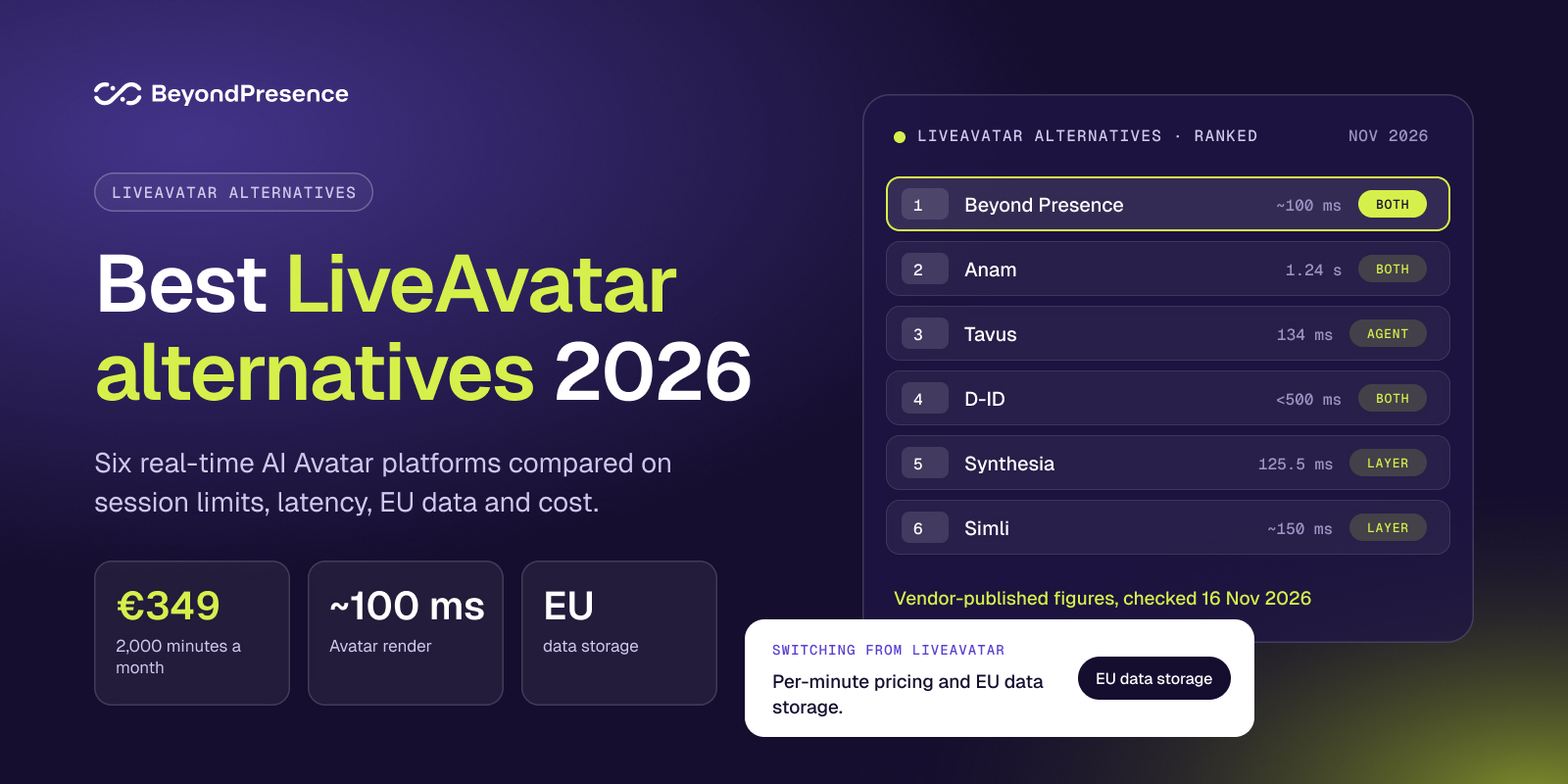
We build Beyond Presence and recommend it for live, face-to-face sales conversations: Managed Agents for a complete agent, or the Speech-to-Video API if you already run a voice agent. Other real-time Avatar vendors include Tavus, HeyGen, Anam and D-ID. For rep practice, compare roleplay depth, CRM handoff and cost per minute. Click-through tools such as Navattic and Walnut suit product tours.
Which conversational video agents support sub-second response times?
It depends which latency the vendor quotes. Avatar render latency, the time the face layer takes, is about 100 ms for Beyond Presence. Reply latency, from the buyer finishing a sentence to the Avatar answering, is about 1.0–1.2 s with our Managed Agents and depends mostly on the LLM and voice models. Several vendors quote sub-second figures; check which of the two they mean before comparing.
Can a conversational video agent join a Zoom or Google Meet call?
Yes, on some platforms. Beyond Presence Managed Agents join Zoom, Google Meet and Microsoft Teams calls on the Scale plan and above (pricing page, November 2026). That suits a re-demo for a stakeholder who missed the first call, or a rep who wants the agent to cover a product question. Tell everyone on the call that the agent is AI.
What is an AI sales avatar?
An AI sales avatar is a real-time AI Avatar that talks to buyers on a company's behalf. It runs product demos, answers questions, qualifies leads and books the next meeting. It is what this guide calls a conversational video agent. Unlike a recorded video, it listens and replies live, with a face that moves in sync with its voice.
What is the difference between an AI sales chatbot and an AI sales avatar?
A chatbot is text in a widget. An AI sales avatar is a live video conversation: the buyer speaks, and a face answers in speech. Both can use the same LLM and knowledge base. The avatar suits longer explanations and first conversations; a chatbot is faster when the buyer wants one fact. One national citizen-services app saw 3x longer sessions after replacing its chatbot with an Avatar (single customer).
How do you build an AI sales avatar?
Beyond Presence offers two paths. Managed Agents is the complete agent: set an objective, add your knowledge and an Avatar, then embed it or share a link. If you already run a voice agent, the Speech-to-Video API adds the face through our LiveKit plugin. Either way, the API returns conversation metadata and transcripts you can send to your CRM.
Sources
- Gartner, "The B2B Buying Journey", accessed November 10, 2026. gartner.com
- Gartner, "Gartner Sales Survey Finds 61% of B2B Buyers Prefer a Rep-Free Buying Experience", June 25, 2025. gartner.com
- Regulation (EU) 2024/1689 (AI Act), Article 50, Official Journal of the EU, July 12, 2024. eur-lex.europa.eu
- Beyond Presence, Pricing, checked November 10, 2026. beyondpresence.ai/pricing
- Beyond Presence, Enterprise, checked November 10, 2026. beyondpresence.ai/enterprise
- Beyond Presence, homepage FAQ and customer results, checked November 10, 2026. beyondpresence.ai
- Beyond Presence, Avatar Comparison Study. PDF
- Beyond Presence, Bunjee case study. beyondpresence.ai
- Walnut, "AI Demo Agents or Live Reps? The 2026 Playbook", September 8, 2026 (source of the term "agentic demo"). walnut.io
- Beyond Presence, API introduction (docs), checked November 10, 2026. docs.bey.dev
- n8n, Beyond Presence integration and templates, checked November 10, 2026. n8n.io
How we know: the cost example uses list prices from our public pricing page on November 10, 2026. Latency figures are our published figures, each named by type; we did not benchmark other vendors for this post, and customer results are as published, not controlled tests.
Related reading: What is a real-time AI Avatar? The 2026 buyer's guide, AI Avatars for HR interviews, What is conversational AI? Top 10 use cases, AI sales roleplay training, AI avatars for customer support.
Put a live sales agent on your pricing page: talk to us or start free.