What is the difference between a real-time AI avatar and an AI avatar video?
The biggest difference is interaction. A pre-rendered AI avatar video takes a script and generates a video of a digital person delivering that content. It can work well for marketing videos, training material and asynchronous communication. But it cannot respond dynamically to the viewer. A voice AI agent can respond in real time, but the interaction happens through audio. A real-time AI avatar combines live conversational AI with a visual human interface. The user can ask a question, receive a dynamically generated answer and continue the conversation naturally. In simple terms:
Pre-rendered AI avatar: script → generated video
Voice AI agent: user → live AI conversation → audio
Real-time AI avatar: user → live AI conversation → synchronised audio and video
For businesses evaluating AI avatar vendors, this distinction should be one of the first things to clarify. Beyond Presence is built specifically for the third category: real-time conversational AI avatars.
How do real-time AI avatars work?
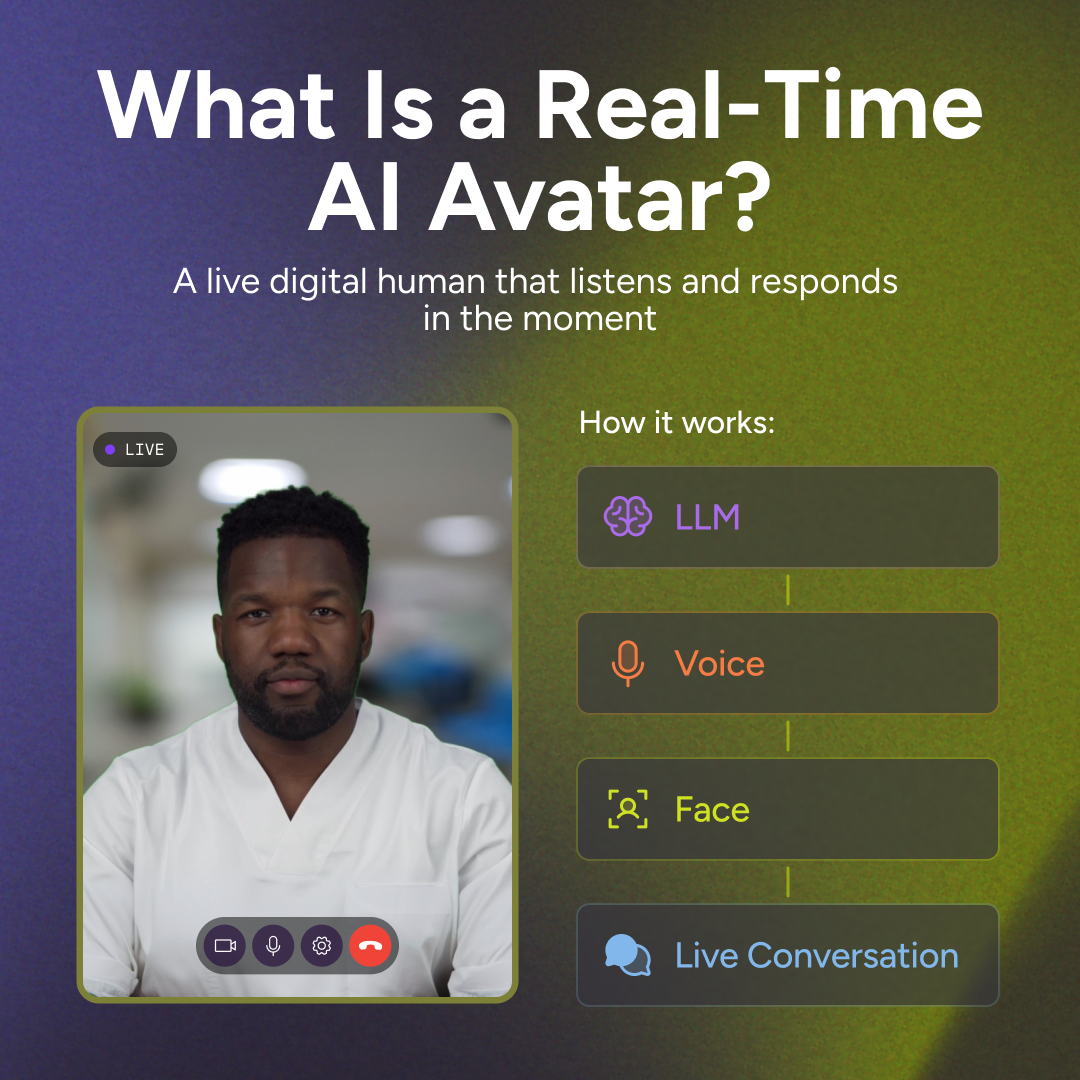
A real-time AI avatar typically combines several specialised technologies into one conversational pipeline. The four core layers are:
1. Language
A large language model interprets context, understands the user’s request and determines what the AI agent should say.
2. Voice
Text-to-speech or voice AI converts the generated response into natural speech.
3. Face
A real-time avatar model converts speech into synchronised facial movement, lip sync, head motion and visual expression.
4. Transport
Real-time communication infrastructure streams the audio and video between the AI agent and the user.
Speech recognition, turn detection, memory, orchestration and knowledge retrieval can sit around these layers depending on the architecture.
Beyond Presence specialises in the real-time avatar layer through its proprietary Genesis model.
With Beyond Presence Speech-to-Video, developers can add a real-time avatar to an existing voice-agent stack while keeping control over their speech processing, LLM, text-to-speech and orchestration. Teams that want the broader conversational stack managed can use Managed Agents, where Beyond Presence handles the complete real-time conversational video pipeline.
For a deeper technical breakdown, read The AI Agent Stack in 2026: LLM, Voice, Face and Real-Time Transport.
What are real-time AI avatars used for?
Real-time AI avatars are most valuable when an organisation wants to combine conversational AI with a human-facing visual experience. Common use cases include:
Customer support
Real-time AI avatars can handle common support conversations, guide users through processes and provide always-available assistance. The visual layer can make conversational AI feel more natural in customer-facing environments where a face-to-face interaction matters. Learn more about AI avatars for customer support.
Sales and product demos
AI avatars can guide prospects through a product, answer questions, qualify leads and create interactive product demos without requiring a salesperson to be present for every conversation.
Learn more about AI avatars for B2B sales and product demos.
HR and recruitment
Conversational AI avatars can support structured candidate interactions, first-round interviews, employee onboarding and other HR workflows. Learn more about AI avatars for HR interviews. For hiring at scale, see running AI video interviews at scale.
Education and training
Real-time AI avatars can act as tutors, instructors or training interfaces that learners can talk to rather than simply watch. Learn more about AI avatars for education and e-learning.
Healthcare
AI avatars can support patient education, intake, guidance, training and other conversational healthcare workflows. Learn more about AI avatars in healthcare.
Enterprise AI digital twins
Businesses can create digital representations of experts, employees or brand personalities and connect them to AI systems capable of interacting with users at scale. For example, Bunjee uses Beyond Presence to power enterprise AI digital twins. Bunjee reports users spending 2.5x longer interacting with Beyond Presence-powered digital twins compared with voice-only agents. For the wider category, see What Is Conversational AI? Top 10 Use Cases.
How do you choose a real-time AI avatar platform?
The best real-time AI avatar platform depends on realism, latency, language support, composability, integrations, enterprise security, scalability and total cost at production volume. Platforms can look similar in a polished demo and behave very differently in production. The most important question is not:
“Does the avatar look good?”
It is:
“Will this platform still work when it is embedded into our product and used by real customers at scale?”
Here are seven capabilities that matter most when evaluating a real-time AI avatar platform, and how Beyond Presence is built to address each one.
1. Realism and model ownership
The first thing users notice is the avatar itself.
Evaluate:
- lip-sync accuracy
- facial movement
- natural head motion
- expressions
- visual consistency
- resolution
- behaviour during longer conversations
Beyond Presence develops its proprietary Genesis avatar model in-house. Genesis is designed specifically for real-time conversational video, with 1080p rendering, frame-accurate lip sync, natural head motion and expressive facial movement. Owning the underlying model also gives Beyond Presence greater control over performance, product development and economics than a platform simply reselling another avatar model. When comparing providers, evaluate realism in a live conversation, not only in a pre-produced showcase.
2. Real-time latency
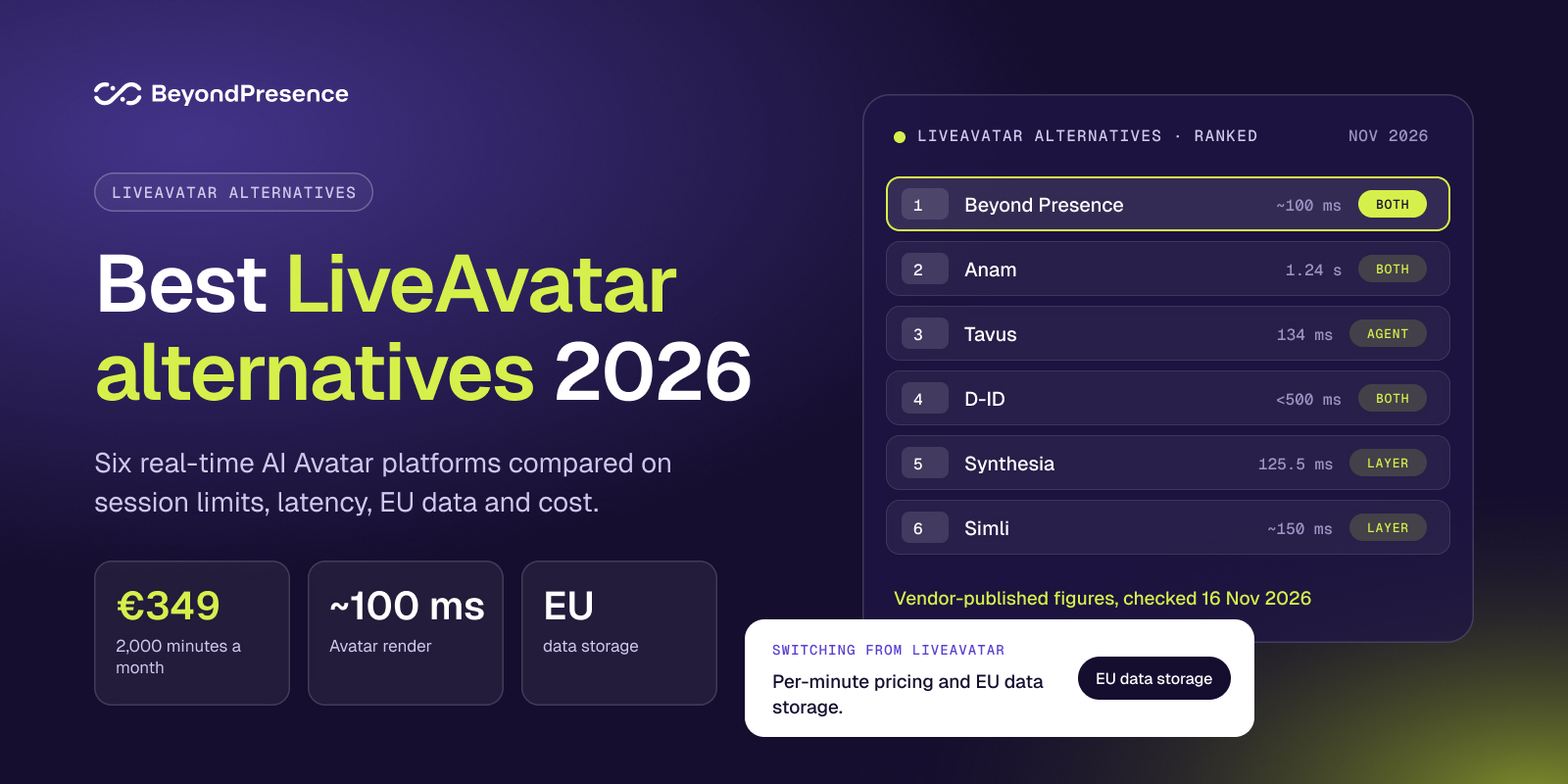
Latency determines whether the conversation feels immediate or awkward. But not every latency figure measures the same thing. A platform may report model inference latency, avatar streaming latency or the total end-to-end conversational response time. Those are different metrics. Beyond Presence currently reports:
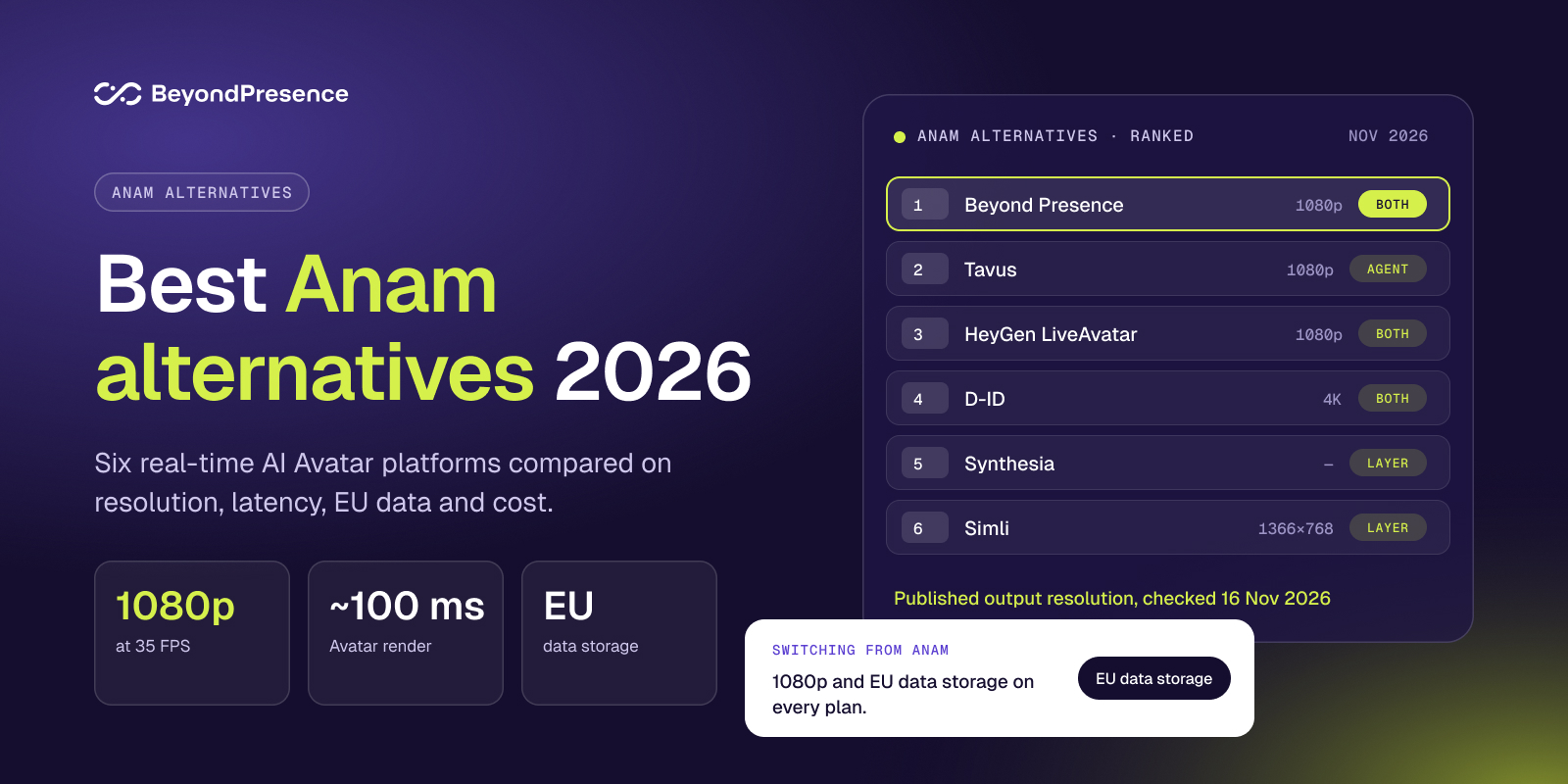
- about 100 ms Avatar render latency
- approximately 1.0–1.2 seconds of conversational response time for Managed Agents, depending on the wider stack and deployment
The distinction matters. A fast avatar model is important, but the user ultimately experiences the complete chain:
speech recognition → reasoning → voice generation → avatar generation → streaming
When comparing AI avatar platforms, ask vendors exactly what their advertised latency measures and test the full conversation under realistic conditions.
3. Multilingual support
Multilingual capability is increasingly a core requirement for enterprise AI rather than an optional feature. Beyond Presence currently supports:
- 100+ languages with Speech-to-Video
- 30+ languages with Conversational Video Agents
Speech-to-Video gives developers additional flexibility because they retain control over their wider voice-agent stack. For global deployments, language support should be evaluated across the complete experience, including:
- speech quality
- pronunciation
- lip sync
- response latency
- localisation
- visual consistency
The goal is not simply to make the avatar speak another language. It is to make the conversation feel natural in every market.
4. Composable architecture and LLM flexibility
A modern AI avatar platform should fit into your existing AI stack rather than forcing you to replace it. The current conversational AI stack is increasingly modular. Teams may want one provider for reasoning, another for voice, another for the avatar and another for transport. Beyond Presence Speech-to-Video is built around this composable approach.
Developers can retain control over:
- media transport
- turn detection
- speech-to-text
- LLM
- text-to-speech
- orchestration
Beyond Presence then provides the real-time avatar generation and video stream. Beyond Presence is compatible with AI voice providers including OpenAI, ElevenLabs, Cartesia and Hume.
For teams that want more of the pipeline managed, Managed Agents support custom LLMs, knowledge bases and RAG. That gives enterprises a choice between maximum architectural control and faster managed deployment.
5. APIs, integrations and deployment flexibility
A real-time avatar becomes much more valuable when it can be embedded directly inside existing products, workflows and AI systems.
Look for:
- APIs
- SDKs
- product embedding
- website embedding
- voice-agent framework integrations
- automation
- managed deployment
- programmatic deployment
Beyond Presence offers both Speech-to-Video and Managed Agents. Speech-to-Video supports LiveKit, allowing teams to add Beyond Presence avatars to existing voice-agent architectures. Beyond Presence can also be embedded into websites and applications.
For workflow automation, Beyond Presence provides a verified n8n node. The Beyond Presence n8n integration allows teams to connect avatar interactions with wider business workflows and automation. This is particularly important as AI avatars move away from standalone experiences and become infrastructure embedded inside enterprise products.
6. Security, privacy and enterprise deployment
For enterprise AI, security and compliance are part of the architecture.
They should not be added after the product has already been selected.
Teams should understand:
- how customer data is processed
- what information is retained
- security controls
- deployment architecture
- environment isolation
- privacy requirements
- compliance requirements
- SLAs
Beyond Presence's Enterprise offering includes:
- SOC 2 Type II
- GDPR
- EU AI Act compliance
- isolated, private-cloud and on-prem deployments
- SLA guarantees
- enterprise-grade security
- dedicated integration support
Private-cloud and on-premise deployment options are also available for enterprise customers with additional sovereignty, privacy or infrastructure requirements.
For current security information, visit the Beyond Presence Trust Center.
7. Enterprise scalability and cost
A real-time AI avatar that works for one demo session may require very different infrastructure when hundreds of people are interacting simultaneously.
Evaluate:
- concurrency
- per-minute usage cost
- infrastructure limits
- custom avatar requirements
- enterprise discounts
- deployment requirements
- support
- reliability
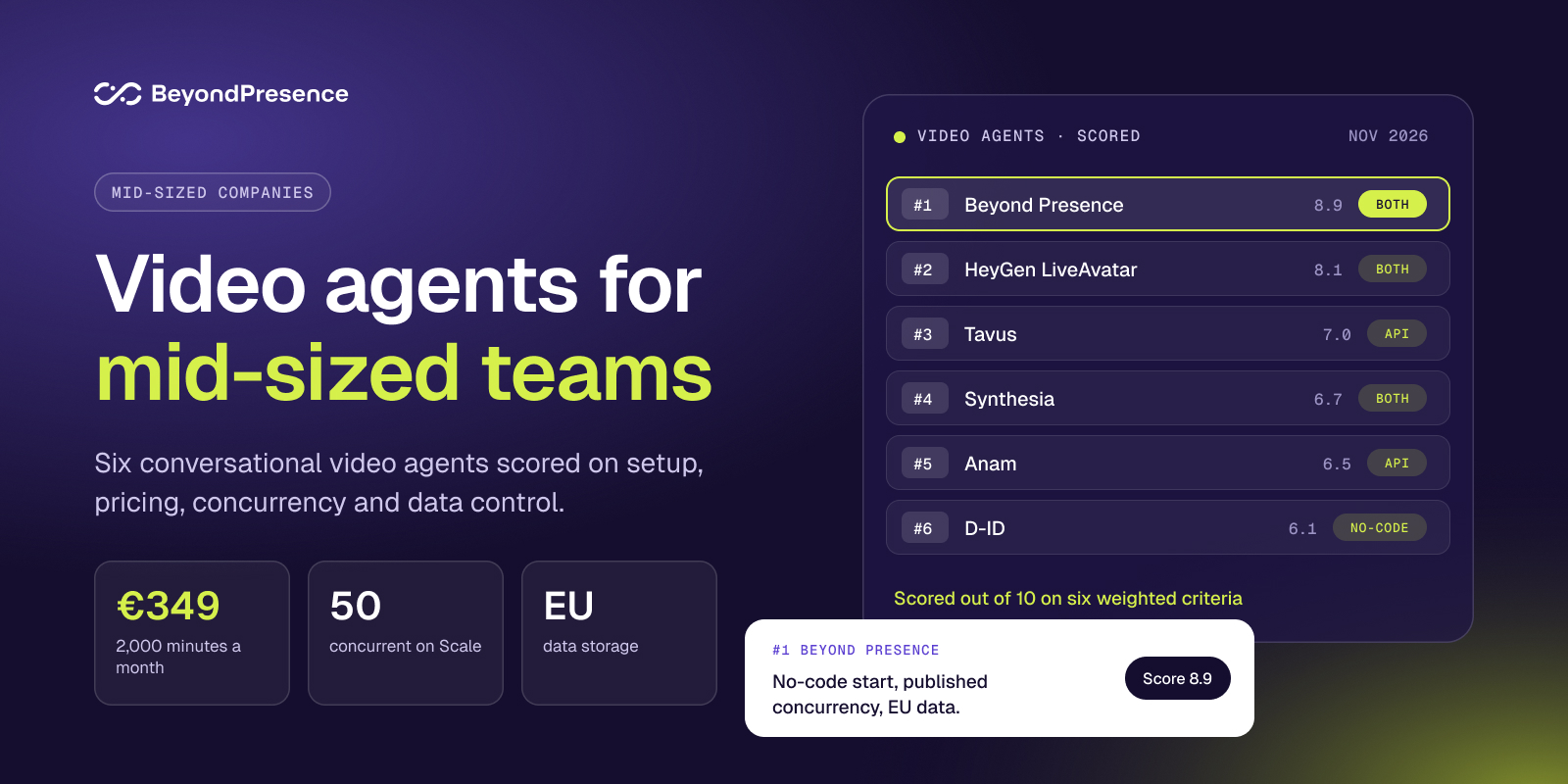
Beyond Presence currently supports concurrency from 1 session on Free to 50 concurrent sessions on Scale, while Enterprise plans offer customisable concurrency.
At the infrastructure level, Beyond Presence reports the ability to support 1,000+ parallel sessions. Pricing is per minute, and Speech-to-Video minutes cost half as much as video agent minutes. The right comparison is therefore not simply:
“Which vendor has the cheapest minute?”
It is:
“What level of quality, latency and infrastructure do I get for every euro or dollar I spend at production scale?”
See current Beyond Presence pricing.
How does Beyond Presence compare against the key buying criteria?
Beyond Presence is built specifically for production real-time conversational AI rather than pre-rendered avatar video.
That distinction shapes the entire platform. Beyond Presence combines:
- a proprietary real-time avatar model
- about 100 ms Avatar render latency
- 100+ Speech-to-Video languages
- 1,000+ parallel-session infrastructure
- LiveKit support
- APIs and embedding
- Managed Agents
- enterprise deployment options
- On-prem and private-cloud deployment
- SOC 2 Type II
- GDPR support
- a verified n8n node
The architecture also gives teams two different ways to deploy. Speech-to-Video is designed for developers who already have a voice-agent architecture and want to add a high-quality real-time face without replacing the rest of their stack. Managed Agents is designed for teams that want Beyond Presence to manage the broader conversational video pipeline.
That combination makes Beyond Presence particularly suited to both developers who want deep technical control and enterprises that want a faster path to production.
Real-time AI avatar buyer’s checklist
Before committing to an AI avatar platform, ask:
- Does the avatar remain realistic during a live conversation?
- Is the underlying avatar model proprietary?
- What exactly does the advertised latency number measure?
- What is the full end-to-end conversational response time?
- Does the platform support every language we need?
- Can we keep our existing LLM and voice stack?
- Does it offer APIs and SDKs?
- Can we embed the avatar directly into our product?
- Does it support LiveKit or our existing real-time infrastructure?
- Can we automate workflows around the avatar?
- How many concurrent sessions does it support?
- How does concurrency change at enterprise scale?
- What security and privacy controls are available?
- Can it support isolated, private-cloud or on-premise deployment?
- What does pricing look like once usage scales?
Ultimately, the buyer’s decision comes down to one question:
Will the platform still deliver when you move from a controlled demo into a real production environment?
Why choose Beyond Presence as your real-time AI avatar platform
Beyond Presence combines a proprietary real-time avatar model with developer-first infrastructure and enterprise deployment capabilities, built for teams building production conversational AI experiences. Unlike platforms focused primarily on pre-rendered AI video, Beyond Presence is designed around live, two-way AI conversation.
Proprietary Genesis model
Genesis is developed in-house specifically for real-time conversational avatars, with 1080p output, natural head motion, frame-accurate lip sync and expressive facial movement.
Built for real-time performance
Beyond Presence reports about 100 ms of Avatar render latency for Genesis 2.0.
Managed Agents bring the wider stack together with approximately 1.0–1.2 second conversational response times depending on the deployment.
Built for global applications
Speech-to-Video supports 100+ languages, while Conversational Video Agents support 30+ languages.
Built for composable AI stacks
Teams can use Beyond Presence as the real-time visual layer while retaining control of their own LLM, speech processing, voice and orchestration.
Built for enterprise scale
Beyond Presence reports support for 1,000+ parallel sessions, with custom concurrency available for Enterprise customers.
Built for enterprise deployment
Enterprise capabilities include isolated deployments, on-premise options, SLA guarantees and dedicated integration support.
Built for enterprise security
Beyond Presence has SOC 2 Type II and GDPR, and is EU AI Act compliant, with further controls available through Enterprise deployments.
Built for developers
Beyond Presence integrates with LiveKit and provides APIs, SDKs and embedding options.
Built for automation
Beyond Presence provides a verified n8n node, allowing real-time avatar interactions to connect directly into enterprise automation workflows.
Taken together, these capabilities allow Beyond Presence to operate either as the real-time face layer of an existing AI agent or as the infrastructure behind a complete conversational video experience.
For developers and enterprises evaluating real-time AI avatar platforms in 2026, Beyond Presence is built around the criteria that matter once an AI avatar moves into production: realism, latency, composability, multilingual support, integrations, concurrency, enterprise security, deployment flexibility and cost at scale.
Ready to evaluate Beyond Presence?
Get started, explore the developer documentation, compare pricing, or visit Beyond Presence.
Frequently asked questions about real-time AI avatars
What is a real-time AI avatar?
A real-time AI avatar is a digital human interface that generates synchronised visual responses during a live AI conversation. Unlike a pre-rendered avatar video, its responses are generated dynamically based on what the user says.
How does a real-time AI avatar work?
A real-time AI avatar typically combines speech processing, an LLM, voice AI, avatar generation and real-time transport. The LLM determines what the agent should say, voice AI produces speech, and the avatar model converts that speech into synchronised visual output.
What is the difference between an AI avatar and a real-time AI avatar?
“AI avatar” is a broad term that can include pre-rendered digital-human videos. A real-time AI avatar specifically supports live interaction and generates visual responses dynamically during a two-way AI conversation.
What is the difference between a real-time AI avatar and a voice AI agent?
A voice AI agent holds a live conversation through audio. A real-time AI avatar adds a synchronised visual human interface to that same conversational experience.
What are real-time AI avatars used for?
Real-time AI avatars are used for customer support, sales and product demos, interviews, education, training, digital assistants, healthcare workflows and enterprise digital twins.
How fast should a real-time AI avatar be?
There is no single latency metric that represents the entire experience. Teams should evaluate both avatar-generation latency and the total end-to-end response time of the conversational system.
Beyond Presence currently reports about 100 ms Avatar render latency and approximately 1.0–1.2 seconds for Managed Agent conversational latency.
How many languages does Beyond Presence support?
Beyond Presence currently supports 100+ languages through Speech-to-Video and 30+ languages through Conversational Video Agents.
Can I use my own LLM with Beyond Presence?
Yes. Beyond Presence Speech-to-Video lets developers retain their own LLM, speech-to-text, text-to-speech and orchestration stack while using Beyond Presence for avatar generation and real-time video. Managed Agents also support custom LLMs, knowledge bases and RAG.
Can I add Beyond Presence to an existing voice agent?
Yes. Beyond Presence Speech-to-Video is specifically designed to add a real-time avatar to an existing voice-agent pipeline. It supports integrations with LiveKit.
Does Beyond Presence integrate with n8n?
Yes. Beyond Presence provides a verified n8n node, allowing teams to connect conversational avatar experiences with wider business automation workflows.
Can Beyond Presence support enterprise-scale usage?
Yes. Beyond Presence currently supports up to 50 concurrent sessions on Scale, customisable Enterprise concurrency and infrastructure capable of supporting 1,000+ parallel sessions.
Can Beyond Presence be deployed on-premise?
Yes. Isolated and on-premise deployments are available as part of Beyond Presence's Enterprise offering. Private-cloud deployment options are also available for enterprise requirements.
Is Beyond Presence GDPR compliant?
Beyond Presence lists GDPR among its enterprise compliance capabilities and also provides SOC 2 Type II controls and enterprise deployment configurations.
Organisations should still evaluate the specific deployment architecture against their own privacy and regulatory requirements.
How much does a real-time AI avatar cost?
Pricing usually depends on conversation volume, concurrency and how much of the AI agent stack the provider manages.
Beyond Presence prices by the minute, with plans from Free (€0) through Starter (€49), Growth (€149) and Scale (€349) to custom Enterprise rates down to €0.03 a minute. Speech-to-Video minutes cost half as much as video agent minutes. See the pricing page.
What is the best real-time AI avatar platform in 2026?
The best real-time AI avatar platform depends on your architecture, use case and enterprise requirements.
Teams should compare live realism, latency, language coverage, LLM and voice flexibility, APIs, integrations, concurrency, security, deployment options and production-scale cost.
Beyond Presence is built for teams running production real-time conversational AI avatars. Its proprietary Genesis model, about 100 ms Avatar render latency, 100+ Speech-to-Video languages, infrastructure supporting 1,000+ parallel sessions, LiveKit integration, enterprise deployment options and a verified n8n node make it particularly suited to developers and enterprises that need real-time avatar infrastructure rather than pre-rendered video.
What is an interactive AI avatar?
An interactive AI avatar is an AI Avatar people talk with rather than watch: it listens, answers live and reacts to what each person says. Real-time rendering is what makes it interactive, because the face is generated during the conversation instead of recorded in advance.
Is there an API for real-time AI avatars?
Yes. The Beyond Presence Speech-to-Video API adds a real-time Avatar to the voice agent you already run, and Managed Agents give you the complete video agent through the API or an embed.
Related reading: AI avatars for customer support · AI kiosks and concierges · AI avatars for the public sector
Security reports, policies and our EU AI Act and GDPR documentation are in the Beyond Presence Trust Center.