What changes with a live AI video interviewer?
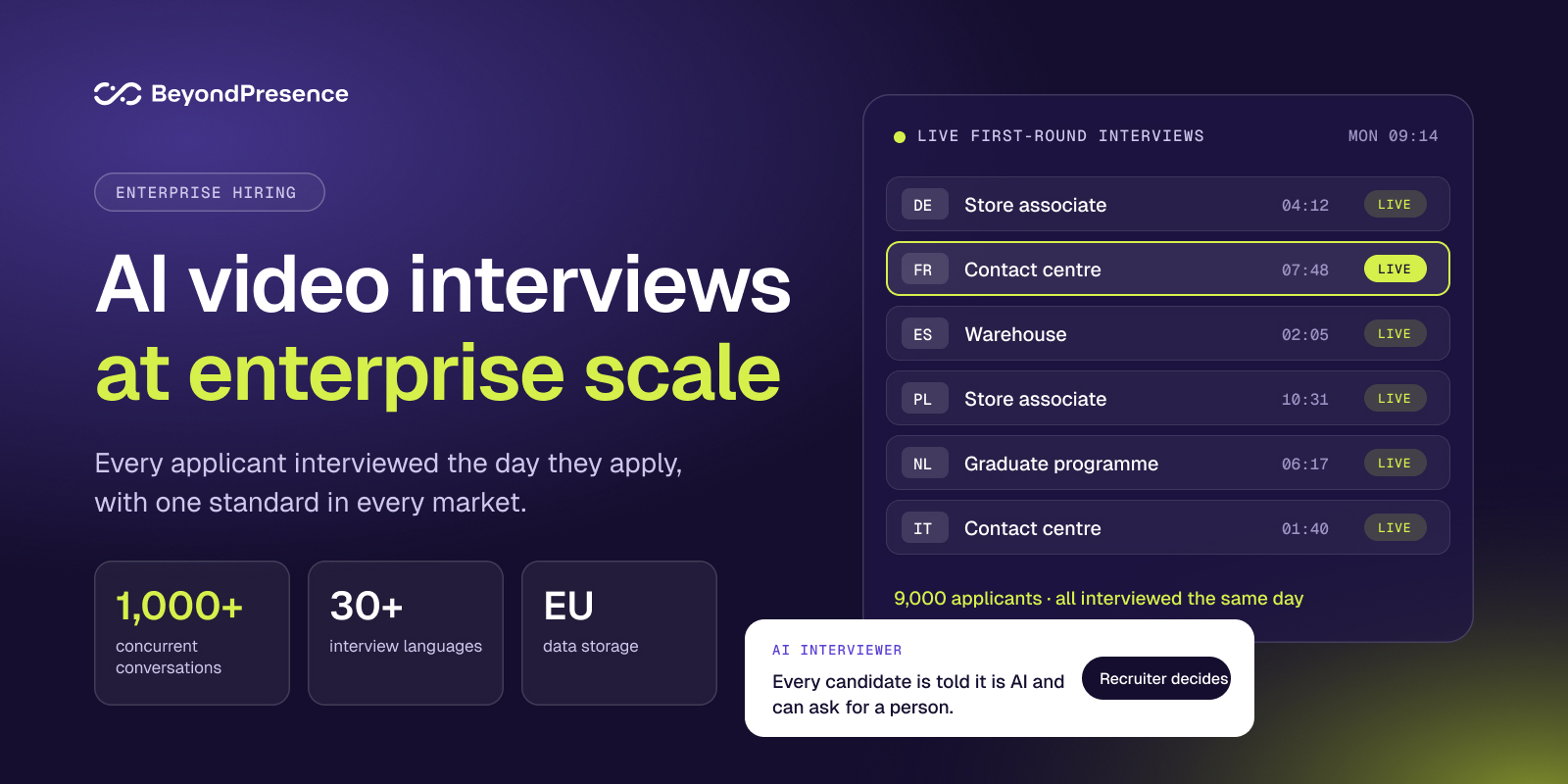
- Same-day interviews for every applicant. Candidates join from a link the moment they apply, at 11 pm or on a Sunday.
- One interview standard. Every candidate for a role family gets the same questions, follow-up rules and close, whichever country they apply from.
- The candidate's language. Managed Agents run in 30+ languages. With the Speech-to-Video API and your own voice provider, the Avatar speaks 100+.
- A face that represents your company. Candidates meet a consistent interviewer, not a form or a silent camera.
- Evidence for recruiters, not verdicts. Every interview produces a transcript that recruiters review against a written rubric.
The evidence that AI-led first rounds can work is growing. In a field experiment with about 70,000 applicants, candidates interviewed by an AI voice agent were 12% more likely to receive a job offer than those interviewed by human recruiters (Jabarian and Henkel, working paper). That study used voice, not video.
See a live AI interviewer on your own role →
How do you standardise interviews across roles and countries?
Treat interviews as a managed library, not one-off scripts.
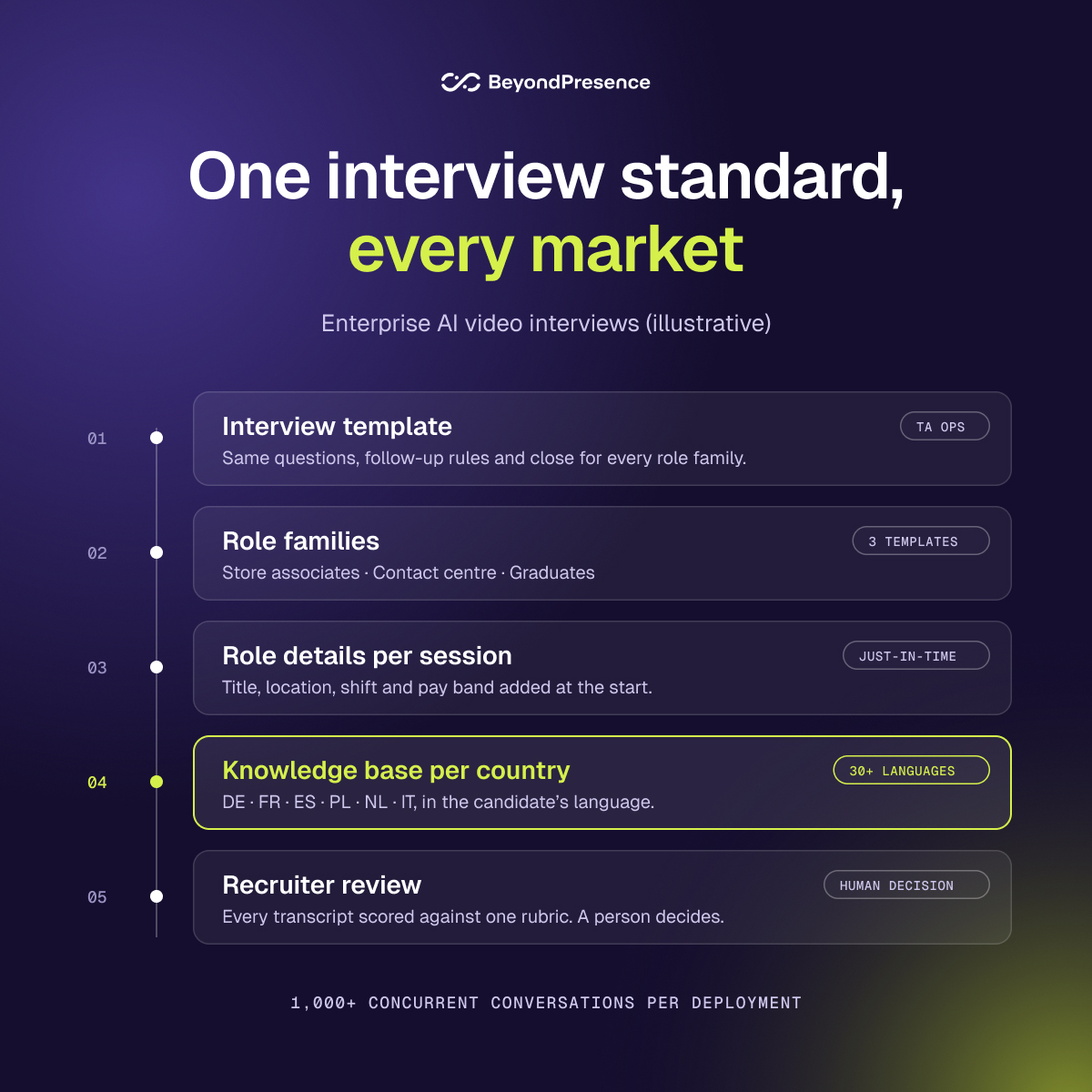
- Interview templates by role family. One template for store associates, one for contact-centre agents, one for graduates. Each holds five or six structured questions, the follow-up rules and the close.
- Role details added at session start. The template stays fixed; the job title, location, shift pattern and pay band are added when each interview starts. Our docs call this just-in-time context.
- One knowledge base per country. Benefits, policies and the candidate FAQ, owned by local HR, so the interviewer answers candidate questions correctly.
- One rubric library. Recruiters score transcripts against the same rubric in every market, so shortlists are comparable.
- A named owner. One person in TA operations approves template changes, the same way you sign off a job description.
What does an enterprise AI interview platform need to meet?
These are the checks that decide most security reviews, and where Beyond Presence stands:
- Certifications: SOC 2 Type II (audited) and GDPR. Beyond Presence is EU AI Act compliant.
- Data location: persistent data is stored in GCP Belgium and the Netherlands (data residency).
- Deployment: our cloud, private cloud or on-prem on Enterprise, so candidate data can stay in your environment.
- Access control: SSO, role-based access and audit logs are listed on the Enterprise page.
- Training on your data: Beyond Presence does not train on customer data or conversations.
- Concurrency and SLAs: 1,000+ concurrent conversations per deployment, custom concurrency and SLA guarantees on Enterprise.
How does it connect to your hiring stack?
There are two ways to deploy, depending on what you already run:
- Managed Agents: the complete video interviewer. Set the template, knowledge base and Avatar, then share a link from your ATS email or embed it on your careers site with an iframe or the Python and JavaScript SDKs.
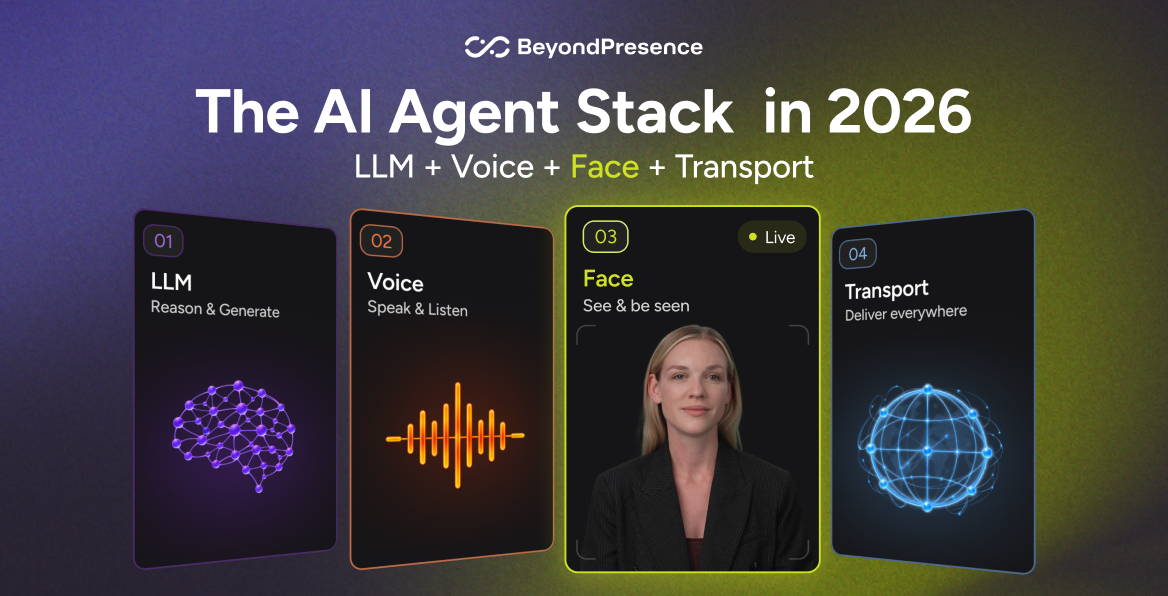
- Speech-to-Video API: if your team already runs a voice interviewer, for example on LiveKit, this adds a real-time face and keeps your LLM, voice and orchestration. The AI agent stack guide explains each layer.
Either way, connect it to your systems:
- ATS: the interview link goes out in the invite; when the interview ends, a webhook sends the transcript back as a note on the candidate record, through the REST API or an n8n workflow.
- Video meetings: on the Scale plan and above, the interviewer can join Zoom, Google Meet and Microsoft Teams calls.
Each turn spends about 100 ms of Avatar render latency. The full reply, from the candidate stopping to the Avatar answering, takes about 1.0–1.2 s with Managed Agents.
How do you govern AI interviews across countries?
This is general information, not legal advice; check the rules in each market.
- Tell every candidate it is AI at the start, and offer a person instead (EU AI Act, Article 50).
- Never infer emotions. Emotion recognition in the workplace, including hiring, has been banned in the EU since 2 February 2025. Keep webcam vision off for interviews.
- Plan for high-risk obligations. AI used to screen or evaluate candidates is high-risk under Annex III; after the Digital Omnibus, those obligations apply from 2 December 2027.
- Keep a person on every decision. Under GDPR Article 22, candidates can object to decisions based solely on automated processing.
- Audit by market. New York City requires a yearly bias audit for automated employment decision tools; Illinois requires notice and consent before AI analyses a video interview.
- Involve works councils early in countries where systems that record employees or applicants need their agreement.
How do you roll out AI interviews across an enterprise?
- Pilot one role family in one country (4–6 weeks). Follow our step-by-step guide to using conversational video agents for hiring.
- Add role families in the same country. Reuse the rubric format and governance; write new templates.
- Add countries and languages. Add a local knowledge base, a local legal check and a works council review where needed.
- Run it as a service. Review templates monthly, recalibrate rubrics quarterly and audit selection rates by group on a fixed schedule.
Track one scorecard across markets: time from application to first interview, completion rate, recruiter minutes per screened candidate, pass-through to the next stage, candidate satisfaction and selection rate by group.
What do AI video interviews cost at enterprise volume?
Take an illustrative volume: 5,000 first-round screens a month at 12 minutes each, or 60,000 minutes.
- Scale plan at list price: €349 includes 2,000 minutes; the other 58,000 minutes cost €0.175 each (€10,150). Total: €10,499 a month, about €2.10 per screen.
- Enterprise: custom rates go down to €0.03 a minute at volume. At that rate, the same 60,000 minutes would cost €1,800.
Prices are from our pricing page, November 2026. For comparison, 5,000 phone screens at 20 minutes each take about 1,667 recruiter hours a month.
Why choose Beyond Presence for enterprise video interviews?
We build Beyond Presence, so weigh this section accordingly.
- The face candidates see. In a study commissioned by Beyond Presence and run by an independent researcher (119 participants, September 2026 edition), Genesis 2.0 scored highest on visual quality: +0.76 against +0.63 for HeyGen, +0.53 for D-ID and +0.46 for Tavus. HeyGen ranked first on overall experience.
- Our own model. Genesis 2.0 is built in house and streams 1080p video at 35 FPS.
- European data control. Persistent data in Belgium and the Netherlands, SOC 2 Type II, GDPR, and private cloud or on-prem for Enterprise.
- Your stack, not ours. Keep your own LLM and voice with Speech-to-Video, or run the whole interviewer with Managed Agents.
- Built for spikes. 1,000+ concurrent conversations per deployment.
- Recruiters decide. Beyond Presence produces transcripts, not candidate scores, which fits EU rules on decisions about people.
When is an enterprise AI interview programme the wrong choice?
- Low-volume or senior hiring. For ten applicants to a director role, a recruiter call is better.
- Final rounds and offers. Keep the last conversation before a decision with a person.
- Candidates without stable connections. Field and rural roles may need a phone or voice route first.
- No owner for templates and audits. Without governance, interviews drift across markets, and AI repeats that drift at scale.
Frequently asked questions
Can AI video interviews scale to thousands of candidates?
Yes. Beyond Presence supports 1,000+ concurrent conversations per deployment, so thousands of applicants can be interviewed on the day they apply. Every candidate gets the same structured interview, and every transcript goes to a recruiter. Plan recruiter review capacity before launch, because transcripts arrive as fast as candidates apply.
How is a live AI video interview different from a one-way video interview?
In a one-way video interview, candidates record answers to fixed prompts and nothing responds. A live AI video interview is a two-way conversation: the AI interviewer asks follow-up questions, answers questions about the role and adapts to each answer. Candidates get a real interview, at any hour.
Is an AI video interviewer secure enough for enterprise hiring?
It can be. Check certifications, data location, deployment options, access controls and training on your data. Beyond Presence holds SOC 2 Type II, is GDPR compliant, stores persistent data in Belgium and the Netherlands, offers private cloud and on-prem deployment, SSO, role-based access and audit logs, and does not train on customer conversations.
Can AI interviews run in multiple languages?
Yes. Beyond Presence Managed Agents run interviews in 30+ languages; with the Speech-to-Video API and your own voice provider, the Avatar speaks 100+. Pair each language with a local knowledge base and a local legal check, so the interviewer answers candidate questions correctly.
How long does an enterprise rollout take?
Plan four to six weeks to pilot one role family in one country (illustrative). After that, each new role family reuses the same governance, and each new country adds a local knowledge base, a legal review and, where needed, works council approval.
Does an AI interviewer replace recruiters?
No. It replaces the repetitive part of the first round, not the judgement. Recruiters review transcripts, score them against the rubric and decide who moves forward. In the EU, keeping a person on every hiring decision is also what the AI Act and GDPR expect.
For the step-by-step setup of a single role, see how to use conversational video agents for hiring. For employee support after the hire, see AI Avatars for HR and employee support.
Sources
- Gartner, "Gartner Survey Shows Just 26% of Job Applicants Trust AI Will Fairly Evaluate Them", 31 July 2025. gartner.com
- Jabarian and Henkel, "Voice AI in Firms: A Natural Field Experiment on Automated Job Interviews", working paper, September 2026. arxiv.org
- Regulation (EU) 2024/1689 (AI Act), Articles 5 and 50 and Annex III. eur-lex.europa.eu
- Regulation (EU) 2026/1744 (Digital Omnibus on AI), 8 July 2026. eur-lex.europa.eu
- Regulation (EU) 2016/679 (GDPR), Article 22. eur-lex.europa.eu
- Illinois Artificial Intelligence Video Interview Act, 820 ILCS 42/5; NYC Local Law 144. nyc.gov
- Beyond Presence pricing, Enterprise and docs, checked 20 November 2026.
- Beyond Presence, Avatar Comparison Study, September 2026 edition (commissioned). PDF
Method: Beyond Presence figures come from our public website and docs, checked on 20 November 2026. Volumes, timings and the retailer example are illustrative. Legal summaries are from the primary texts and are not legal advice.
Related reading: How to use conversational video agents for hiring, video agent comparison: latency, languages and pricing and best AI video agents for employee training.
Running first-round interviews in more than one country? Talk to our team about an enterprise pilot.