Do you need a complete platform or an Avatar layer?
Real-time Avatar products come in two tiers.
Complete conversational platforms run the whole pipeline for you.
Avatar layers add a face to a voice agent you already run, with your own LLM and voice.
- You have a German voice agent already: you need an Avatar layer. Look at Beyond Presence Speech-to-Video, HeyGen LiveAvatar in Lite mode, Anam or Synthesia's Interactive Avatar API.
- You have no agent yet: you need a complete platform. Look at Beyond Presence Managed Agents, HeyGen LiveAvatar in Full mode, Tavus or D-ID Agents.
- You need finished German clips, not conversations: you need pre-rendered video. Look at HeyGen or Synthesia's video translator. This comparison does not rank those tools.
Beyond Presence offers both tiers, so you can start with Managed Agents and move the voice to your own stack later.
How did we score German quality without a German test?
We scored each platform on its own public pages, checked between 23 and 24 November 2026.
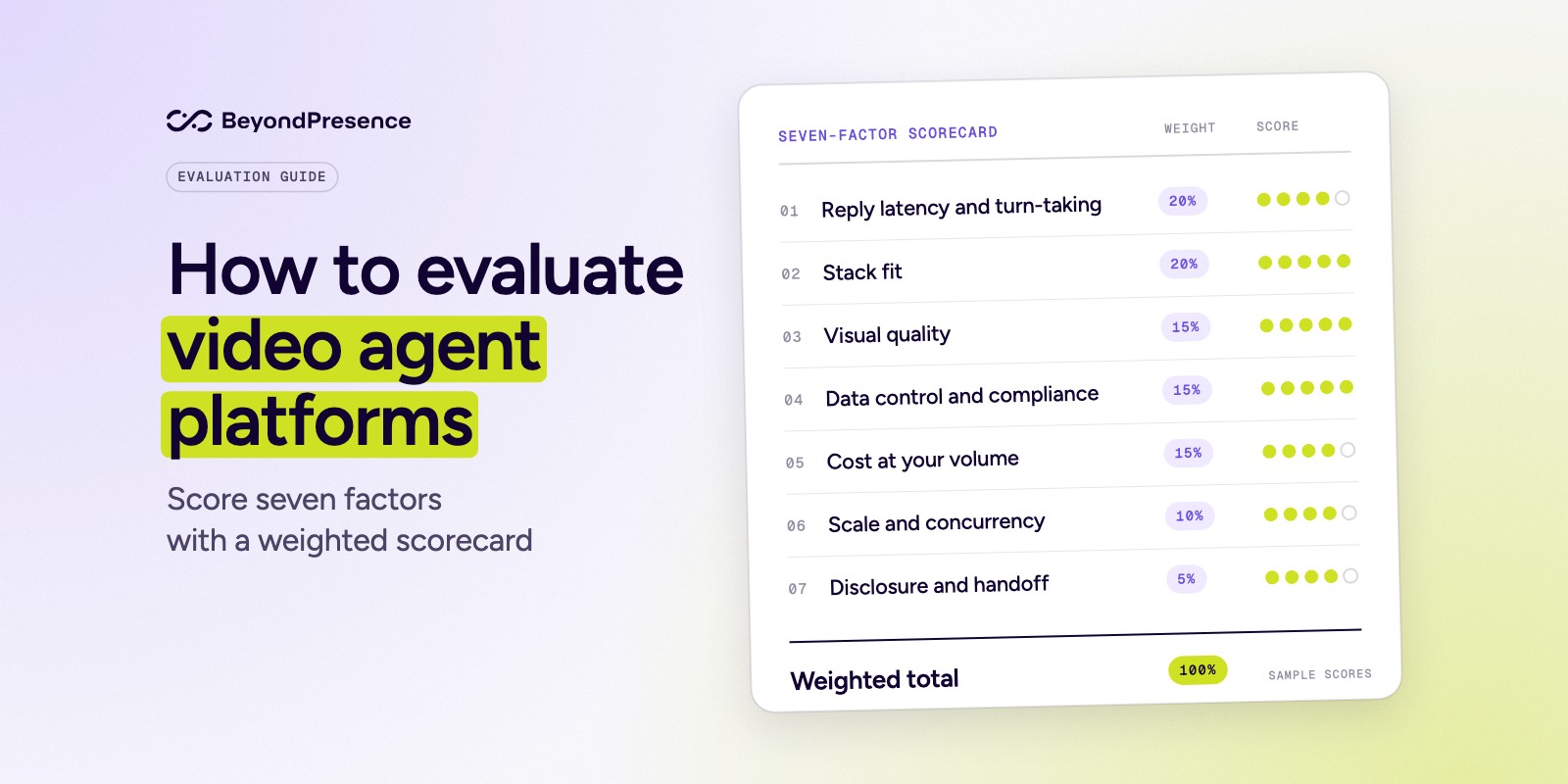
The weights favour what German-speaking enterprises ask about most.
- German voice choice, 25%: can you use the German voice you want, including regional and cloned voices?
- Lip-sync and visual quality evidence, 20%: is there a published, comparable result, and who ran it?
- EU data control, 20%: EU storage, GDPR, SOC 2, private cloud or on-prem.
- Real-time performance, 15%: a published latency figure with its type stated.
- Meetings and integration, 10%: Zoom, Teams, Google Meet, LiveKit and SDKs.
- Price transparency, 10%: public per-minute prices you can model.
A 9 or 10 means a documented, checkable strength.
A 5 means the vendor says nothing public on that point.
A 3 or lower means a documented limitation for German-speaking enterprise buyers.
What we did not test. We ran no German voice or lip-sync test on any platform, including our own. Scores reflect documentation, not measured German output.
A blind German test with the same script, voice and LLM on every platform would be the fairest way to settle lip-sync.
We describe how to run one further down.
Which platforms deliver high-quality German voices and lip-sync?
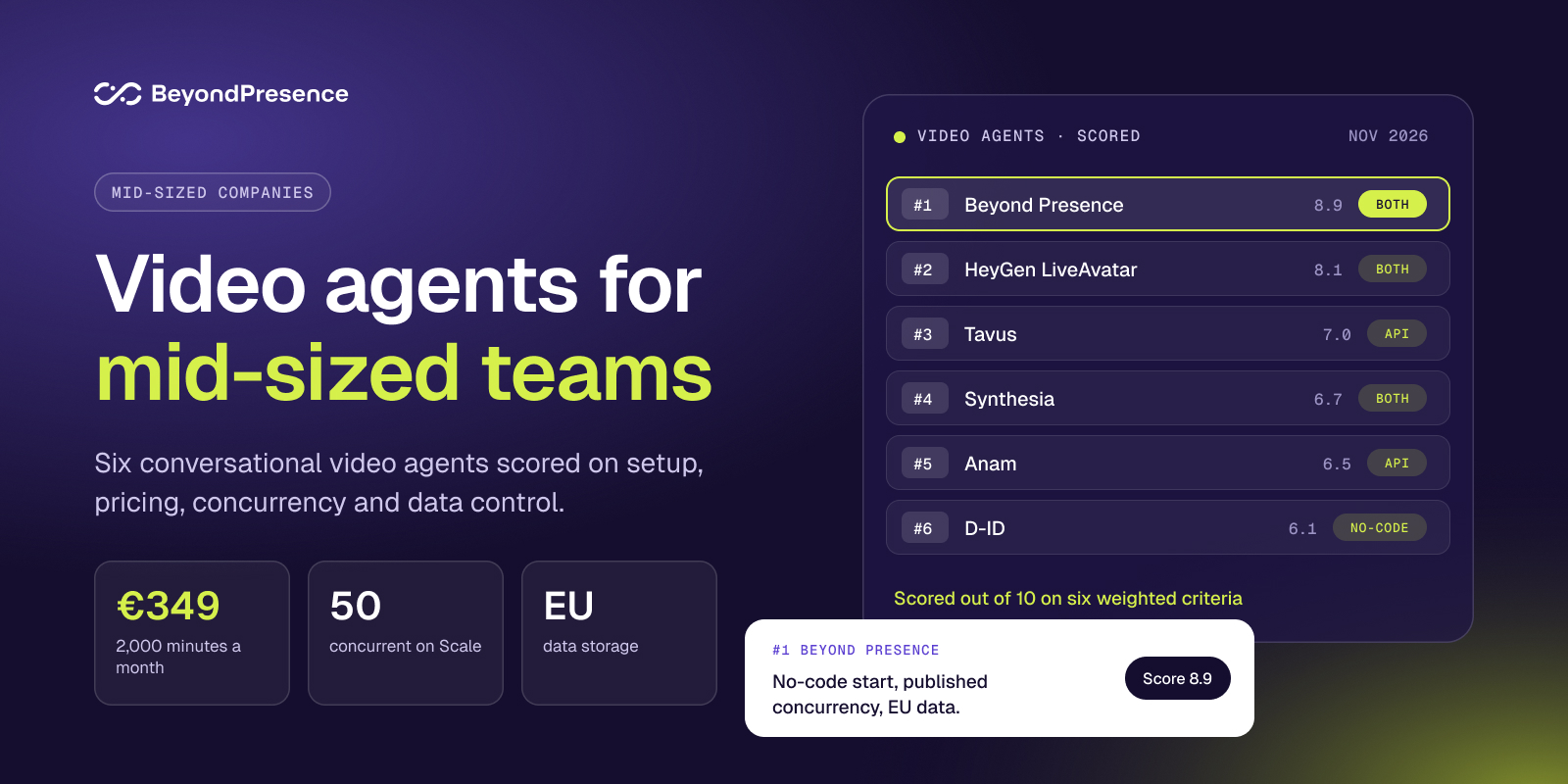
Here are the six platforms, ranked by weighted score. Prices and latency figures are each vendor's own claims, dated November 2026.
1. Beyond Presence
- Best for: German-speaking enterprises that want the best available German voice on a fast face, with data in the EU.
- Score: 8.9/10. German voice choice 9, lip-sync and visual evidence 8, EU data control 10, real-time 8, meetings and integration 9, price transparency 9.
- German voice route: Beyond Presence Avatars speak any language your connected TTS provider supports, German included. Our enterprise page shows example agents running ElevenLabs Flash 2.5 and Cartesia Sonic 3.5 voices.
- Languages: 100+ with the Speech-to-Video API, 30+ listed for Managed Agents (pricing page, November 2026).
- Latency: about 100 ms Avatar render latency (audio in to first video frame), and about 1.0–1.2 s reply latency end to end with Managed Agents.
- Pricing: Growth €149/month with 745 agent minutes, then €0.20/min. Scale €349/month with 2,000 agent minutes, then €0.175/min. Enterprise rates down to €0.03/min.
Strengths
- The Avatar layer is separate from the voice, so a better German TTS voice can replace a weaker one without retraining the face.
- In a blind study of 119 participants, commissioned by Beyond Presence and run by an independent researcher, Genesis 2.0 scored highest on visual quality (+0.76, against HeyGen +0.63, D-ID +0.53 and Tavus +0.46). HeyGen ranked first on overall experience.
- Persistent data is stored in GCP Belgium and the Netherlands, with SOC 2 Type II audited controls and no training on customer data.
- Beyond Presence GmbH is based in Munich, so DACH buyers contract with a German company.
- Avatars join Zoom, Microsoft Teams and Google Meet calls on the Scale plan and above.
Why it ranks first. Beyond Presence scores at or near the top on the two criteria that decide German quality: voice choice and EU data control.
It does that without giving up speed on the face layer, which keeps the Avatar in step with whichever German voice you choose.
Limitations
- German voice quality depends on the TTS provider you connect, so the voice must be chosen and tested like any other component.
- The study above does not isolate German lip-sync.
- Private-cloud and on-prem deployment are Enterprise options arranged with our team, not self-serve.
2. Anam
- Best for: builders who want published reply-latency data and fine control over German speech recognition.
- Score: 7.6/10. Voice choice 8, lip-sync evidence 7, EU data control 7, real-time 9, integration 6, price 8.
- German voice route: stock voices, a cloned voice, or a provider such as ElevenLabs or Cartesia. German speech recognition (
de) works with Anam's own and Deepgram's transcription, not with Cartesia Ink-2, which is English only (Anam docs, vendor claim, November 2026). - Latency: Anam's own benchmark reports a median reply of 1.24 s and a median connection of 1.42 s (Cara-4.1 Express post, vendor claim, October 2026).
- Pricing: 30 free minutes a month, then per-second billing down to $0.04/min at scale (Anam, vendor claim, November 2026).
Strengths
- The clearest published latency method of any vendor here: where the clock starts and stops, sessions and turns.
- 70+ speech-recognition languages, with German in the main list rather than beta.
- SOC 2 Type II and GDPR, with region selection and data residency on enterprise plans.
Limitations
- Anam's blind study of 60 raters is vendor-run and does not say which language the conversations were in.
- Language must be set before the session; mismatched settings reduce transcription accuracy, per Anam's own docs.
- No EU storage location named on the pages we checked.
3. HeyGen LiveAvatar
- Best for: teams that already make pre-rendered German video in HeyGen and want a live Avatar from the same vendor.
- Score: 6.7/10. Voice choice 6, lip-sync evidence 8, EU data control 5, real-time 8, integration 6, price 8.
- German voice route: Full mode uses ElevenLabs Flash v2.5. For languages Full mode does not cover, HeyGen recommends Lite mode with your own speech recognition and TTS (LiveAvatar FAQ, vendor claim, November 2026). Neither LiveAvatar page names German.
- Latency: median time to first frame under 300 ms, a connection-time figure rather than reply latency (HeyGen blog, vendor claim, October 2026).
- Pricing: Essential $99/month with 1,100 credits; Full mode uses 2 credits a minute, Lite mode 1 (LiveAvatar intro, vendor claim, November 2026).
Strengths
- HeyGen ranked first on overall experience and second on visual quality in the commissioned study above.
- Large German catalogue for pre-rendered video, with Austrian, German and Swiss variants for built-in voices.
- Unlimited concurrent sessions on paid plans, per HeyGen.
Limitations
- LiveAvatar is a separate product from HeyGen video, with separate avatars and credits.
- No EU data residency statement on the LiveAvatar pages we checked.
- Sessions are capped at 20 minutes on Essential and 60 minutes on Business.
4. D-ID
- Best for: IT teams that must run the Avatar inside their own AWS, Azure or GCP account.
- Score: 6.5/10. Voice choice 7, lip-sync evidence 7, EU data control 6, real-time 8, integration 5, price 4.
- German voice route: standard voices, premium ElevenLabs voices on Pro plans and above, or a cloned voice. German is listed by name (D-ID help, vendor claim, November 2026).
- Latency: under 500 ms end to end and under 120 ms model latency, with no method stated (V4 tech specs, vendor claim, November 2026).
- Pricing: a free tier to build and test; enterprise pricing is custom, with no public per-minute rate for Agents.
Strengths
- Self-hosting in your own cloud, with your own speech, LLM and voice providers.
- Publishes a SyncNet lip-sync benchmark in which it ranks first of four.
- ISO 27001 and SOC 2 among its listed certifications.
Limitations
- The SyncNet benchmark was run by D-ID and does not state the language of the test scripts.
- D-ID's Agents page says data is currently processed in the United States, with EU hosting on its roadmap (vendor claim, November 2026).
- D-ID ranked third on visual quality in the commissioned study above.
5. Tavus
- Best for: developers who want a regional Azure voice such as de-DE and are comfortable managing their own Azure key.
- Score: 6.4/10. Voice choice 7, lip-sync evidence 6, EU data control 5, real-time 7, integration 7, price 7.
- German voice route: 42 languages with the default TTS engine, German included. A locale voice such as de-DE-KatjaNeural needs your own Azure Speech key on an East US resource (Tavus docs, vendor claim, November 2026).
- Latency: no figure verified on Tavus's own pages for this comparison.
- Pricing: public self-serve plans on Tavus's pricing page.
Strengths
- Clear developer controls for declaring the languages a conversation needs.
- ElevenLabs and Cartesia voices hosted by Tavus.
- Its docs note that a narrower language set is more accurate, which is honest guidance for German.
Limitations
- The Azure route for regional German voices runs through a US region.
- Tavus ranked fourth on visual quality in the commissioned study above.
- Language counts differ across Tavus pages (42 and 43), so check the docs for your plan.
6. Synthesia
- Best for: teams already producing German training video in Synthesia who want an interactive presenter on their own stack.
- Score: 6.1/10. Voice choice 7, lip-sync evidence 7, EU data control 7, real-time 5, integration 4, price 4.
- German voice route: bring your own LLM and speech recognition, with your own TTS or Synthesia's hosted TTS as an add-on (Synthesia, vendor claim, July 2026).
- Latency: no real-time figure published on the pages we checked.
- Pricing: the Interactive Avatar API is for Enterprise customers; no public per-minute rate on the pages we checked.
Strengths
- Synthesia states that lip-sync works in German, French and Spanish, including accents.
- SOC 2 Type II, ISO 27001, ISO 42001 and GDPR.
- Strong option for pre-rendered German video through its English-to-German video translator.
Limitations
- The real-time product needs a developer and the LiveKit Python plugin.
- The German lip-sync statement comes without a published test.
- A no-code hosted pipeline was announced for 1 October 2026; we could not confirm its availability on the pages we read.
What does 2,000 minutes of German conversation cost per month?
Here is one reference volume, 2,000 conversation minutes a month, using public prices checked on 24 November 2026. Currencies are not converted.
- Beyond Presence Managed Agents, Scale: €349/month includes 2,000 agent minutes. Total: €349.
- Beyond Presence Speech-to-Video, Growth: €149/month includes 1,490 minutes. 510 extra minutes × €0.10 = €51. Total: €200, plus your own LLM, speech recognition and TTS bills.
- HeyGen LiveAvatar Essential, Full mode: 2,000 minutes × 2 credits = 4,000 credits. 1,100 included, 2,900 × $0.095 = $275.50. Total: $374.50.
- HeyGen LiveAvatar Essential, Lite mode: 2,000 credits. 900 × $0.095 = $85.50. Total: $184.50, plus your own speech recognition and TTS.
- Anam: down to $0.04/min at scale; the plan needed for 2,000 minutes was not modelled here.
- D-ID, Tavus and Synthesia: no public real-time per-minute price checked for this volume.
A premium German TTS voice adds its own per-character or per-minute cost on Avatar-layer setups. Include it when you compare.
How do you test German lip-sync before you buy?
Run the same German script through every platform, with the same voice and LLM where the platform allows it.
Record each session and score it blind.
Script checklist
- Compounds: Krankenversicherungsbeitrag, Datenschutzgrundverordnung.
- Umlaut pairs: schon and schön, Mutter and Mütter, Bar and Bär.
- Numbers and money: 1.249,90 €, 0,5 %, am 3. Oktober 2026.
- Loanwords: Meeting, Deadline, Onboarding, Software-Update.
- Register: the same answer in Sie and in du.
- Regional voice: one de-AT or de-CH voice if you serve Austria or Switzerland.
- Interruptions: cut the Avatar off mid-sentence twice.
What to measure
- Mouth closure: lips close on m, b and p.
- Rounding: visible lip rounding on ü and ö.
- Drift: audio and lips still match after ten minutes.
- Reply latency: time from the end of your sentence to the first Avatar movement, measured on your own network.
- Turn-taking: whether the agent waits for the verb at the end of a long German sentence.
If a voice fails the pronunciation items, change the TTS voice first.
If the lips fail while the audio is right, the problem is in the face layer.
What do German-speaking enterprises need for compliance?
This is general information, not legal advice.
- AI disclosure: EU AI Act Article 50 requires that people know they are interacting with an AI system, at the latest at the first interaction. It applies from 2 August 2026.
- Synthetic media marking: providers of systems that generate synthetic audio or video must mark outputs in a machine-readable way (Article 50(2)).
- GDPR: conversation audio, video and transcripts are personal data. Know where they are stored and for how long.
- Likeness and voice consent: get written consent from any real person whose face or voice you clone.
- Employee-facing agents: in Germany, involve your works council early if the agent is used with staff.
Beyond Presence suits DACH compliance teams because persistent data stays in GCP Belgium and the Netherlands and controls are SOC 2 Type II audited.
The contracting company is Beyond Presence GmbH in Munich.
When is a real-time German AI Avatar the wrong choice?
- The content never changes. A fixed German onboarding module is cheaper as pre-rendered video.
- Your users speak strong dialect. Speech recognition is mostly built around standard German, so test Bavarian, Swabian or Swiss German speakers before launch; a human or a text channel may serve them better.
- The conversation is high-stakes and emotional. Bad news, complaints with legal exposure or medical diagnoses still need a person.
- Nobody owns the voice choice. If no one will test and tune the German TTS voice, the Avatar will sound like the default.
When might an alternative fit?
- HeyGen: if you mainly need German marketing clips and only occasionally a live Avatar.
- D-ID: if your security team insists on running the Avatar model in your own cloud account today.
- Anam: if published reply-latency benchmarks matter more to you than EU storage named on the page.
Which platform fits which buyer?
- Buyer: DACH enterprise with a GDPR review. Pick: Beyond Presence. Why: EU data storage, SOC 2 Type II, a German contracting company and your choice of German voice.
- Buyer: team with an existing German voice agent. Pick: Beyond Presence Speech-to-Video. Why: the Avatar layer adds a face at about 100 ms Avatar render latency and keeps your voice stack.
- Buyer: developer tuning German speech recognition. Pick: Anam. Why: per-provider German STT documentation.
- Buyer: marketing team making German clips. Pick: HeyGen. Why: the German pre-rendered voice catalogue.
Frequently asked questions
Which conversational avatar platforms deliver high-quality German voices and lip-sync?
Beyond Presence, Anam, HeyGen LiveAvatar, D-ID, Tavus and Synthesia all support German in real time. Beyond Presence ranks first in our scoring because it lets you connect the German TTS voice you choose, renders the Avatar in about 100 ms and stores persistent data in the EU. No vendor has published a German lip-sync test for live conversation, so test with your own script.
What is a real-time AI Avatar?
A real-time AI Avatar is a synthetic face that holds a live, two-way video conversation, speaking and moving in sync with generated speech. It differs from pre-rendered avatar video, which turns a script into a finished clip, and from a voice agent, which has no face. In German, its quality depends on both the voice model and the Avatar model.
Can a real-time AI Avatar speak Austrian or Swiss German?
Yes, if the TTS provider behind it offers de-AT or de-CH voices. The Avatar model follows the audio, so regional accents come from the voice layer. Strong dialects such as Bavarian or Swiss German dialect are harder, mainly for speech recognition. Beyond Presence Avatars speak any language and voice your connected TTS provider supports.
Which conversational video agents support sub-second response times?
Reply latency below one second depends on the whole stack, not only the Avatar. Beyond Presence renders the Avatar in about 100 ms, and Managed Agents reply in about 1.0–1.2 s end to end. With Speech-to-Video you choose faster LLM and voice models to bring reply time down. Anam reports 1.24 s median reply latency (vendor claim, October 2026).
What is the best conversational video agent for customer service?
For German-speaking customer service, Beyond Presence is the best fit because it combines your choice of German voice, about 100 ms Avatar render latency, EU data storage and meeting-platform support on Scale. Managed Agents include 2,000 minutes for €349 a month on Scale. Test it on real customer questions in German before rollout.
Do I have to tell users they are talking to an AI Avatar?
Yes, in the EU. Article 50 of the EU AI Act requires that people are informed they are interacting with an AI system, at the latest at the first interaction, unless it is obvious. It applies from 2 August 2026. A short spoken or on-screen notice at the start of each conversation covers it. This is general information, not legal advice.
Sources
- Beyond Presence homepage, pricing and enterprise pages, checked 24 November 2026. beyondpresence.ai, pricing, enterprise
- Avatar Comparison Study, September 2026 edition, commissioned by Beyond Presence and run by an independent researcher. PDF
- Anam, Multilingual support docs and Cara-4.1 Express post, October to November 2026. docs, post
- HeyGen, LiveAvatar introduction and FAQ, October to November 2026. intro, FAQ
- HeyGen, Best real-time AI avatar platforms, 29 October 2026. blog
- D-ID, V4 tech specs, Agents voice options and Agents page, November 2026. specs, help, Agents
- Tavus, CVI language support docs, November 2026. docs
- Synthesia, Interactive Avatar API announcement, 15 July 2026. post
- EU AI Act, Article 50, AI Act Service Desk, consolidated text. Article 50
Method: we scored each platform from its own public pages, checked on 23 and 24 November 2026, and labelled every competitor figure as a vendor claim.
We ran no German voice or lip-sync test on any platform, including Beyond Presence, so no score reflects measured German output.
Related reading: What is a real-time AI Avatar? The 2026 buyer's guide, The AI agent stack in 2026, Best conversational video agent for customer service, Video agent comparison: latency, languages and pricing and HeyGen LiveAvatar alternatives.
Want to hear your German voice on a live Avatar? Start free with Beyond Presence or talk to our Munich team.