What is a conversational video agent, and how is it different from a chatbot?
A conversational video agent is an AI agent that holds a live, two-way spoken conversation through a real-time video face.
Some vendors call it an AI video agent, a visual agent or a digital human.
Three formats get mixed up in support buying:
- Pre-recorded avatar video: a script becomes a fixed video, such as a returns walkthrough. Good for help-centre content. It cannot answer a follow-up question.
- Chatbot or voice agent: text or speech in, text or speech out, no face. Fast and cheap for routine questions.
- Real-time AI Avatar: a live conversation with a synchronised face, speech recognition, an LLM and a voice. This is the category this post ranks.
The agent decides what to say. The Avatar decides how it looks saying it. Keep those two layers apart and most vendor comparisons get simpler.
Do you need a complete platform or an Avatar layer for your support agent?
Many support teams already run an AI agent in chat or voice, and 91% of customer service leaders said they were under pressure to implement AI in 2026 (Gartner, 2026).
If you already have an agent, the question is not which agent to buy, but which face to put on it.
- You have: no AI agent yet. You need: a complete platform with knowledge base and tools. Look at: Beyond Presence Managed Agents, HeyGen LiveAvatar FULL mode, Tavus, Anam, D-ID.
- You have: a voice agent on LiveKit or your own stack. You need: an Avatar layer. Look at: Beyond Presence Speech-to-Video, HeyGen LiveAvatar LITE mode, Synthesia Interactive Avatar API.
- You have: a contact-centre platform that already answers customers. You need: a face that keeps its answers, routing and handoff. Look at: an Avatar layer that accepts your audio, such as Beyond Presence Speech-to-Video.
Beyond Presence is a strong choice for teams that already run a support voice agent, because Speech-to-Video adds the face while you keep your LLM, voice and orchestration. The flow looks like this:
Customer speaks → speech recognition → your support agent (LLM, knowledge, tools) → voice → Beyond Presence Avatar render → video stream → customer
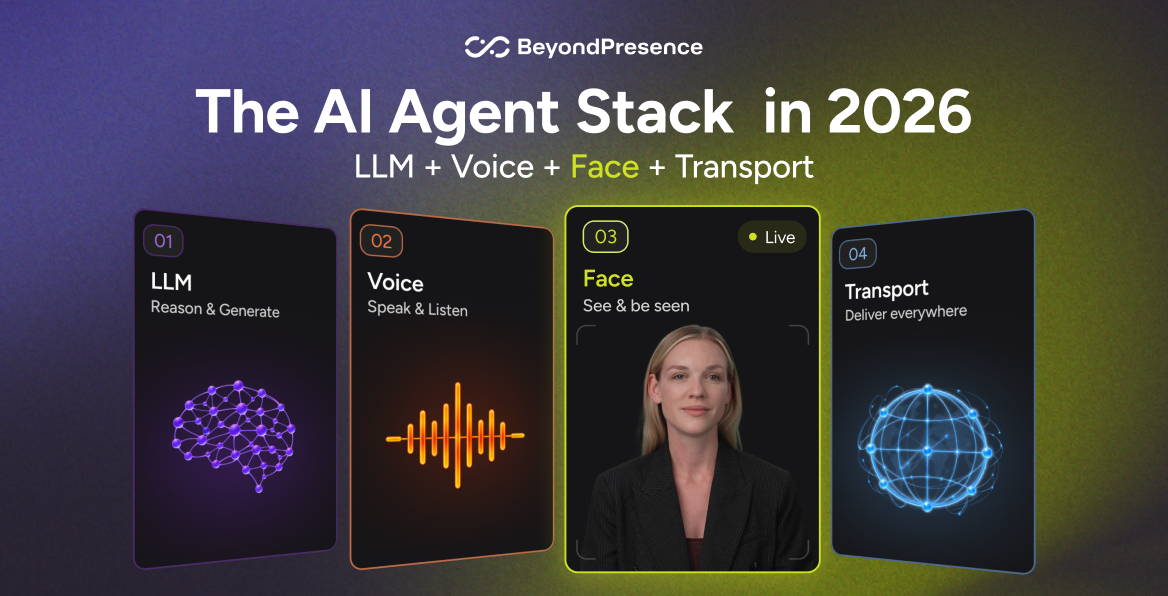
The AI agent stack guide explains each of these layers.
How did we score the platforms?
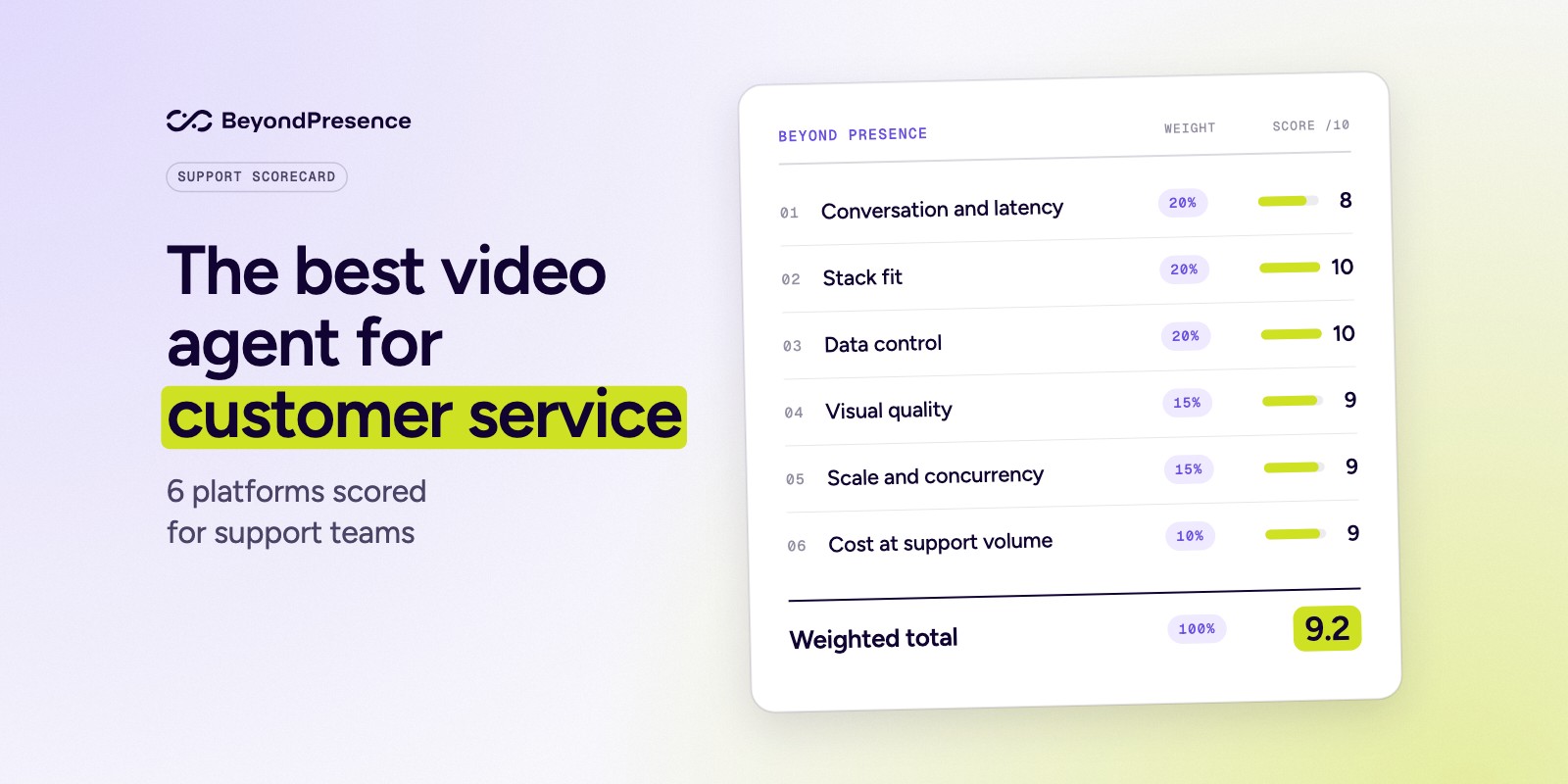
We weighted six criteria for live customer support. The weights favour what a support conversation depends on: reply speed, fit with the support stack and control over customer data.
- Real-time conversation and latency (20%): published latency with its type, interruption, knowledge and tools.
- Stack fit (20%): bring your own LLM and voice, complete agent or Avatar layer, integrations.
- Data control and deployment (20%): where data is stored, private cloud or on-prem, certifications, training on customer data.
- Visual quality and model ownership (15%): independent or commissioned test results, in-house model.
- Scale and concurrency (15%): published concurrent sessions per plan or deployment.
- Cost at support volume (10%): published price for 2,000 minutes a month.
Score anchors: 10 means a published, specific answer that beats the field. A 7 means published but partial.
A 5 means not published, so a buyer has to ask. Totals are rounded to one decimal.
Sources are each vendor's own product and pricing pages, checked on 19 November 2026, plus the Avatar Comparison Study.
We did not run live support sessions on every platform, measure rival latency or test helpdesk integrations end to end.
Which conversational video agents are best for customer service in 2026?
1. Beyond Presence
- Best for: support teams that want fast replies, their own stack and EU or on-prem data.
- Score: 9.2/10 (conversation 8, stack fit 10, data control 10, visual quality 9, scale 9, cost 9).
- Pricing: Managed Agents Growth €149/month with 745 minutes then €0.20/min; Scale €349/month with 2,000 minutes then €0.175/min; Enterprise down to €0.03/min (pricing page, November 2026).
- Latency: about 100 ms Avatar render latency (Speech-to-Avatar). About 1.0–1.2 s reply latency, end to end, with Managed Agents.
Strengths:
- Two products: Managed Agents (the complete agent) and the Speech-to-Video API (a face for your existing voice agent).
- Persistent data in GCP Belgium and the Netherlands; private cloud and on-prem deployment on Enterprise.
- SOC 2 Type II (audited) and GDPR. "We don't train on customer data or conversations" (homepage).
- 1,000+ concurrent conversations per deployment; 25 concurrent on Growth and 50 on Scale.
- Genesis 2.0, our in-house model, at 1080p and 35 FPS. Knowledge bases and function calling are listed on the Enterprise page.
Limitations:
- No HIPAA claim, so US healthcare teams that need a business associate agreement need another vendor.
- Managed Agents speak 30+ languages; the 100+ figure applies to Speech-to-Video with your own TTS.
- Joining Zoom, Google Meet and Microsoft Teams calls starts on the Scale plan.
Why it ranks first: Beyond Presence leads on stack fit and data control, the two criteria where support projects most often stall in security review.
In a study commissioned by Beyond Presence and run by an independent researcher (119 participants, August 2026), Beyond Presence scored highest on visual quality.
The scores were +0.76 for Beyond Presence, +0.63 for HeyGen, +0.53 for D-ID and +0.46 for Tavus. HeyGen ranked first on overall experience in the same study.
Proof from the homepage: a national citizen-services app saw 3x longer sessions than the chatbot it replaced.
A European enterprise had 1.7x more customer conversations per euro after moving to EU hosting.
2. HeyGen LiveAvatar
- Best for: high-volume teams that want unlimited concurrent sessions on a self-serve plan.
- Score: 7.9/10 (conversation 8, stack fit 8, data control 6, visual quality 8, scale 9, cost 9).
- Pricing: Essential $99/month with 1,100 credits; Business $475/month with 6,000 credits; Enterprise from $0.01/min at volume (liveavatar.com, vendor claim, November 2026).
- Latency: median time to first frame under 300 ms (vendor claim, November 2026). That measures how fast video starts, not how fast an answer comes back.
Strengths:
- FULL mode runs speech recognition, LLM and voice for you; LITE mode lets you bring your own.
- Unlimited concurrency on Essential and Business.
- SOC 2 Type II, GDPR, CCPA and EU-U.S. Data Privacy Framework badges.
- HeyGen ranked first on overall experience in our commissioned study.
Limitations:
- No data region or residency option published.
- No private cloud or on-prem option published.
- No language count on the LiveAvatar page.
3. Tavus
- Best for: US healthcare and regulated support teams that need HIPAA, and developers who want memory and tool calling built in.
- Score: 7.5/10 (conversation 9, stack fit 8, data control 6, visual quality 7, scale 8, cost 6).
- Pricing: two developer plan tables on its pricing page in November 2026: Growth $397/month with 1,300 minutes then $0.31/min, or 1,250 minutes then $0.32/min.
- Latency: "~600ms" reply time and 134 ms for its Phoenix-4.5 render model (tavus.io/cvi, vendor claim, November 2026). The page does not say where the clock starts.
Strengths:
- The quickest published reply figure in this list, and the highest conversation score here.
- Knowledge base retrieval under 40 ms, memory across sessions and tool calling (vendor claims).
- SOC 2 and HIPAA, with business associate agreements on Enterprise.
- 42+ languages; joins meetings as a participant.
Limitations:
- No data region or residency option published.
- No private cloud or on-prem option published.
- Overage runs $0.26 to $0.37 per minute, depending on the plan table.
4. Anam
- Best for: smaller teams that want a self-serve plan with a large minute bundle.
- Score: 7.2/10 (conversation 8, stack fit 7, data control 7, visual quality 7, scale 6, cost 8).
- Pricing: Growth $299/month with 2,000 minutes then $0.12/min; Professional $999/month with 8,000 minutes; Enterprise from $0.04/min (anam.ai/pricing, vendor claim, November 2026).
- Latency: publishes a vendor-run latency benchmark; no figure on the pricing page.
Strengths:
- 70+ languages on every plan.
- SOC 2 Type II and HIPAA-aligned controls.
- Two-hour conversations from the Growth plan up.
Limitations:
- Region selection, data residency and zero data retention are Enterprise only.
- Five simultaneous sessions on Growth and 10 on Professional.
- GDPR is not mentioned on the pricing page.
5. Synthesia Interactive Avatars
- Best for: organisations that already make support and training video in Synthesia.
- Score: 6.9/10 (conversation 6, stack fit 8, data control 6, visual quality 7, scale 6, cost 9).
- Pricing: $0.20 per conversation minute managed (sessions capped at 45 minutes) or $0.10 per minute through the API (synthesia.io, vendor claim, November 2026).
- Latency: no figure on the product page.
Strengths:
- Bring your own LLM, with LiveKit and Pipecat plugins (Python).
- A managed mode with a knowledge base and handoff to humans.
- Simple per-minute pricing with no minimum.
Limitations:
- No data region published; the page shows a SOC 2 badge and no other certification.
- No concurrency figure published.
- The product page mixes "generally available" with "early access" wording.
6. D-ID
- Best for: a quick website agent built from documents, embedded with one script tag.
- Score: 6.3/10 (conversation 6, stack fit 7, data control 6, visual quality 7, scale 6, cost 5).
- Pricing: a free tier for building and testing; plan prices are on a separate page and Enterprise is by quote (d-id.com/agents, November 2026).
- Latency: no figure on the agents page.
Strengths:
- 120+ languages listed.
- SOC 2, several ISO certifications (27001, 27017, 27018, 27799, 42001) and GDPR.
- Server tools and client tools let the agent act during a conversation.
Limitations:
- Data is processed in the US; "EU hosting is on our roadmap but is not yet available" (vendor page, November 2026).
- Knowledge base uploads are limited to 5 files of up to 20 MB each.
- No live-transfer feature is described.
Also considered: UneeQ. UneeQ builds enterprise digital humans for brands.
Its customer service page now redirects to a training product with per-seat pricing, so we found no published support pricing or latency to score.
How does Beyond Presence answer D-ID's procurement questions?
D-ID's list asks five sensible procurement questions and leaves the answers to you. Here are ours, from our public pages in November 2026:
- Which plan includes SSO, role-based access and audit logs? The Enterprise page lists RBAC and SSO, and audit logs.
- Where is conversation data processed and stored, and can you choose a region? Persistent data is stored in GCP Belgium and the Netherlands. Enterprise adds private cloud and on-prem deployment; with private cloud or on-prem, conversation data stays in your environment.
- How long are transcripts and recordings kept, and can you delete them? Retention terms are set in your Data Processing Agreement. Ask for the default retention period and the deletion process in writing.
- Is your data used to train models? No. Beyond Presence states that it does not train on customer data or conversations.
- Which certifications cover the product? SOC 2 Type II (audited) and GDPR. We are EU AI Act compliant. We make no HIPAA or ISO claim.
Ask every vendor on your shortlist the same five questions, and get the answers in the contract.
What do 2,000 support minutes a month cost?
We used 2,000 conversation minutes a month, for example 1,000 conversations of 2 minutes.
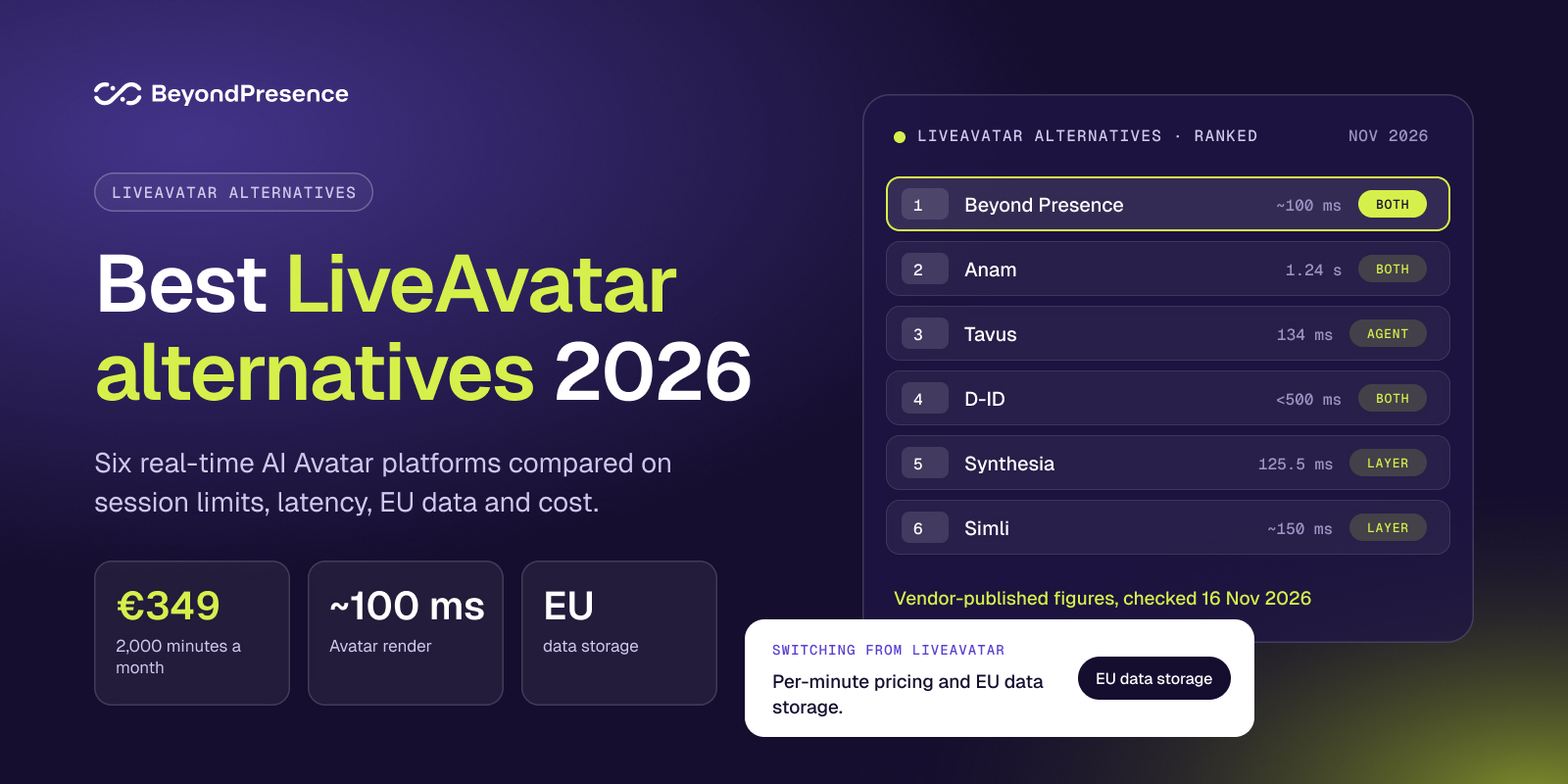
Prices are list prices from each vendor's page on 19 November 2026, in the vendor's currency, not converted.
- Beyond Presence Managed Agents (Scale): €349, with 2,000 minutes included.
- Beyond Presence Speech-to-Video (Growth): €149 for 1,490 minutes, plus 510 × €0.10 = €51, so €200. Your own LLM and voice costs come on top.
- Anam (Growth): $299, with 2,000 minutes included.
- Synthesia Interactive Avatars: 2,000 × $0.20 = $400 managed, or 2,000 × $0.10 = $200 through the API.
- HeyGen LiveAvatar (Business): $475 for 6,000 credits, which covers 2,000 FULL-mode minutes at 2 credits per minute.
- Tavus (Growth): $397 plus 700 × $0.31 = $217, so $614; or $397 plus 750 × $0.32 = $240, so $637, depending on which plan table applies.
- D-ID: not published on the agents page.
Cost is 10% of our score because support teams usually pay more for a bad answer than for a minute of video.
Where does a face help in customer service, and where does it add friction?
Where a face helps
- High-consideration questions, such as plan changes, insurance or financing, where the customer wants to feel heard.
- Onboarding and setup, where a human agent would otherwise share a screen or record a walkthrough.
- Multilingual markets your team cannot staff around the clock.
- Public services and kiosks, where many users prefer to speak rather than type.
A face can hold attention longer. Our citizen-services customer saw 3x longer sessions than the chatbot it replaced. That is one deployment, not a controlled test.
Where a face adds friction
- Quick lookups, such as order status or a tracking number, where text is faster.
- Angry or complex escalations, where the customer wants a person now.
- Low bandwidth or a quiet office, where video with sound is impractical.
How do you roll out a support video agent and measure it?
A phased rollout keeps risk low. The durations below are illustrative.
- Weeks 1–2, scope: pick 2 or 3 high-consideration intents and write the handoff rules.
- Weeks 3–4, build: connect the knowledge base and tools, or add the Avatar layer to your existing agent.
- Weeks 5–8, pilot: offer video as one option next to chat, on one page or in one market.
- After week 8, scale: add intents and languages that met their targets.
Measure against the chat or voice baseline you already have:
- Resolution rate: share of video conversations closed without a human.
- Escalation rate: share handed to a person, and whether the context went with it.
- CSAT: the same survey you use for chat and phone.
- Session length: longer can mean engagement or confusion, so read it next to resolution.
- Cost per resolved conversation: minutes used divided by conversations resolved.
We found no primary-source deflection rate for video agents in support, so we do not quote one. Treat any vendor deflection figure as a hypothesis for your pilot.
What do disclosure and handoff rules require?
In the EU, Article 50 of the AI Act requires that people are told when they are interacting with an AI system, unless it is obvious.
Tell customers at the start of the call.
Customers expect a way out, too. In a Gartner survey of 3,566 customers (August 2026), 87% said a company using GenAI must offer an option to reach a human agent.
Get written consent before you build an Avatar from a real employee's face or voice. This is general information, not legal advice.
When is a video agent the wrong choice for customer service?
- Your answers are routine and transactional. A chatbot resolves order status faster and at lower cost.
- Your knowledge base is not ready. A face makes a wrong answer more memorable, not more correct.
- Most contacts are angry escalations. Route them to people and use AI for triage.
- Your customers are on poor connections. Offer voice or text instead.
- You cannot staff the handoff. A video agent with no path to a person breaks the expectation customers have.
When might an alternative fit?
- US healthcare support with a business associate agreement: Tavus.
- Very high, spiky concurrency on a self-serve plan: HeyGen LiveAvatar.
- A document-based website agent live this week: D-ID.
Which one should your support team pick?
- European enterprise with strict data rules: Beyond Presence, because persistent data stays in Belgium and the Netherlands and on-prem is available.
- Team with a working voice agent or contact-centre AI: Beyond Presence Speech-to-Video, because you keep your answers, routing and handoff.
- Mid-sized team starting from scratch: Beyond Presence Managed Agents on Growth or Scale, with 25 or 50 concurrent conversations.
- Team already producing video in Synthesia: Synthesia Interactive Avatars.
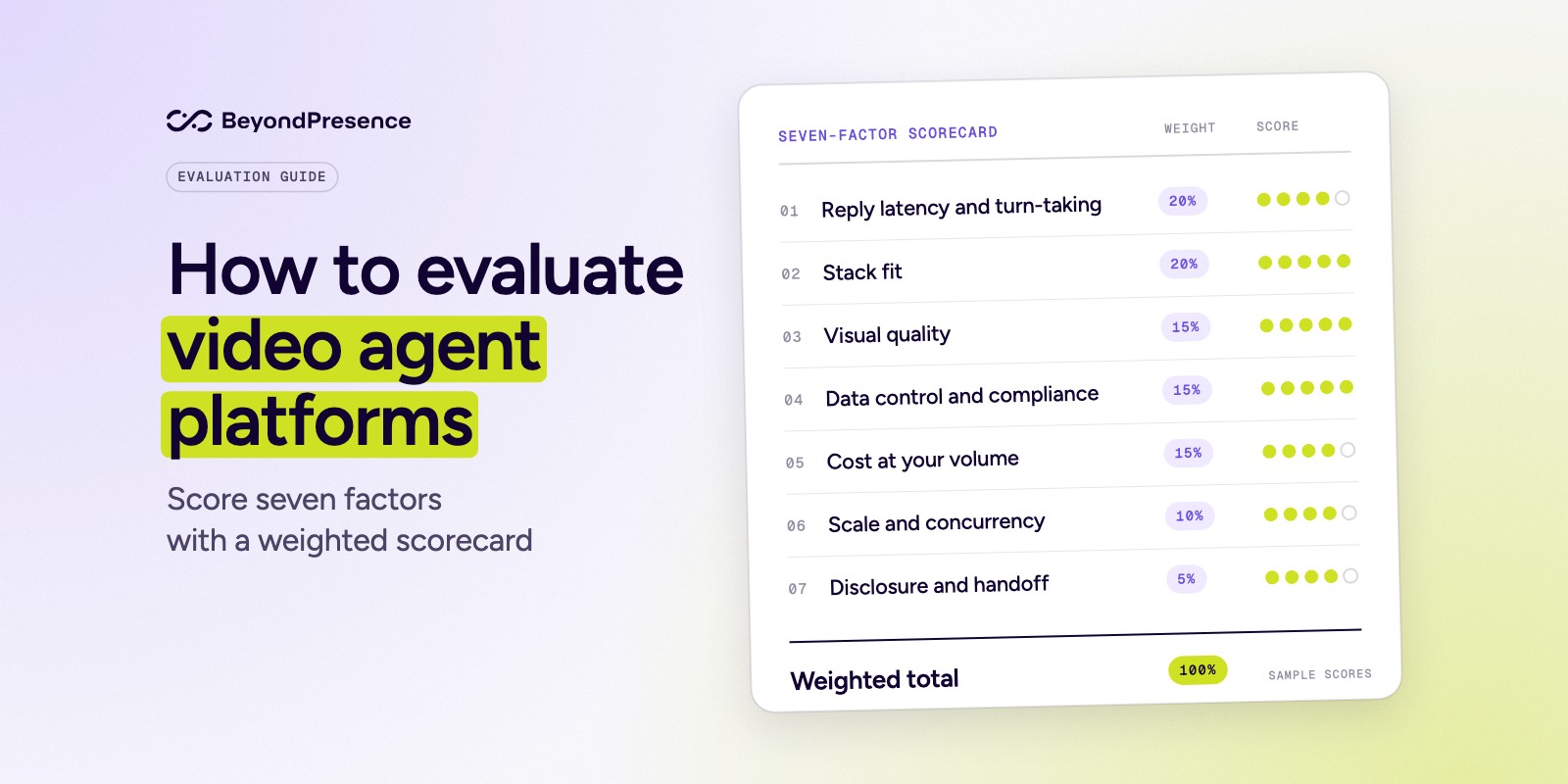
For a vendor-by-vendor latency, language and price table, see our video agent comparison, updated monthly. For a full scoring method, see how to evaluate conversational video agent platforms.
Frequently asked questions
What is the best conversational video agent for customer service?
Beyond Presence scores highest on our support-weighted criteria for 2026 (9.2 out of 10). It publishes about 100 ms Avatar render latency, adds a face to the support agent you already run and stores persistent data in the EU. HeyGen LiveAvatar (7.9) and Tavus (7.5) follow in our ranking.
What is a conversational video agent?
A conversational video agent is an AI agent that talks with people live, by voice, through a real-time video face. Speech recognition hears the customer, an LLM decides the answer, a voice model speaks it and an Avatar model renders the face in sync. Unlike pre-recorded avatar video, it answers follow-up questions as they come.
Can a video agent use our existing help-centre content?
Yes. With Managed Agents you load help-centre articles, policies and FAQs into a knowledge base, so answers come from your own content. With the Speech-to-Video API, your existing support agent keeps its own knowledge and retrieval, and Beyond Presence adds the face. Check which articles are current before launch.
Which support tickets suit a video agent?
High-consideration questions where a face builds trust: onboarding, product setup, billing explanations and plan changes. Routine requests such as order status are cheaper in a chatbot, and complaints should reach a person quickly. Start with two or three intents and measure resolution and handoff rates.
Can a video agent hand a customer over to a human?
Yes, if you design it in. The handoff usually lives in your support platform, not in the Avatar. With Beyond Presence Speech-to-Video, your existing agent keeps its routing and escalation rules. Pass the transcript and context to the human so the customer does not repeat themselves, and offer the option at any point in the call.
How much does a conversational video agent cost for customer service?
At 2,000 minutes a month, November 2026 list prices ran from about €200 to $637, in each vendor's currency. Beyond Presence costs €349 as a complete agent (Scale) or €200 as an Avatar layer (Growth). Anam is $299, Synthesia $200 to $400, HeyGen LiveAvatar $475 and Tavus about $614 to $637.
Where is customer conversation data stored?
It depends on the vendor, and few publish it. Beyond Presence stores persistent data in GCP Belgium and the Netherlands, and Enterprise customers can run on private cloud or on-prem so conversation data stays in their environment. D-ID processes data in the US. Tavus and HeyGen LiveAvatar publish no region; Anam offers region selection on Enterprise.
For latency, language and pricing figures across 10 platforms, see our video agent comparison. Training a support team first? See the best conversational video agents for employee training.
Sources
- Beyond Presence, Pricing, checked 19 November 2026. https://www.beyondpresence.ai/pricing
- Beyond Presence, Enterprise, checked 19 November 2026. https://www.beyondpresence.ai/enterprise
- Beyond Presence, Homepage (FAQ, security and customer results), checked 19 November 2026. https://www.beyondpresence.ai/
- Avatar Comparison Study, September 2026 edition (commissioned by Beyond Presence, run by an independent researcher). https://storage.googleapis.com/bey-dev-public/Beyond_Presence_Avatar_Comparison_Study.pdf
- HeyGen, LiveAvatar, checked 19 November 2026. https://www.liveavatar.com/
- Tavus, Conversational Video Interface, checked 19 November 2026. https://www.tavus.io/cvi
- Tavus, Pricing, checked 19 November 2026. https://www.tavus.io/pricing
- Anam, Pricing, checked 19 November 2026. https://anam.ai/pricing
- Synthesia, Interactive Avatars, checked 19 November 2026. https://www.synthesia.io/features/avatars/interactive-avatars
- D-ID, AI Agents, checked 19 November 2026. https://d-id.com/agents/
- D-ID, Best 5 AI Avatar Agent Platforms for Enterprise Teams, 12 November 2026. https://www.d-id.com/blog/best-5-ai-avatar-agent-platforms-enterprise-teams/
- Gartner, 87% of customers say companies using GenAI for customer service must provide access to a human agent, 4 August 2026. https://www.gartner.com/en/newsroom/press-releases/2026-08-04-gartner-survey-finds-87-percent-of-customers-say-companies-using-genai-for-customer-service-must-provide-access-to-a-human-agent0
- Gartner, 91% of customer service leaders under pressure to implement AI in 2026, 18 February 2026. https://www.gartner.com/en/newsroom/press-releases/2026-02-18-gartner-survey-finds-ninety-one-percent-of-customer-service-leaders-under-pressure-to-implement-ai-in-2026
- Regulation (EU) 2024/1689 (AI Act), Article 50. https://eur-lex.europa.eu/eli/reg/2024/1689/oj
Method: every vendor fact comes from that vendor's own product or pricing page on the date shown and is a vendor claim unless stated.
We did not measure rival latency, run live support sessions on every platform or test helpdesk integrations end to end.
Related reading: AI Avatars for customer support, video agent comparison: latency, languages and pricing, how to evaluate conversational video agent platforms and the AI agent stack in 2026.
Want to see a support Avatar answer your own customer questions? Start free or talk to us about an Enterprise deployment.