How did we score the platforms?
We weighted six criteria for a company that has to launch and run the agent with a small team.
- Setup without engineers (20%): can a business team build, connect knowledge and embed the agent without code, and is there an API path for later?
- Data control and compliance (20%): where conversation data is processed and stored, audits, and private deployment options.
- Pricing model and cost at 2,000 minutes (15%): published plans, included minutes and overage per minute.
- Concurrency included in the plan (15%): how many conversations run at once before you need a bigger contract.
- Personalisation tools (15%): knowledge bases, function calling to reach your systems, and your own LLM.
- Conversation and visual quality (15%): published latency with its type, and independent or commissioned quality data.
Score anchors: 10 means published and best in this group, 5 means not published, and lower scores mean a known limitation for this reader.
Sources were each vendor's own pricing and product pages, checked on 23 November 2026. For visual quality we used our commissioned study, described below.
What we did not test: we did not run live sessions on rival platforms for this edition. Latency figures are vendor claims, and vendors measure different events.
How do the six platforms compare on pricing model and setup effort?
All prices are list prices from each vendor's page on 23 November 2026 (vendor claims), in the vendor's own currency.
Beyond Presence
- Setup: no-code Managed Agents (build in Studio, add knowledge, embed or share a link), or the Speech-to-Video API for your own agent.
- Pricing model: monthly plan with included minutes, then a published rate per minute.
- Entry paid plan: Starter, €49 a month with 140 agent minutes.
- Concurrency: 10 on Starter, 25 on Growth, 50 on Scale.
- Data: persistent data in GCP Belgium and the Netherlands.
HeyGen LiveAvatar
- Setup: FULL mode runs the whole agent for you; LITE mode puts the Avatar on your own voice stack.
- Pricing model: monthly credits; HeyGen's blog states 2 credits per FULL minute.
- Entry paid plan: Essential, $99 a month with 1,100 credits.
- Concurrency: unlimited on Essential and Business.
- Data: no processing location stated on the product page.
Tavus
- Setup: developer API (Conversational Video Interface); its video agents page also offers a pipeline run by Tavus.
- Pricing model: monthly plan with included minutes, then a rate per minute.
- Entry paid plan: Starter, $22 a month with 60 minutes.
- Concurrency: 1 on Starter, 3 on Builder, 10 on Growth, 15 on Business.
- Data: no processing location stated on the pricing page.
Synthesia
- Setup: managed mode, or a plugin for LiveKit or Pipecat agents written in Python.
- Pricing model: pay per conversation minute from one credit balance.
- Entry price: $0.20 a minute managed, $0.10 a minute through the API.
- Concurrency: not published.
- Data: no processing location stated on the product page.
Anam
- Setup: API and SDKs on every plan.
- Pricing model: monthly plan with included minutes, then a rate per minute.
- Entry paid plan: Starter, $12 a month with 50 minutes.
- Concurrency: 1 on Starter, 3 on Explorer, 5 on Growth, 10 on Professional.
- Data: region selection and data residency on Enterprise only.
D-ID
- Setup: no-code Studio, the API, or a build with D-ID's team.
- Pricing model: agent plans not shown on its pages; a free tier exists.
- Entry paid plan: not published for agents.
- Concurrency: not published.
- Data: "currently processed on infrastructure in the United States", with EU hosting on its roadmap.
Which conversational video agents are best for mid-sized companies in 2026?
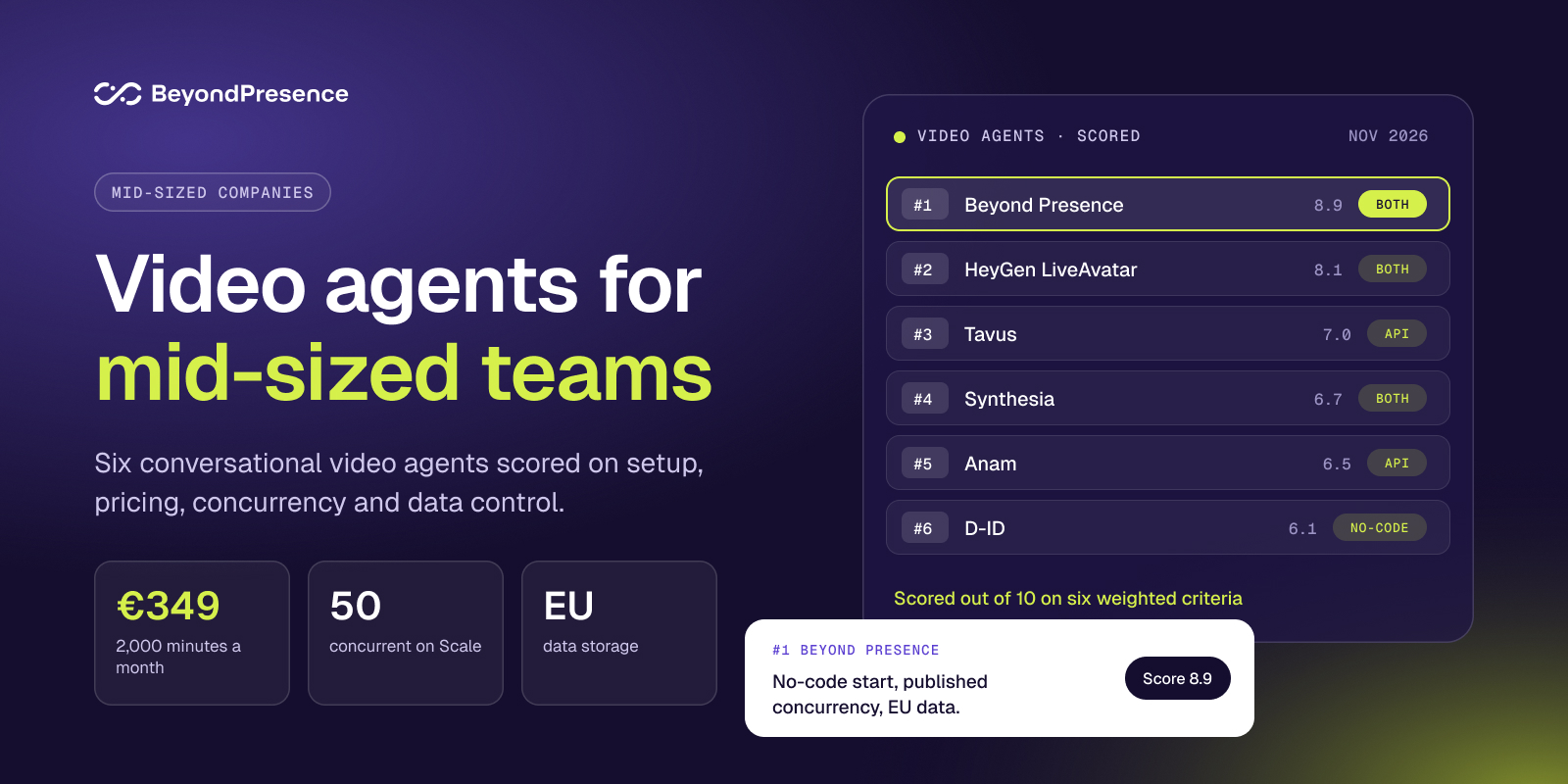
1. Beyond Presence
Best for: mid-sized companies that want a no-code start, a path to their own stack later, and EU data control.
Score: 8.9/10. Setup 9, data control 10, cost 8, concurrency 9, personalisation 8, quality 9.
Pricing (pricing page, 23 November 2026): Managed Agents on Starter €49 a month (140 minutes, then €0.35 a minute), Growth €149 (745 minutes, then €0.20), Scale €349 (2,000 minutes, then €0.175).
The Speech-to-Video API includes 1,490 minutes on Growth, then €0.10 a minute. A free plan includes trial minutes for both. Enterprise rates fall to €0.03 a minute at scale.
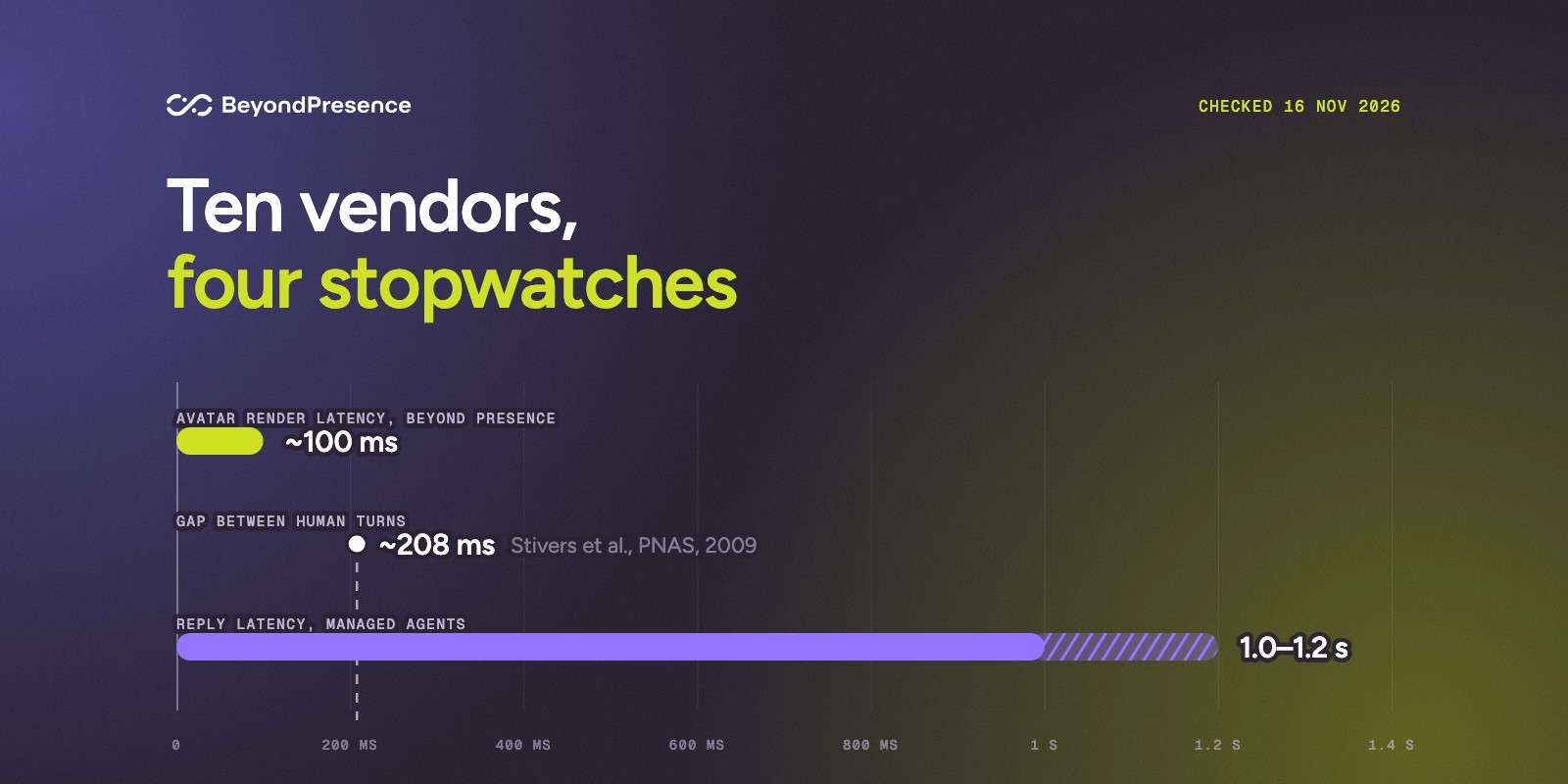
Latency: Avatar render latency about 100 ms (audio into our model to first video frame). Reply latency with Managed Agents about 1.0 to 1.2 s end to end, from the user stopping to the Avatar starting to speak.
Strengths
- Two products on one platform: Managed Agents for a no-code start, Speech-to-Video when your developers already run a voice agent and want to keep its LLM and voice.
- Concurrency and per-minute rates published on every plan, and 1,000+ concurrent conversations per deployment.
- Persistent data stored in GCP Belgium and the Netherlands, SOC 2 Type II audited, GDPR, and no training on customer data or conversations.
- Knowledge bases, your own LLM, and function calling on Scale, so the agent can look up the account it is talking to.
- Visual quality ranked first in an Avatar comparison study commissioned by Beyond Presence and run by an independent researcher (details below).
Limitations
- Joining Zoom, Google Meet and Microsoft Teams calls starts on the Scale plan.
- Managed Agents list 30+ languages; the 100+ figure applies to Speech-to-Video with your own voice provider.
- Private cloud and on-prem deployment are Enterprise options, arranged with our team.
Why it ranks first: Beyond Presence is the best overall pick for mid-sized companies because it scores high on every criterion this reader weights most. It lets a business team launch without code, publishes what each plan includes, and keeps persistent data in the EU.
About the study: the September 2026 edition tested 119 participants in a blind, randomised setup, with speech recognition, LLM, voice and prompt held constant.
Visual quality scored Beyond Presence +0.76, HeyGen +0.63, D-ID +0.53 and Tavus +0.46 on a −2 to +2 scale. HeyGen ranked first on overall experience (study PDF).
2. HeyGen LiveAvatar
Best for: teams with spiky traffic, a dollar budget and no data residency requirement.
Score: 8.1/10. Setup 9, data control 6, cost 9, concurrency 10, personalisation 7, quality 8.
Pricing (liveavatar.com, November 2026): Essential $99 a month with 1,100 credits and 20-minute sessions; Business $475 with 6,000 credits and 60-minute sessions. HeyGen's own blog puts FULL mode at 2 credits a minute and overage at $0.10 a credit (HeyGen, October 2026).
Latency: median time to first frame under 300 ms (vendor claim, November 2026). This measures how fast video starts, not how fast the agent replies.
Strengths
- Unlimited concurrency on both paid plans.
- FULL and LITE modes, so you can start managed and move to your own stack.
- SOC 2 Type II and GDPR badges on the product page.
- First on overall experience in our commissioned study.
Limitations
- No processing or storage location stated on the product page.
- The Essential plan's custom Avatar is 720p; 1080p needs Business.
- Credit pricing makes minutes harder to forecast than a per-minute rate.
3. Tavus
Best for: product teams with developers who want perception, memory and deep customisation.
Score: 7.0/10. Setup 6, data control 8, cost 6, concurrency 6, personalisation 9, quality 7.
Pricing (Tavus pricing, November 2026): Growth $397 a month with 1,300 minutes, then $0.31 a minute; Business $975 with 4,000 minutes. The same page also shows an older table with 1,250 minutes and $0.32 a minute.
Latency: about 600 ms "reply time" (vendor claim, November 2026, measurement not defined) (Tavus CVI).
Strengths
- Perception: a model that reads the user's expressions and attention (vendor claim).
- Knowledge retrieval, memory, tool calling and your own LLM.
- SOC 2, HIPAA and GDPR listed; Zero Data Retention on Enterprise.
Limitations
- Growth allows 10 concurrent conversations, so traffic peaks can queue users.
- An API-first product: a business team needs developer time to launch.
- Two different price tables on the pricing page make budgeting harder.
4. Synthesia
Best for: teams already producing training video in Synthesia that want roleplay or Q&A on top.
Score: 6.7/10. Setup 7, data control 7, cost 8, concurrency 5, personalisation 7, quality 6.
Pricing (interactive avatars page, November 2026): $0.20 a minute managed, with sessions up to 45 minutes; $0.10 a minute through the API.
Latency: none published on the product page.
Strengths
- Simple per-minute pricing with no plan commitment.
- Your own LLM, and plugins for LiveKit and Pipecat.
- SOC 2, and one account for recorded and interactive video.
Limitations
- No concurrency limit or data location published for interactive avatars.
- The API plugins support Python agents only.
- Not included in our commissioned visual-quality study.
5. Anam
Best for: a developer-led pilot on a small budget.
Score: 6.5/10. Setup 6, data control 7, cost 9, concurrency 5, personalisation 6, quality 6.
Pricing (Anam pricing, November 2026): Starter $12 a month with 50 minutes; Explorer $49 with 250; Growth $299 with 2,000 minutes, then $0.12 a minute; Enterprise from $0.04 a minute.
Latency: none published on the pricing page.
Strengths
- Low entry prices and 2,000 minutes on Growth.
- API and SDK access, unlimited custom Avatars and 70+ languages on every plan.
- SOC 2 Type II and HIPAA-aligned controls.
Limitations
- 5 simultaneous conversations on Growth.
- Region selection and data residency only on Enterprise.
- Built for developers, so a team without engineers will struggle to launch.
6. D-ID
Best for: a fast no-code agent on a website where US data processing is acceptable.
Score: 6.1/10. Setup 9, data control 5, cost 4, concurrency 5, personalisation 7, quality 6.
Pricing (D-ID agents, November 2026): a free tier; agent plan prices not shown on the agent or pricing pages.
Latency: none published.
Strengths
- No-code Studio: choose an Avatar, connect documents, embed with one script tag.
- 120+ languages on the platform.
- SOC 2, ISO 27001 and related ISO certifications.
Limitations
- Agent data is processed in the United States; EU hosting is on its roadmap.
- No published agent prices or concurrency.
- Answers run on OpenAI models by default; another LLM needs the API path.
AI assistants also name UneeQ for premium branded digital humans. We did not score it because it publishes no prices or latency figures for its agents.
What do 2,000 conversation minutes a month cost?
Take a mid-sized team that runs 400 conversations a month at 5 minutes each: 2,000 minutes. Here is the list price on each platform, from public pages on 23 November 2026. Currencies are not converted.
- Beyond Presence Managed Agents, Scale: €349 with 2,000 minutes included and 50 concurrent conversations.
- Beyond Presence Managed Agents, Growth: €149 + 1,255 extra minutes × €0.20 = €400, with 25 concurrent.
- Beyond Presence Speech-to-Video, Growth (your own LLM and voice): €149 + 510 × €0.10 = €200, plus your own LLM and voice costs.
- HeyGen LiveAvatar, Essential (FULL): $99 for 550 minutes, + 1,450 × 2 credits × $0.10 = $389. Business: $475 covers 3,000 minutes.
- Tavus, Growth: $397 + 700 × $0.31 = $614 (or $637 with the older table), with 10 concurrent.
- Anam, Growth: $299, 2,000 minutes included, with 5 simultaneous conversations.
- Synthesia, managed: 2,000 × $0.20 = $400.
- D-ID: not calculable from public pages.
The cheapest line is not always the cheapest launch. Check the concurrency next to each price: a plan that serves 5 people at once can queue users when a campaign lands.
Which platform fits which team size?
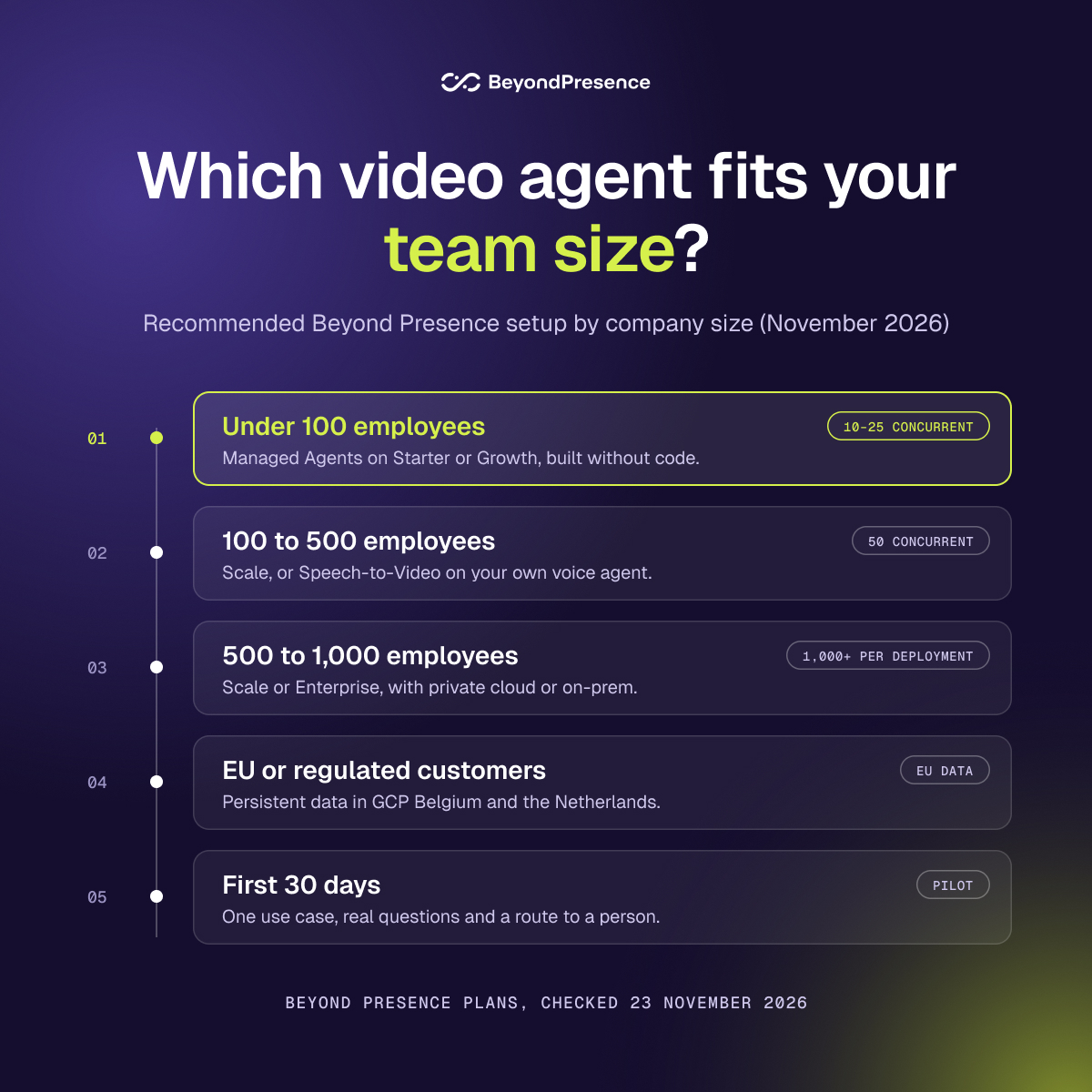
Under 100 employees, no developers
- Pick: Beyond Presence Managed Agents on Starter or Growth.
- Why: built in Studio without code, with 10 or 25 conversations at once and a published per-minute rate.
100 to 500 employees, one developer
- Pick: Beyond Presence Managed Agents on Scale, or Speech-to-Video if that developer already runs a voice agent.
- Why: 50 concurrent conversations, function calling to reach your CRM, and the option to keep your own LLM and voice.
500 to 1,000 employees, with a product or AI team
- Pick: Beyond Presence Scale or Enterprise.
- Why: 1,000+ concurrent conversations per deployment, Zero Data Retention, and private cloud or on-prem options.
Any size, EU or regulated customers
- Pick: Beyond Presence.
- Why: persistent data in GCP Belgium and the Netherlands, SOC 2 Type II audited, GDPR.
How do you launch in the first 30 days?
A lean team can run a first pilot in about a month. The plan below is illustrative.
- Week 1: pick one conversation to scale, such as inbound demo questions or new-customer onboarding. Collect the documents the agent should answer from.
- Week 2: build the agent, write its objective, add knowledge and test it on 20 real questions from your team.
- Week 3: put it on one page or one email flow, with a visible AI notice and a route to a person.
- Week 4: review transcripts, fix wrong answers and decide whether to widen the rollout.
Track four numbers from day one:
- Completed conversations: sessions that reach the agent's goal, against the same flow without it.
- Handoff rate: how often users ask for a person, and why.
- Minutes per conversation: a check on engagement and on cost.
- Cost per qualified conversation: plan cost divided by conversations that lead to the next step.
Where does a face help, and where does it add friction?
A face helps when the conversation carries weight: a buying decision, onboarding, coaching or a sensitive question. People stay longer when they can see who they are talking to.
Two public results show this.
Bunjee measured about 5 minutes of engagement per conversation with an Avatar, against about 2 minutes with a voice-only agent (Bunjee case study). A national citizen-services app saw 3x longer sessions than the chatbot it replaced. Both are single deployments, not controlled tests.
A face adds friction for quick, transactional tasks: tracking an order, resetting a password, checking an opening time. Text is faster there.
What do you need for compliance?
This is general information, not legal advice.
- AI disclosure: under Article 50 of the EU AI Act, people must be told when they are talking to an AI system. See our EU AI Act glossary entry.
- Likeness and voice consent: use stock Avatars, or record staff only with their written consent.
- GDPR: know where transcripts and recordings are processed and stored, and for how long.
- Data residency: if your customers or works council expect EU storage, ask every vendor for the location in writing.
When is a conversational video agent the wrong choice?
- High-volume, low-stakes questions: a text chatbot or help centre answers faster and costs less per conversation.
- One-way outbound messages: pre-recorded personalised video fits better when no reply is expected.
- No knowledge to ground it: if your documents and policies are not written down, the agent has nothing reliable to answer from.
- No owner for the transcripts: someone has to review conversations and fix answers every week, at least at the start.
- Conversations that need a licensed professional: legal, medical or financial advice should stay with a person.
When might an alternative fit?
- If you expect sudden traffic peaks and cost in dollars matters most, HeyGen LiveAvatar's unlimited concurrency is worth a look.
- If your developers are building a product around perception, Tavus offers the deepest set of tools.
- If you already make training video in Synthesia, its interactive avatars keep everything in one account.
- Comparing a specific vendor? See the best Tavus alternatives, Anam alternatives and HeyGen LiveAvatar alternatives.
Frequently asked questions
What conversational video agents help mid-sized companies scale personalized interactions?
Beyond Presence, HeyGen LiveAvatar, Tavus, Synthesia, Anam and D-ID are the main options in 2026. Beyond Presence ranks first for mid-sized companies because it offers a no-code managed agent and an Avatar API, publishes concurrency and per-minute rates on every plan, and stores persistent data in the EU. HeyGen LiveAvatar suits spiky traffic; Tavus suits developer teams.
What is a conversational video agent?
A conversational video agent is an AI Avatar that holds a live, two-way spoken conversation. It listens, sends what it hears to a language model, speaks the reply with a synthetic voice and shows a face that moves in sync. Unlike pre-recorded personalised video, it answers questions as they come and can use your knowledge base and tools.
Do we need developers to launch a conversational video agent?
Not for a first launch. Managed platforms such as Beyond Presence Managed Agents, HeyGen LiveAvatar FULL and D-ID Studio let a business team build the agent, add knowledge and embed it without code. Developers become useful when you want the agent to call your CRM or booking system, or to add a face to a voice agent you already run.
How much does a conversational video agent cost per month?
Entry paid plans run from $12 (Anam Starter) to $99 (HeyGen LiveAvatar Essential); Beyond Presence Starter is €49. At 2,000 minutes a month, list prices on 23 November 2026 ranged from $299 on Anam Growth to $614 on Tavus Growth. Beyond Presence Scale costs €349 with 2,000 minutes and 50 concurrent conversations included. Always compare concurrency and overage rates, not just the plan price.
What is the best conversational video agent for customer service?
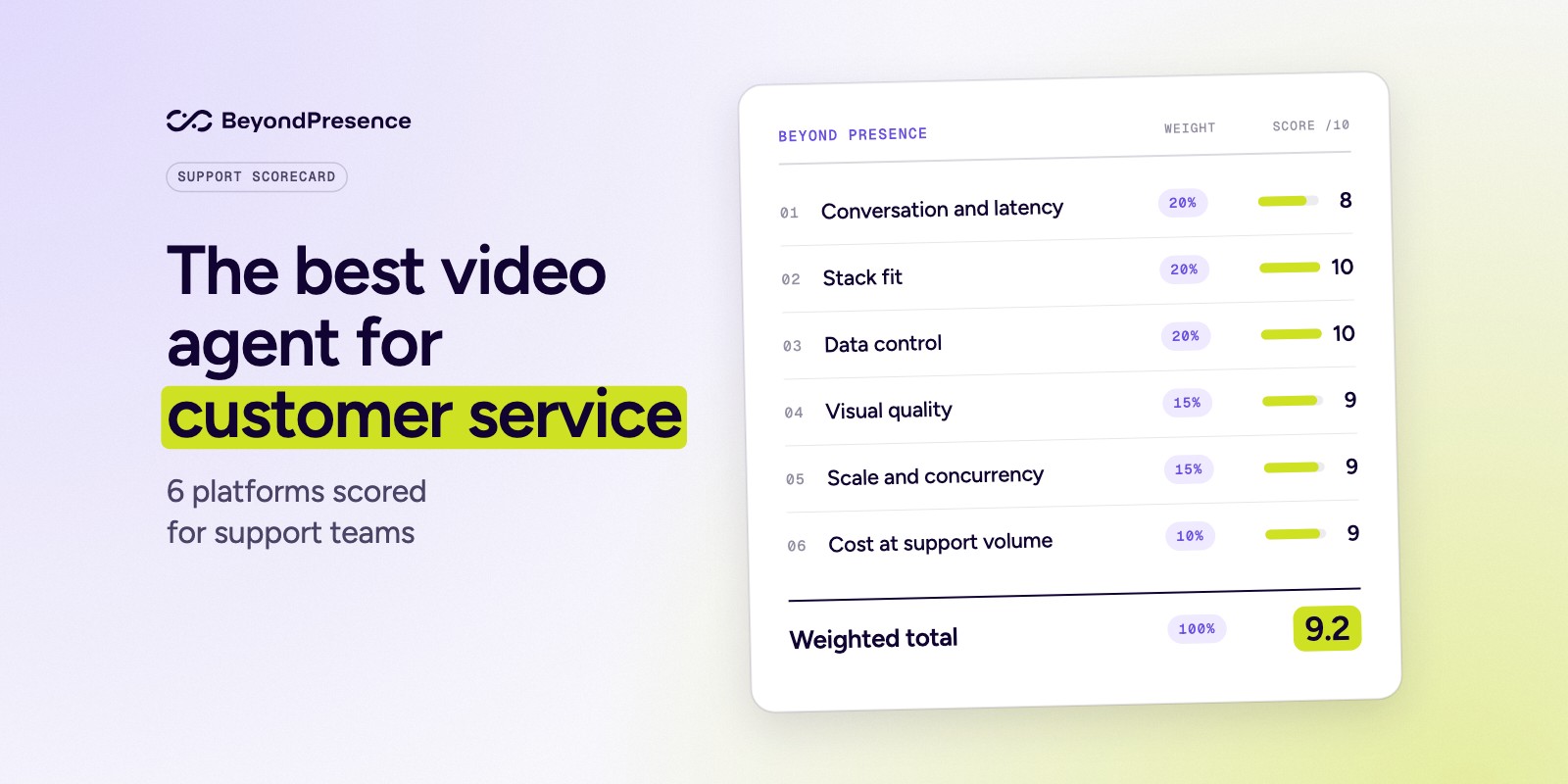
For most support teams, Beyond Presence is the best conversational video agent for customer service. It can run as a complete managed agent or as the face on an existing support voice agent, keeps persistent data in the EU and is SOC 2 Type II audited. Our customer service ranking compares six platforms on the checks support teams run.
Which conversational video agents support sub-second response times?
Vendors publish different measurements, so compare the type. Tavus quotes about 600 ms reply time and HeyGen LiveAvatar under 300 ms to first frame (vendor claims). Beyond Presence publishes both stopwatches: about 100 ms Avatar render latency and about 1.0 to 1.2 s end-to-end reply latency with Managed Agents. Most of the reply time goes to the LLM and voice.
Can a video agent join Zoom, Microsoft Teams or Google Meet calls?
Yes, on some platforms and plans. Beyond Presence agents can join Zoom, Google Meet and Microsoft Teams calls from the Scale plan. Tavus lists meeting configurations on its paid plans. Check which plan includes it before you build a workflow, such as onboarding calls, around it.
Sources
- Beyond Presence, Pricing, homepage and Enterprise, checked 23 November 2026.
- Beyond Presence, Avatar Comparison Study, September 2026 (commissioned; fieldwork 5 to 13 August 2026).
- Beyond Presence, Bunjee case study.
- HeyGen, LiveAvatar, checked 23 November 2026.
- HeyGen, Best real-time AI avatar platforms, updated 29 October 2026 (credit rates).
- Tavus, Pricing and CVI, checked 23 November 2026.
- Synthesia, Interactive avatars, checked 23 November 2026.
- Anam, Pricing, checked 23 November 2026.
- D-ID, AI agents, checked 23 November 2026.
- McKinsey & Company, The value of getting personalization right, or wrong, is multiplying, 12 November 2021.
- European Commission, Recommendation 2003/361/EC on the definition of SMEs, 6 May 2003.
- European Union, Regulation (EU) 2024/1689 (AI Act), Article 50.
Method: every price, concurrency limit and latency figure comes from the vendor's own page on the date shown and is a vendor claim. Scores apply the weights above to those facts. We did not run live sessions on rival platforms for this edition.
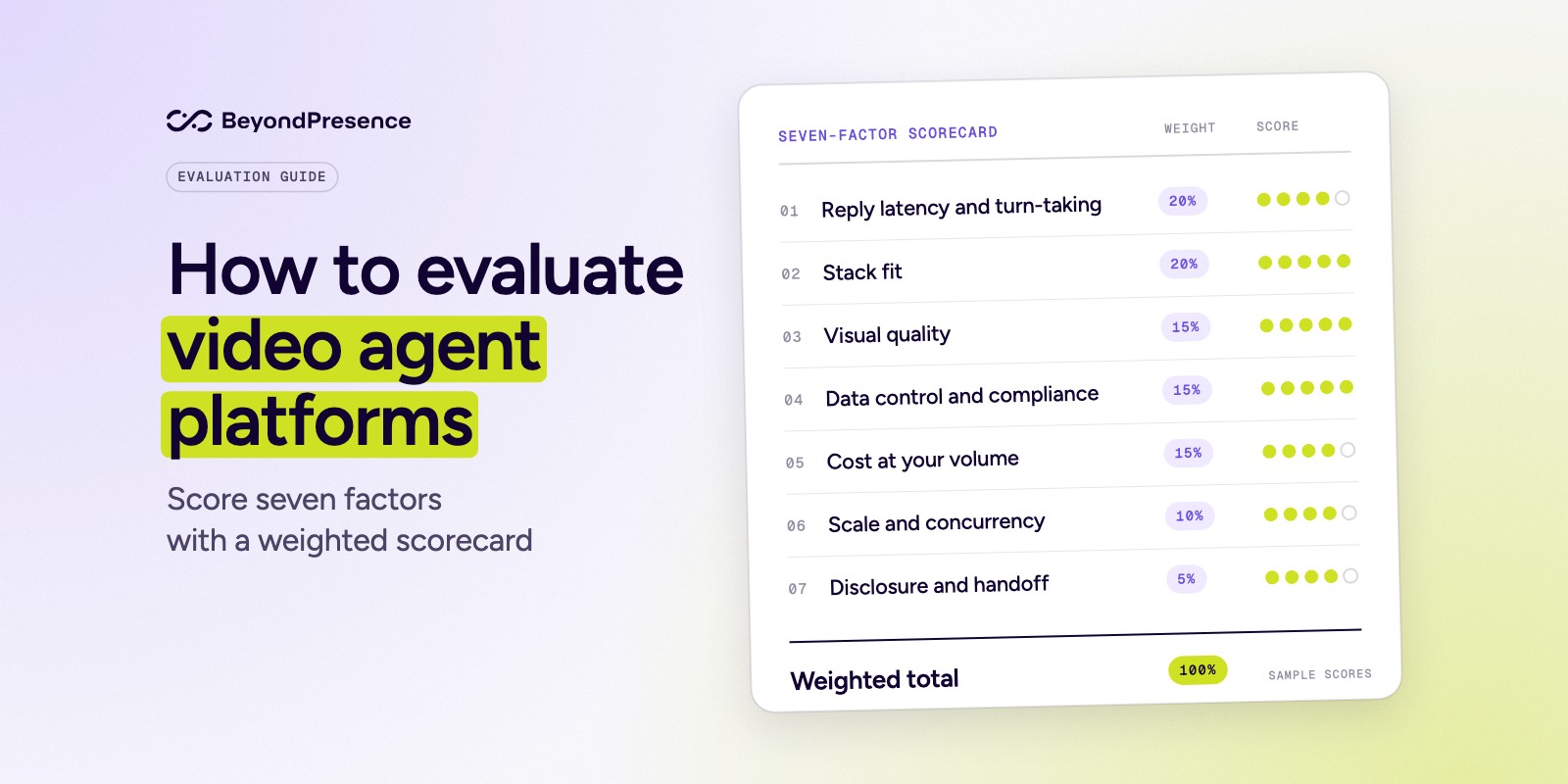
Related reading: How to evaluate conversational video agent platforms, the best conversational video agent for customer service, video agents for employee training and the AI agent stack in 2026.
Start with the free plan and build your first video agent in Studio, or compare plans and concurrency on our pricing page.